
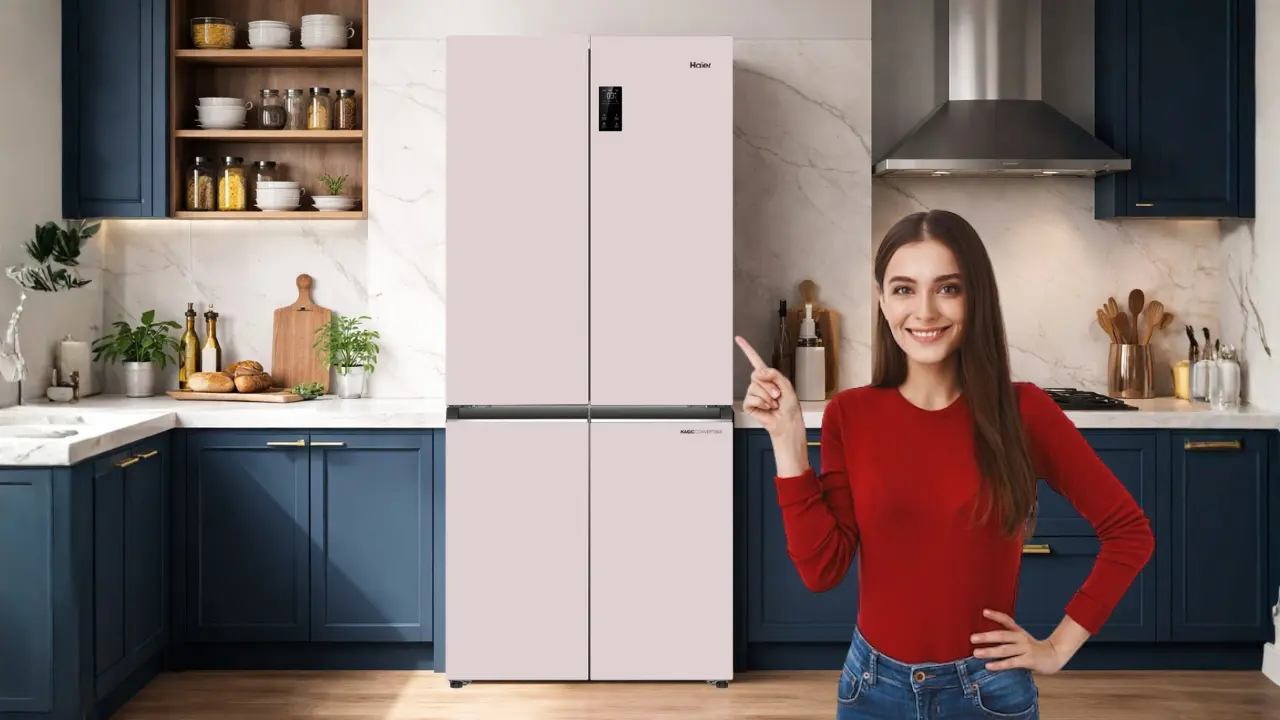

32.6 inches works beautifully for many Indian kitchens because it balances three realities of modern homes.
Limited apartment space, high food storage needs, and constant kitchen movement. This width allows large refrigerators to offer generous capacity without blocking the natural workflow of cooking.
That is the simple explanation.
The real story begins with a moment almost every Indian household recognizes.
The 7:15 PM kitchen moment every Indian home knows.
It is 7:15 pm.
Someone opens the refrigerator.
The pressure cooker whistles on the stove.
Another person walks in to wash vegetables.
A child comes looking for cold water.
Indian kitchens rarely host just one person.
They function like small ecosystems.
Doors open. Containers move. People pass through.
And suddenly one detail determines whether the kitchen feels comfortable or chaotic.
Space.
Not decorative space.
Functional movement space.
Sometimes the difference between an easy kitchen and a stressful one is just a few inches.
This is where 32.6 inches quietly becomes important.
Why 32.6 Inches Works So Well in Indian Kitchens
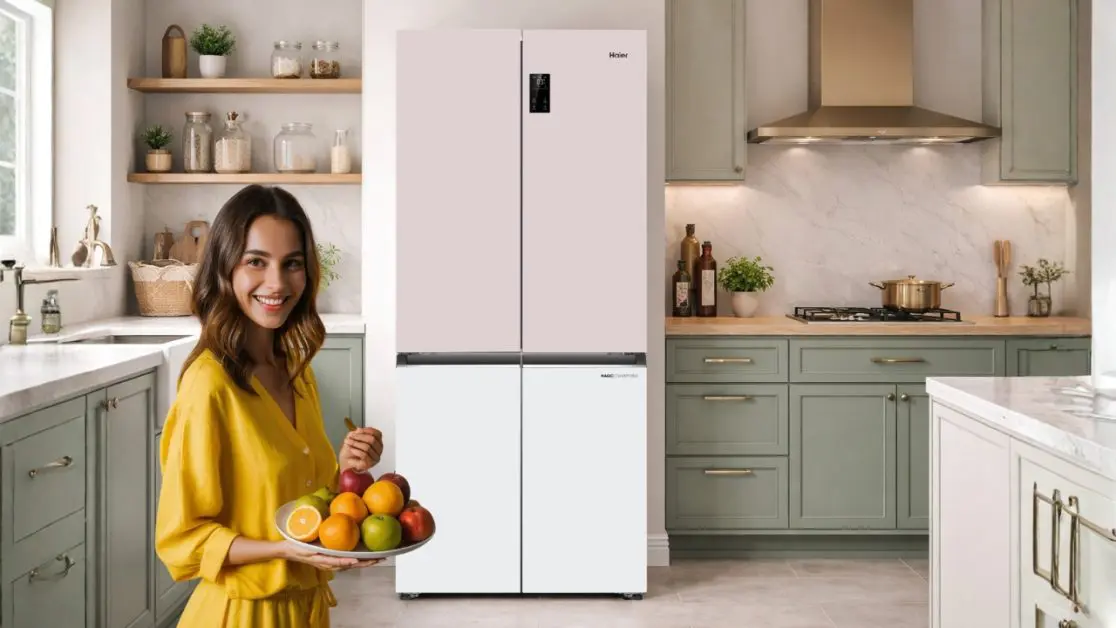
Design rarely fails because of big ideas.
It fails because of measurements.
Most Indian homes follow predictable kitchen layouts.
| Kitchen Layout | Typical Width | Real-Life Movement |
| Parallel kitchen | 7 to 8 feet | Two people cooking comfortably |
| L-shaped kitchen | 6 to 7 feet | Corner workflow |
| Compact apartment kitchen | 5 to 6 feet | Single-person cooking |
| Studio kitchen | 4 to 5 feet | Minimal clearance |
Now imagine placing a refrigerator in that space.
If it becomes too wide, movement stops.
If it becomes too narrow, storage disappears.
32.6 inches sits right in the balance point.
Wide enough to store weekly groceries.
Slim enough to preserve walking space.
Good design rarely calls attention to itself.
It simply works.
The Invisible Geometry of Kitchen Movement
Professional kitchen designers often refer to something called the kitchen work triangle.
It connects three areas:
- Refrigerator
- Sink
- Stove
Cooking happens inside this triangle.
Open fridge.
Wash ingredients.
Move to the stove.
Repeat.
If any appliance disrupts that triangle, cooking slows down.
Width becomes critical.
Three Appliance Width Choices
Option One: Compact refrigerators under 28 inches
Benefits:
- Save floor space
- Fit in small kitchens
Costs:
- Limited storage
- Frequent grocery trips
Option Two: Oversized refrigerators above 36 inches
Benefits:
- Large storage
- Premium appearance
Costs:
- Block movement
- Doors collide with cabinets
Option Three: Balanced refrigerators around 32 to 33 inches
Benefits:
- Large capacity
- Comfortable kitchen movement
- Better integration with modular kitchens
This third option is where the 32.6 inch width fits perfectly.
The best design decisions often sit in the middle.
Indian Cooking Demands More Refrigerator Space
Open a refrigerator in an Indian home.
You rarely see empty shelves.
Instead you see layers of food preparation.
- Steel containers filled with dal
- Fresh vegetables bought for the week
- Homemade chutneys
- Cut fruit bowls
- Marinated paneer
- Leftover sabzi
- Tiffin boxes
- Bottles of water and buttermilk
Indian kitchens do not store ingredients alone.
They store preparation.
This is why larger refrigerators have become essential.
A great example is the Haier 520L Convertible 4 Door Refrigerator from the Haier Lumiere Series, designed to deliver large capacity storage without demanding excessive kitchen width.
With 520 litres of total capacity and around 440 litres dedicated to fresh food storage, this refrigerator supports the high storage demands of Indian cooking while maintaining a balanced appliance footprint.
That combination matters.
Large inside.
Practical outside.
Why Urban Indian Kitchens Need Smarter Appliance Dimensions
Cities are changing.
Apartments are getting smaller.
This shifts the entire design logic of appliances.
Manufacturers must now solve three problems simultaneously.
- Limited floor space
- High storage needs
- Multiple users in the kitchen
Oversized appliances disrupt this balance.
The Kitchen Congestion Problem
When refrigerators become too wide:
- Refrigerator doors block cabinet drawers
- Walking paths narrow
- Two people cannot cook comfortably
- Kitchens feel cramped and hotter
When appliances stay within balanced dimensions like 32.6 inches, kitchens remain functional.
- Doors open freely
- Cooking zones stay accessible
- Movement paths remain clear
A kitchen should feel breathable.
Not crowded.
The Storage Illusion Most People Do Not Notice
Many people assume larger refrigerators require larger external size.
But smart appliance design challenges that assumption.
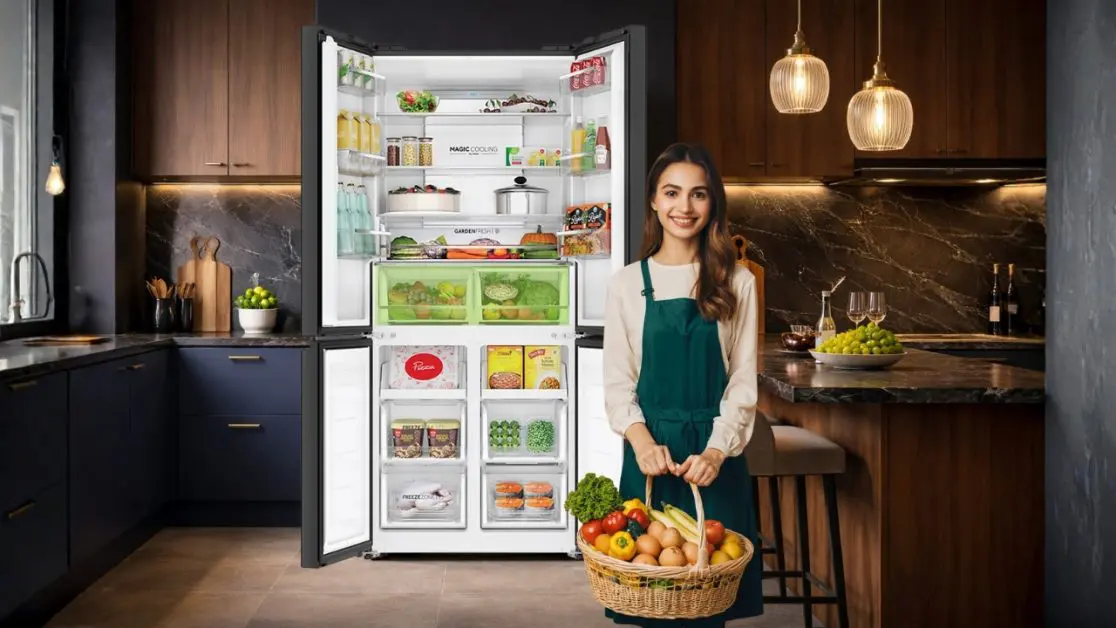
The Haier 520L Convertible 4 Door Refrigerator from the Haier Lumiere Series proves this point through intelligent internal architecture.
Instead of expanding width, the refrigerator improves internal organization.
Key features include:
- Convertible freezer zones that switch to refrigerator mode
- Adjustable shelves for large Indian utensils
- Toughened glass shelves for heavy cookware
- Anti tipping bottle racks
- Multiple cooling zones for fresh food
These design choices create more storage without increasing external footprint.
Good design expands function, not size.
Movement Comfort Is the Real Luxury in Kitchens
Luxury kitchens are often misunderstood.
They are not defined by marble counters or designer cabinets.
They are defined by movement comfort.
Consider a typical evening cooking moment.
One person opens the refrigerator.
Another stands near the stove.
Someone enters the kitchen for water.
At that moment, appliances either support the flow or disrupt it.
When appliances are oversized
- Doors collide with drawers
- Movement becomes awkward
- Cooking slows down
When appliances follow balanced dimensions
- Doors open smoothly
- Movement paths stay clear
- Kitchen activity feels effortless
Sometimes the difference between stress and comfort is only a few inches.
Why Appliance Designers Focus on Small Measurements

Designing appliances for Indian homes requires careful observation.
Because Indian kitchens involve:
- Larger grocery storage
- Heavy utensils
- Frequent cooking
- Multiple family members using the kitchen
Refrigerators like the Haier 520L Convertible 4 Door Refrigerator from the Haier Lumiere Series integrate features such as Twin Inverter technology for energy efficiency and multiple convertible compartments to support everyday cooking patterns while maintaining a controlled appliance footprint.
The goal is simple.
More capability.
Less spatial disruption.
How One Measurement Solves Multiple Kitchen Problems
32.6 inches solves several practical problems at once.
| Kitchen Challenge | How 32.6 Inch Appliances Help |
| Narrow apartment kitchens | Maintain comfortable walking space |
| Large grocery storage | Support high-capacity refrigerators |
| Multi-person cooking | Leave enough room for movement |
| Modular kitchen alignment | Fit neatly with standard cabinet modules |
It is a compromise.
Not too wide.
Not too narrow.
Just balanced.
How Modern Indian Kitchens Are Quietly Changing
Three shifts are reshaping kitchen design in India.
1. Urban Homes Are Compact
City apartments demand appliances that maximize storage without expanding footprint.
2. Cooking Habits Are Faster
Working professionals cook quicker meals but store more ingredients.
3. Appliances Are Becoming Flexible
Convertible refrigerators like the Haier 520L Convertible 4 Door Refrigerator from the Haier Lumiere Series allow households to convert freezer sections into fridge space when storage needs increase.
Flexibility becomes the new definition of convenience.
The Deeper Lesson Behind 32.6 Inches
At first glance, 32.6 inches looks like a random specification.
But it reveals a deeper principle.
Good design begins with observing how people actually live.
Indian kitchens are dynamic places.
They host breakfast rushes.
Afternoon snack breaks.
Late night leftovers.
Festival cooking marathons.
They are not quiet spaces.
They are living systems.
And living systems need breathing room.
A Final Thought About Kitchen Design
Great design rarely announces itself.
It hides inside the smallest decisions.
The space between a cabinet and a refrigerator door.
The extra shelf that holds one more container of curry.
The ease with which two people move past each other.
A few inches shape those experiences.
Sometimes exactly 32.6 inches.
Not dramatic.
Just right.
And when a kitchen works effortlessly every day, those few inches quietly become one of the smartest design decisions in the home.
Frequently Asked Questions
I feel stuck choosing between a big fridge and saving space. What should I prioritize?
Prioritize movement first, then storage. A fridge that blocks your walking path will frustrate you daily. Around 32.6 inches gives you enough storage without choking kitchen flow.
Is 32.6 inches really enough for a family of 4 in India?
Yes, if the fridge is well-designed internally. Models with convertible zones and adjustable shelves can store weekly groceries comfortably without needing extra width.
I’m tempted to buy a bigger 36-inch fridge for “future needs” . Is that a mistake?
Often, yes. In Indian kitchens, oversized fridges:
Block cabinet access
Restrict movement
Create daily inconvenience
You’re better off with smarter storage than extra width.
Why does my kitchen feel crowded even though it’s not that small?
Because usable movement space matters more than total size. If your fridge is too wide, it disrupts:
Walking paths
Door clearance
Multi-person cooking
I notice people bump into each other in my kitchen is appliance size the issue?
Very likely. Indian kitchens often have 2–3 people moving at once, and oversized appliances reduce shared movement space.
Does a wider fridge always mean more storage?
No. Modern designs (like convertible compartments) increase capacity without increasing width.