
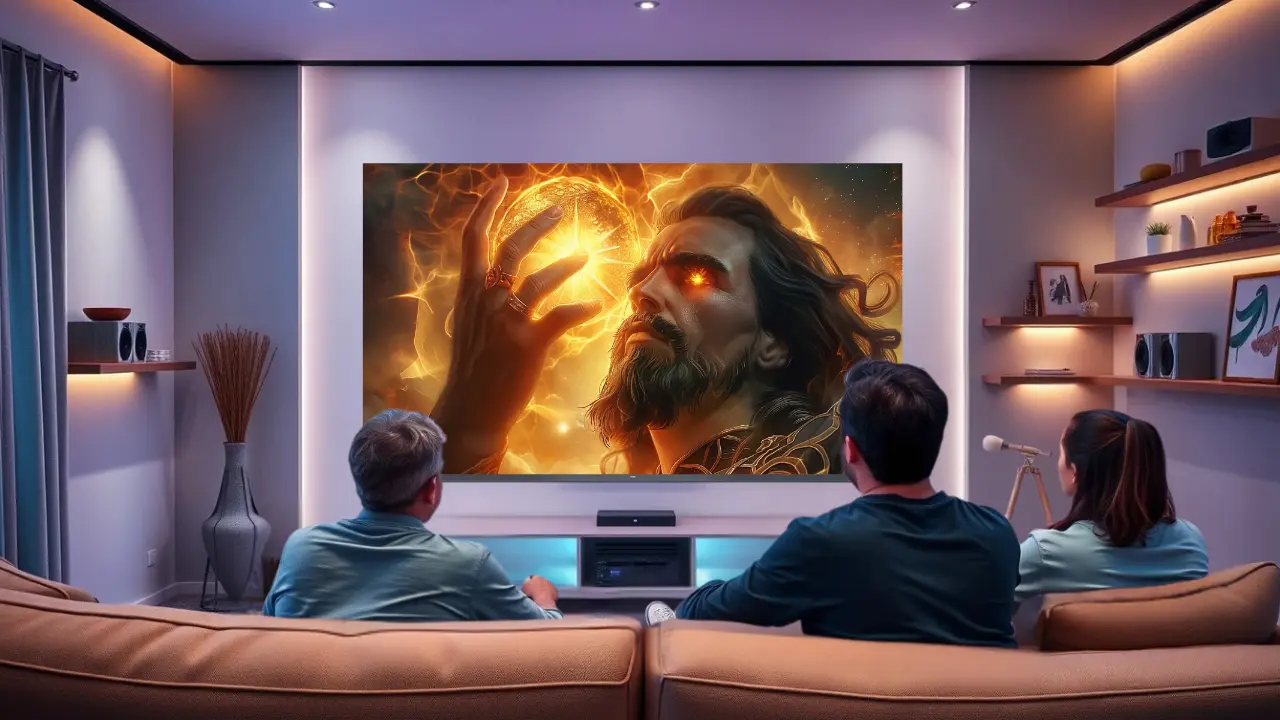

A 6.2.2 channel system delivers sound in every direction around you including above, below, and behind, creating a true three dimensional field instead of flat stereo.
With six main speakers, two subwoofers, and two height channels, audio stops sitting in front of you and starts surrounding you.
Now picture this.
India needs 12 runs off the last three balls. The entire room is silent. Then the bat connects.
You do not just hear it.
You feel the crowd rise behind you.
You sense the commentator’s voice float above you.
You catch the echo of the stadium expanding around the room.
That is the difference between watching a moment and standing inside it.
And once you hear sound move around you, ordinary TV audio feels unfinished.
Why Flat Sound No Longer Matches Big Screens
Screens have grown.
Living rooms have grown.
Expectations have grown.
Today we stream 4K HDR content. We watch Dolby Vision IQ tuned visuals. We play games at 144Hz refresh rates. Visual technology has evolved rapidly.
Sound must evolve too.
Studies from Dolby show immersive audio formats significantly increase emotional engagement compared to traditional stereo. The brain processes spatial cues as real environment signals. That is why surround sound feels natural.
When visuals are cinematic but audio stays flat, the experience breaks.
Immersion demands alignment.
What 6.2.2 Channels Actually Mean
Breaking the Numbers into Real Life
6.2.2 is not technical jargon. It is architecture.
- 6 main channels create horizontal surround sound
- 2 subwoofers handle deep bass evenly
- 2 height channels project audio vertically
Here is how that translates in experience:
| Component | Technical Role | What You Experience |
| 6 Channels | Front, side, rear placement | Sound travels around you |
| 2 Subwoofers | Dual low frequency control | Balanced, room filling bass |
| 2 Height Channels | Vertical projection | Rain above, aircraft overhead |
Instead of left and right, sound now moves forward, backward, upward, and downward.
It breathes.
When paired with Dolby Atmos, audio objects are placed in three dimensional space instead of fixed channels. Dialogue stays centered. Effects move dynamically. You can explore how object based audio works directly on Dolby’s official platform.
This is not a louder sound.
It is a smarter placement.
How This Feels Inside a Real Indian Home
Technology matters only if it changes daily life.
Let us bring this home.
1. The Cricket Night Scenario
India recorded over 400 million viewers during major ICC events. Cricket is not background noise. It is a ritual.
With 6.2.2 channels:
- Stadium energy wraps around the sofa.
- The commentary feels elevated and distinct.
- Every bat impact carries weight.
The benefit is intensity.
The cost is choosing a system that matches your space.
The reward is shared memory.
2. Weekend Movie Immersion
A thriller plays on a 254cm 100 QD Mini LED screen.
Footsteps move behind you.
Thunder rolls above you.
Dialogue stays clear in front without increasing volume.
Clear separation reduces ear fatigue. Lower strain means longer comfortable viewing.
That is intelligent design.
3. The Competitive Gamer
Modern gaming is fast. 144Hz refresh rate and AMD FreeSync Premium Pro reduce motion blur and tearing.
Spatial audio adds another layer.
- Directional cues become precise.
- Enemy movement becomes audible before visible.
- Reaction time sharpens.
Sound becomes strategy.
Not decoration.
The System Most People Overlook

Here is the hidden truth.
Two subwoofers change everything.
Single sub setups often create uneven bass pockets in a room. Dual subwoofers balance low frequency waves, reducing distortion and improving clarity.
Think of it like using two ceiling fans instead of one. Air distributes evenly.
Height channels also matter more than expected. They create vertical layering. Rain feels like it falls from above. Helicopters feel overhead. Devotional music gains spatial depth.
Sound stops being flat.
It becomes architectural.
Where the Haier New M96 Series 254cm 100 QD Mini LED AI Smart Google TV H100M96FUX Fits In
The Haier New M96 Series 254cm 100 QD Mini LED AI Smart Google TV H100M96FUX integrates a 6.2.2 channel speaker system with Sound by KEF and Dolby Atmos support.
That matters.
This is not an add on soundbar. The multi layered speaker configuration is built into the television’s design architecture.
The same model includes AI Center MAX and an AI Ultra Sense Processor co-developed with MediaTek. That means picture optimization and audio tuning operate as a unified system.
When the scene changes, processing adapts.
When lighting shifts, Dolby Vision IQ adjusts brightness.
When action intensifies, sound scales with clarity.
Picture and sound respond together.
That is what a modern smart TV ecosystem should do.
6.2.2 Compared to Traditional Audio Setups
| Feature | Stereo | 5.1 Setup | 6.2.2 Integrated System |
| Surround Depth | Limited | Moderate | Full horizontal wrap |
| Height Audio | No | No | Yes |
| Bass Stability | Single source | Single sub | Dual subwoofer balance |
| Immersion | Basic | Engaging | Cinematic scale |
| Installation | Simple | Medium complexity | Built in advanced TV |
There is a cost difference.
But there is also a scale difference.
When your screen stretches 254cm 100 , audio must scale proportionally. Otherwise the mismatch becomes obvious.
Is 6.2.2 Overkill for a Living Room?
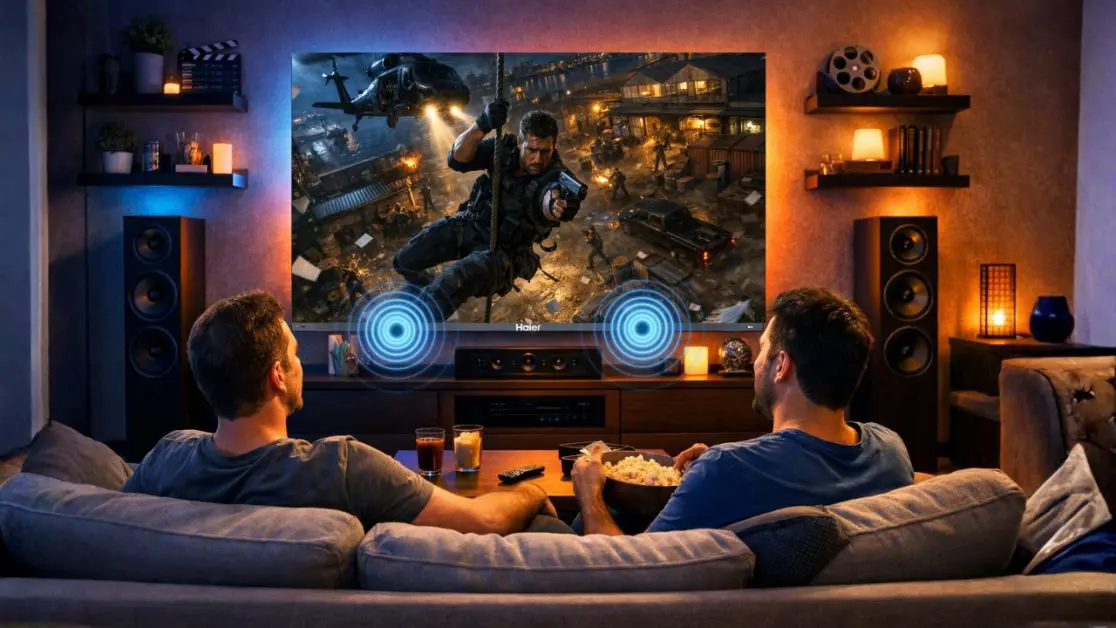
That depends on intention.
One option is to treat television as background filler.
The second option is to treat it as family entertainment.
The third option is to design your living space as an immersive zone.
Each choice has trade offs.
Background viewing is economical.
Mid tier surroundings balance price and experience.
Integrated 6.2.2 demands investment but delivers theater scale immersion without external clutter.
The real question is not technical.
It is emotional.
What kind of space are you building?
The Bigger Pattern: Sound Is Becoming Environment
We used to measure comfort by furniture.
Now we measure comfort by sensory depth.
When AI processors optimize visuals, when low blue light certification reduces eye strain, when 144Hz refresh rates smooth motion, and when 6.2.2 channels distribute sound across dimensions, the TV stops being a device.
It becomes part of the room’s architecture.
Families gather longer.
Game nights feel competitive.
Movies feel deliberate.
Sound becomes social glue.
Final Thought: Immersion Is the New Luxury
6.2.2 channels are not about volume.
They are about spatial clarity.
About depth.
About presence.
In a world where homes double as offices, theaters, and gaming, the quality of environment shapes the quality of downtime.
And downtime is not optional anymore.
It is recovery.
The next time you sit down for a match or a film, ask yourself something simple.
Do you want to hear it?
Or do you want to stand inside it?
Because when sound moves around you, the walls disappear.
And that changes everything.
Frequently Asked Questions
I’m upgrading to a big 254cm(100) TV. Will normal stereo speakers feel disappointing?
Yes, very often they do. Large screens create cinematic visuals, but stereo sound stays flat in front of you. A 6.2.2 system spreads sound around and above you, so explosions, crowds, and music fill the room instead of coming from a single direction. This alignment between screen scale and sound scale is what makes the experience feel complete.
I mostly watch cricket and movies with my family. Is a 6.2.2 system actually noticeable?
Absolutely. During live sports like cricket, surround systems reproduce stadium ambience, crowd reactions, and commentary positioning realistically. Instead of just hearing the match, you feel immersed in the stadium atmosphere. For movies, directional sound (footsteps, rain, helicopters) becomes much clearer.
My living room isn’t huge. Will a 6.2.2 system still make sense?
Yes, especially when the speakers are integrated into the TV design. Systems like the Haier M96 Series place multiple speakers strategically so the room still feels clean without external wiring or clutter. Even medium-sized living rooms benefit from better sound separation and balanced bass.
I hate messy cables and multiple speakers around the room. Is surround sound always complicated?
Not anymore. Traditional surround setups require external speakers and AV receivers. However, some modern TVs integrate multi-channel speakers directly inside the TV chassis. That means immersive audio without complicated installation.
My family watches TV late at night. Will immersive audio make things too loud?
Not necessarily. Immersive systems actually improve clarity, which means you don’t need to increase volume as much. Dialogue remains clear while background effects stay controlled, reducing listening fatigue.
I play competitive games. Can spatial audio actually improve my gameplay?
Yes. Spatial audio lets you hear directional cues like footsteps, gunfire, or movement before you see them on screen. Combined with high refresh rates (like 144Hz), this gives gamers a reaction advantage.
My gaming setup already has a headset. Do I still benefit from surround sound speakers?
Headsets provide excellent positional audio, but room speakers offer a shared immersive experience. When gaming with friends or family watching, surround sound makes the environment feel larger and more cinematic.