

Let’s begin with a simple truth.
Not all screens are created equal.
You realise this the moment you sit down for a Christopher Nolan film.
Because a Nolan experience isn’t just about watching a movie. It’s about surviving it. Hearing every whisper. Reading every expression. Absorbing every shift in light.
And with The Odyssey set to drop as Nolan’s most ambitious project yet, here’s the real question:
Is your TV even ready for this kind of storytelling?
Because this isn’t just entertainment anymore.
This is a stress test.
What Makes a Nolan Movie So Demanding?
Let’s unpack the chaos.
His storytelling style doesn’t just entertain. It is challenging.
Unforgiving audio layers
Backgrounds blend into foregrounds. Dialogue often hides beneath ambient score.
If your TV can’t handle nuanced sound separation, you’re already missing half the plot.
Dramatic shifts in lighting
One minute, you’re in a sunlit battlefield. Next, you’re inside a dimly lit submarine.
Your screen must adapt instantly or the immersion collapses.
High-speed sequences + psychological pauses
Few directors toggle between intensity and stillness like Nolan.
If your refresh rate can’t keep up, the motion blur alone can wreck the experience.
So if you thought this was just another Greek epic
It’s not.
It’s a full-blown performance review for your television.
Not Every TV Is Built for This Level of Storytelling
Let’s say you’re watching The Odyssey on a regular LED TV.
You’ll still see things.
But what you won’t feel is the tension in Odysseus’ brow.
You won’t hear the war drums echo from one end of the sea to the other.
And you certainly won’t catch that split-second flicker of betrayal in someone’s eyes.
Because average TVs flatten out the storytelling.
And Nolan doesn’t do flat.
So, What Kind of TV Does This Story Deserve?
Here’s what we know about Nolan’s The Odyssey:
- Epic Greek settings shot in natural
- Practical effects over CGI
- A star-studded cast delivering layered performances
- Soundscapes that shift like waves on the Aegean Sea
To handle all this?
You need three things.
1. A Panel That Does Justice to Shadows and Contrast
This is where OLED reigns.
Unlike regular LED TVs that use a backlight, OLEDs light up each pixel individually.
Which means:
- True blacks (not grey pretending to be black)
- Infinite contrast
- Perfect picture uniformity
When Odysseus sails at night under a moonlit sky, it should feel like you’re on the ship.
Not just watching from your sofa.
2. A Refresh Rate That Can Keep Up With The Action
Nolan doesn’t slow down for anyone.
And if your TV runs at 60Hz or even 90Hz, motion blur will destroy the pacing.
144Hz refresh rate, on the other hand, handles it like a breeze.
Every frame is delivered with surgical precision.
No ghosting. No flickering. No lag.
Just unfiltered storytelling, as intended.
3. A Sound System That Understands Silence
Not just volume. Not just bass. But precision.
You need audio that lets you hear water dripping in a cave and the roar of a monster from Greek mythology.
That’s where the Harman Kardon-tuned 50W sound makes the difference.
With cinematic audio tuning, you don’t need extra speakers.
The sound moves around you. Swells. Drops. Whispers. Hits.
It makes storytelling three-dimensional.
But What About Streaming It at Home? Isn’t That Good Enough?
Fair question.
With OTT platforms releasing films within weeks of theatrical runs, a lot of us now prefer home viewings.
But here’s the hidden trade-off.
If your TV isn’t up to the mark, you’re watching a degraded version of the film.
It’s not about internet speed.
It’s about:
- Ambient light control
Is your TV adjusting visuals depending on the light in your room? - Scene-by-scene HDR enhancement
Is it processing the metadata dynamically, or just applying a blanket filter? - Voice control and convenience
Are you still fumbling with remotes while Nolan throws a timeline puzzle at you?
Watching The Odyssey without the right screen is like playing football in sneakers on a wet pitch.
You can do it.
But it’s not the same game.
What Does Haier Bring to the Table?
Let’s zoom into something made exactly for this moment.
The 144Hz OLED 165cm (65-inch) TV.
Built not just for passive watching but for active immersion.
Here’s why it’s more than ready for The Odyssey:
- OLED panel: Delivers intense contrast, perfect blacks, and vibrant colours
- 144Hz refresh rate: Handles fast cuts and high-energy scenes without lag
- Dolby Vision IQ + HDR10+: Adjusts visuals in real-time based on your room’s lighting
- 50W Harman Kardon sound: Studio-like audio that makes every footstep, sword clash, and ocean wave land with impact
- Dolby Atmos: Adds spatial awareness to your sound so you feel where the sound is coming from
- AMD FreeSync Premium: If you’re watching and gaming, it offers smooth transitions without screen tearing
- Solar-powered remote + Hands-Free voice control: A glimpse of tomorrow’s TV experience today
So when Nolan demands the best from your TV, this screen doesn’t flinch.
Why It Matters in the Indian Context
Let’s not pretend we don’t multitask.
We watch, pause, switch tabs, take calls, play music, and scroll Instagram all from the same screen.
A good TV today must be more than just a display.
It has to be:
- A second theatre
- A first screen for gaming
- A concert speaker for Spotify
- A storyteller when your parents watch their epic serials
- A smart assistant that obeys commands without delays
The OLED is designed keeping this Indian lifestyle in mind.
From smart voice control to Google TV interface, everything flows intuitively.
And for viewers in cities like Pune, Indore, Ahmedabad, Jaipur, Kochi or Guwahati it’s a bridge to global-level entertainment without leaving your living room.
A TV Is No Longer a Gadget. It’s an Experience Interface
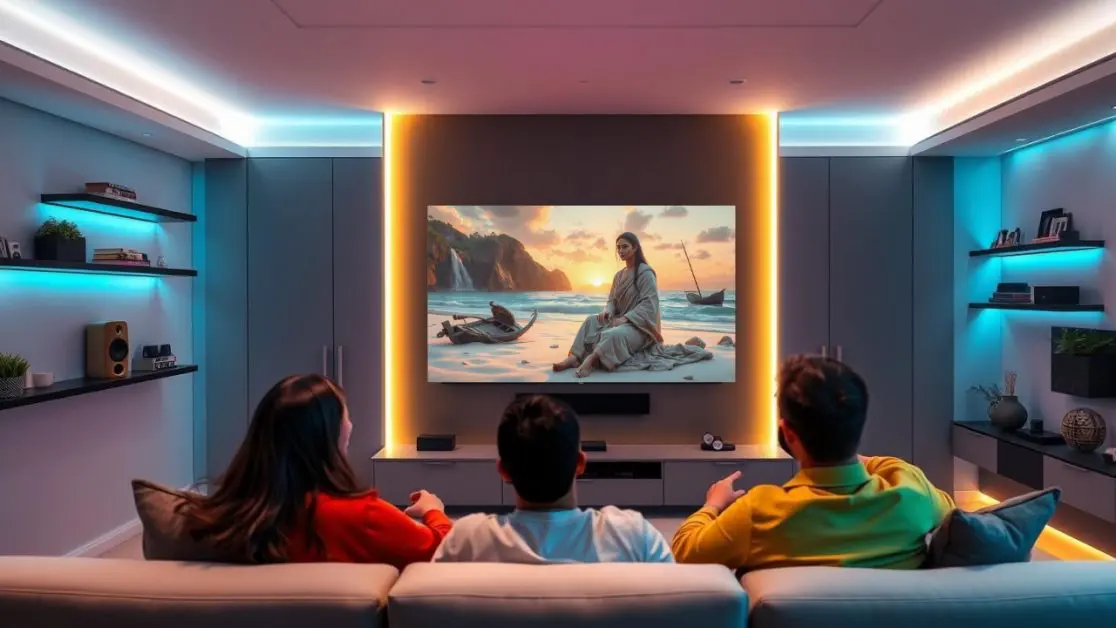
Nolan’s The Odyssey proves one thing clearly.
We’ve entered a new era of visual storytelling.
It’s not about clarity anymore.
It’s about depth.
Not just resolution.
But interpretation.
The screen in your home is not just reflecting pixels.
It’s translating a director’s vision.
So when the story gets as layered, demanding, and technically advanced as The Odyssey, your TV becomes part of the storytelling team.
Not a spectator.
If Nolan Trusts the Frame, Shouldn’t You Trust Yours?
Every filmmaker is particular about framing. But Nolan? He’s obsessed.
He’ll wait for the right light, use real film stock, build entire sets instead of green screens.
So if he trusts each frame to carry emotional weight, visual complexity, and audio brilliance…
Then you need a screen that respects the same frame.
The Odyssey isn’t just a movie.
It’s a call to level up how you watch.
Where to Begin?
If you’re ready to upgrade your home entertainment, Haier India’s 144Hz OLED TV (H65C95EUX) is waiting.
- 65-inch cinematic OLED panel
- Dolby Vision IQ, HDR10+, Dolby Atmos
- Harman Kardon 50W sound
- Hands-free voice control
- Solar-powered remote
- 144Hz refresh rate
- FreeSync Premium for smooth gameplay
- Google TV interface for personal content curation
You don’t just buy a screen like this.
You invest in how stories feel in your living room.
So here’s the final question:
If your TV can’t handle The Odyssey, what else are you compromising on?
Let your next TV match your ambition.
Let it pass the Nolan Test.