


A New Year family game night works when the TV removes effort, not when it demands attention.
VRR and ALLM enabled TVs create smoother gameplay, faster responses, and fewer interruptions, turning the living room into a space where everyone can participate comfortably, from kids holding a controller for the first time to parents cheering from the sofa.
That is the simple truth.
Now let us unpack why this matters so much in Indian homes today.
Why New Year game nights are becoming a family ritual
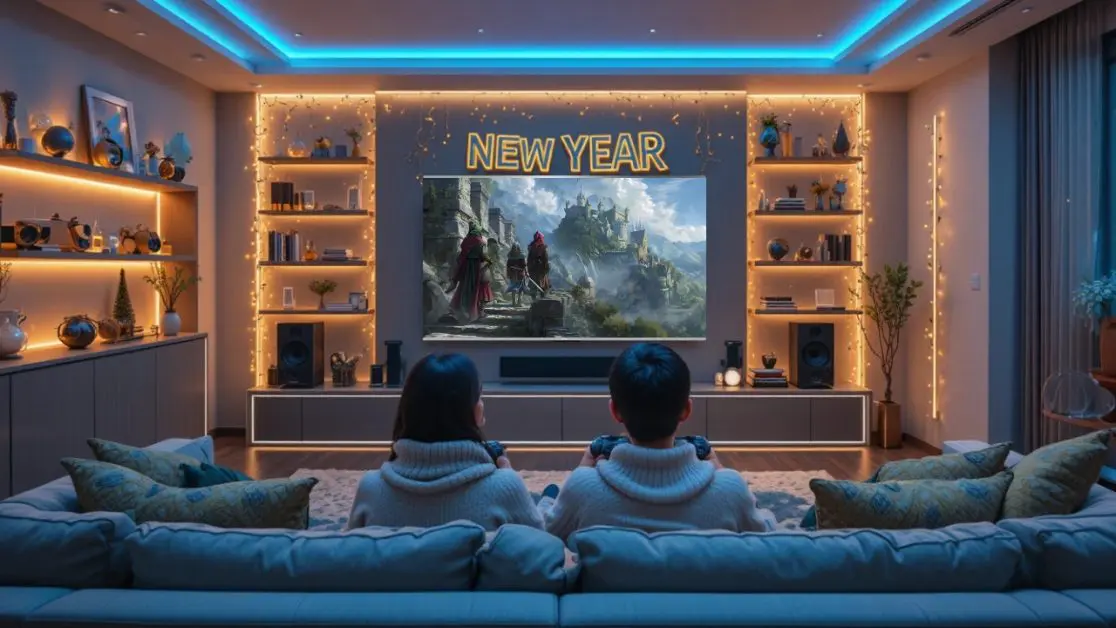
New Year evenings in Indian homes follow a familiar rhythm.
Dinner winds down earlier than usual.
The table gets cleared.
Someone asks the inevitable question.
“What now?”
This is where family game night quietly steps in.
Not loud arcade chaos.
Not solo gaming behind closed doors.
But shared play.
A football game where cousins argue over teams.
A racing game where parents take turns.
A co-op adventure where everyone shouts advice.
These moments work only when the screen keeps up with human energy.
Lag breaks momentum.
Delayed response creates frustration.
Technical interruptions kill spontaneity.
A successful New Year game night is not about winning.
It is about flow.
And flow depends on the TV.
What actually breaks the experience during game night
Most households assume the problem lies with the console or the game.
In reality, the TV is often the bottleneck.
Common issues show up fast.
- Input delay that makes actions feel late
- Visual tearing during fast scenes
- Manual settings that confuse non-gamers
When different generations play together, tolerance drops quickly.
Children sense delay instantly.
Adults lose patience with menus.
Everyone starts blaming the controller.
A TV designed for modern gaming quietly removes these problems before they surface.
This is where VRR and ALLM matter.
What VRR really means in everyday language
VRR stands for Variable Refresh Rate.
Forget the technical definition for a moment.
VRR simply means the TV adjusts itself to the game, not the other way around.
Think of walking in a group.
If everyone walks at a different speed, the group stretches and breaks.
If everyone adjusts pace naturally, the walk feels effortless.
VRR does that for visuals.
What VRR improves during family game night
- Smooth motion in racing and sports games
- No screen tearing during fast camera pans
- Consistent visuals even during sudden action
For spectators sitting around the room, these details matter more than expected.
When visuals feel stable, people stay engaged.
When visuals stutter, attention drifts.
VRR keeps everyone locked into the moment.
Why ALLM quietly changes the mood of the room
ALLM stands for Auto Low Latency Mode.
Its value is deeply human.
Nobody wants to open picture settings on New Year’s Eve.
ALLM automatically detects when a console is turned on and switches the TV into game mode.
No instructions.
No explanations.
No asking someone tech-savvy for help.
What ALLM enables
- Instant low input lag
- Equal responsiveness for all players
- Smooth switching between gaming and streaming
A child can start a game without help.
A parent can later open a movie app.
The TV adjusts silently.
The less the TV interrupts, the more the family connects.
The Indian living room works as a shared system
Indian homes are not single-use spaces.
The living room constantly shifts roles.
- Afternoon cartoons
- Evening news
- Late-night movies
- Midnight games
A good TV respects this rhythm.
VRR and ALLM do not just serve gamers.
They support seamless transitions between uses.
Game night ends.
A movie starts.
No one touches the settings.
That is what stress-free technology looks like.
Why screen size and brightness matter on New Year nights
Game nights are rarely neat.
People sit at angles.
Some stand behind the sofa.
Others watch from the dining area.
Bigger screens solve a simple problem.
Everyone can see.
Mini LED displays help even more.
Higher brightness means visuals remain clear even with lights on, which is common during New Year gatherings.
Strong contrast keeps characters and objects defined from every seat.
This is not about cinematic perfection.
It is about shared visibility.
Where the Haier M90 Mini LED 165 cm 55 inch Google TV fits naturally
Some TVs are built to impress in showrooms.
Others are built to work in real homes.
The Haier M90 Mini LED 165 cm 55 Google TV is designed for households that mix entertainment, gaming, and everyday viewing.
Here is how its features support New Year family game nights.
Key features that matter during gaming
- 144Hz refresh rate for smoother motion in fast-paced games
- AMD FreeSync Premium support to reduce screen tearing and stutter
- Mini LED display with local dimming zones for deeper contrast and clarity
- Dolby Vision IQ and HDR10+ for adaptive picture quality based on room lighting
- ALLM support for automatic low latency when a console is detected
- Google TV interface that makes switching between apps intuitive
These features are not about showing off specifications.
They are about removing friction from shared experiences.
The TV adapts quietly so people do not have to.
All specifications and features referenced above are part of the Haier M90 Mini LED 165 cm 55 Google TV product details .
Three ways families approach New Year game nights
Not every household plays the same way.
Patterns emerge.
One option is casual group play
- Party games
- Sports simulations
- Turn-based challenges
VRR keeps visuals smooth.
ALLM ensures no setup confusion.
The second option is competitive gaming
- Racing titles
- Action games
- Online matches
Low latency becomes critical.
High refresh rates reduce visual fatigue.
The third option is mixed entertainment
- Games first
- Movies later
- Music and streaming in between
Automatic switching becomes more valuable than raw performance.
A TV that handles all three without effort earns its place in the living room.
Why this matters beyond entertainment
Family game nights are not really about games.
They are about alignment.
People reacting together.
Celebrating the same moment.
Laughing at the same mistake.
Technology either supports this or disrupts it.
VRR reduces visual interruptions.
ALLM removes setup friction.
Together, they make participation easier.
When participation increases, habits form.
Habits turn into traditions.
This is how screens stop being distractions and start becoming anchors.
What to look for when choosing a TV for family game nights
Keep the checklist practical.
- Automatic game mode switching
- Variable refresh rate support
- Strong brightness for well-lit rooms
- Wide viewing angles for group seating
- Simple, familiar interface
If a feature needs explaining every time, it adds stress.
The best TVs work silently in the background.
The bigger pattern behind smarter TVs
Every generation of home technology follows the same journey.
First, it impresses.
Then, it simplifies.
Finally, it disappears into daily life.
VRR and ALLM belong to that final stage.
They do not announce themselves.
They do not demand attention.
They simply make evenings smoother.
In a year where families value shared time more than novelty, this shift matters.
The New Year insight to carry forward
A great New Year family game night is not defined by graphics or scores.
It is defined by rhythm.
When the TV keeps pace with people, not the other way around, moments feel effortless.
VRR keeps visuals in sync.
ALLM keeps effort low.
Together, they make gaming inclusive, not intimidating.
The best compliment a TV can receive is silence.
When no one talks about the screen, but everyone remembers the night, the technology did its job.