
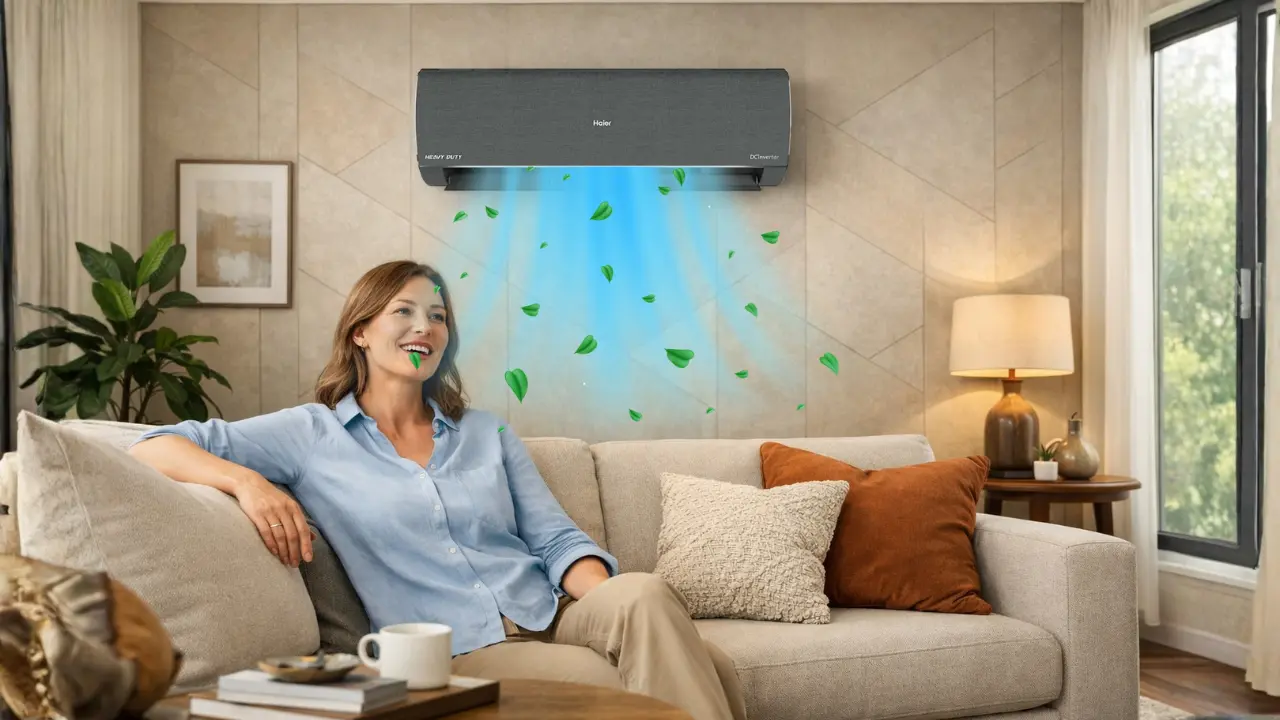

AI climate control changes cooling from a manual habit into an adaptive system.
Instead of guessing temperatures and modes, AI-powered ACs learn how a home behaves, how people move, and how weather shifts. Conventional ACs follow instructions.
AI ACs follow patterns. That difference quietly changes comfort, energy use, and daily life.
The familiar ritual of adjusting the AC
Every Indian household knows this routine.
You come home tired.
You switch on the AC.
You lower the temperature.
You feel cold.
You raise it again.
This back-and-forth is not about preference.
It is about systems that do not understand context.
Conventional AC cooling works on commands.
AI climate control works on comprehension.
That distinction matters more than we realise.
What conventional AC cooling actually does
Conventional ACs respond. They do not anticipate.
They wait for you to decide everything.
- Temperature setting
- Fan speed
- Swing direction
- Timer on or off
- Power mode selection
The machine follows. Faithfully. Blindly.
This design made sense when electricity was cheap, homes were predictable, and usage was limited to a few hours a day.
That world no longer exists.
Indian homes today are dynamic systems.
People come and go.
Rooms serve multiple purposes.
Weather changes by the hour.
A static cooling system struggles in a dynamic environment.
The hidden cost of manual control
Manual cooling has three invisible penalties.
- Overcooling
Rooms often become colder than needed, especially at night. - Energy waste
ACs run at higher loads even when fewer people are present. - Mental load
Someone always has to remember to adjust settings.
The AC cools the room.
The human manages the system.
That is an outdated division of labour.
What AI climate control changes at the system level
AI climate control shifts decision-making from the user to the machine.
Not through guesswork.
Through learning.
Modern AI-driven ACs analyse multiple inputs at once.
- Room temperature trends
- Outdoor weather conditions
- Time of day
- Usage history
- Occupancy patterns
Instead of reacting, the system predicts.
That prediction layer is the real upgrade.
Learning replaces adjusting
Think of it like this.
Conventional ACs are light switches.
AI ACs are autopilots.
Once trained, the system adjusts cooling automatically to match real conditions rather than fixed settings.
This is not about comfort alone.
It is about efficiency without effort.
According to Haier’s AI Atmox AI climate control continuously analyses environmental data and user behaviour to optimise cooling and energy use without manual input .
That means fewer decisions.
And fewer regrets at the electricity bill.
AI climate control in real Indian homes
The value of AI cooling shows up in ordinary moments.
Not in showrooms.
In daily life.
Scenario one: The late workday return
You leave home in the afternoon heat.
You return after sunset.
A conventional AC waits for you to switch it on.
An AI-enabled AC anticipates arrival through learned patterns and pre-cools the room so comfort begins the moment you enter.
No timers.
No reminders.
No manual scheduling.
Scenario two: The shared living room
Parents watching TV.
A child doing homework.
Someone is scrolling on the sofa.
Conventional ACs cool the entire room evenly, whether people need it or not.
AI target cooling focuses airflow where people are actually seated, reducing wasted cooling and improving comfort where it matters most.
This is not stronger cooling.
It is a smarter direction.
Scenario three: The forgotten empty room
A room with the AC running.
No one inside.
Traditional systems keep cooling until someone intervenes.
AI-powered human detection senses inactivity and gradually reduces power or switches modes automatically.
The system notices what humans forget.
Comparing AI climate control and conventional AC cooling
The difference is not technology. It is philosophy.
| Aspect | Conventional AC | AI Climate Control |
| Decision-making | Manual | Automated |
| Response style | Reactive | Predictive |
| Energy optimisation | Fixed modes | Dynamic adjustment |
| Occupancy awareness | None | Real-time detection |
| User effort | High | Minimal |
| Comfort consistency | Variable | Stable |
This is not about replacing control.
It is about removing unnecessary control.
Energy savings are a byproduct, not the goal
Most people think AI ACs exist to save electricity.
That is only half the story.
The real goal is balance.
AI climate control systems monitor temperature gaps between desired comfort and actual conditions.
Based on this gap, the system adjusts power levels automatically instead of running at full capacity all the time.
The result is fewer spikes.
Smoother operation.
Lower strain on the compressor.
Energy savings follow naturally.
Not because you tried harder.
Because the system worked smarter.
Why conventional AC efficiency hits a ceiling
Conventional ACs already have inverter technology.
They already offer energy ratings.
So why is improvement limited?
Because efficiency without intelligence plateaus.
Without understanding occupancy, usage habits, or environmental shifts, even efficient machines make inefficient decisions.
They cool when no one needs cooling.
They run harder than necessary.
They depend on humans to optimize.
That dependency is the bottleneck.
AI climate control reduces decision fatigue
Comfort should not require management.
Every adjustment costs attention.
Multiply that by days.
Weeks.
Years.
AI cooling systems quietly remove dozens of micro-decisions from daily life.
- No constant temperature tweaking
- No guessing which mode to use
- No anxiety about forgetting to switch off
This matters more than most feature lists admit.
A well-designed system saves energy.
A great system saves attention.
Where Haier’s approach fits naturally
Haier’s AI climate control philosophy focuses on blending into daily routines rather than demanding behaviour change.
Features like AI climate control, pre-cooling, target cooling, Electricity monitoring 2.0, and human detection work together as a single system rather than isolated functions.
This integrated approach reflects a broader shift in home appliances.
From tools to partners.
From devices to systems.
The goal is not to impress.
It is to disappear into daily comfort.
What this shift means for modern Indian households
Homes are becoming intelligent ecosystems.
Cooling is no longer a standalone function.
It is part of a larger rhythm.
- Work-from-home schedules
- School hours
- Sleep cycles
- Seasonal humidity
- Power cost awareness
AI climate control adapts across these variables without constant instruction.
That adaptability is the real luxury.
Not colder air.
Not faster cooling.
But cooling that feels considered.
The broader implication
Every generation upgrades appliances for a reason.
Earlier, it was capacity.
Then efficiency.
Now intelligence.
AI climate control is not about replacing conventional ACs overnight.
It is about redefining what cooling should feel like in complex, lived-in homes.
The future of comfort is not colder.
It is calmer.
And once a system learns your rhythm, going back to manual guesswork feels surprisingly outdated.
Frequently Asked Questions
Why do I keep adjusting my AC temperature multiple times every night?
Because conventional ACs don’t understand context. They follow fixed commands, not changing conditions like body temperature, sleep cycles, or outdoor cooling at night. AI climate control reduces this back-and-forth by automatically fine-tuning cooling as conditions shift.
Is it normal to feel mentally tired just managing AC settings every day?
Yes and it’s more common than people admit. Manual cooling creates constant micro-decisions: temperature, fan speed, mode, timers. AI climate control removes that cognitive load by making those decisions for you in the background.
Does AI climate control actually work in busy Indian households?
Yes, especially in busy homes. Indian households are dynamic: people move in and out, rooms have multiple purposes, and weather changes fast. AI cooling adapts to these shifts automatically instead of assuming a fixed usage pattern.
Is AI climate control just about faster or stronger cooling?
No. It’s about balanced cooling, not aggressive cooling. Instead of running at full capacity, AI systems adjust power gradually to maintain comfort without overcooling.
What exactly makes an AC “AI-powered”?
AI-powered ACs analyse multiple data points at once usage history, time of day, room temperature trends, occupancy, and outdoor weather then predict cooling needs instead of waiting for manual commands.