
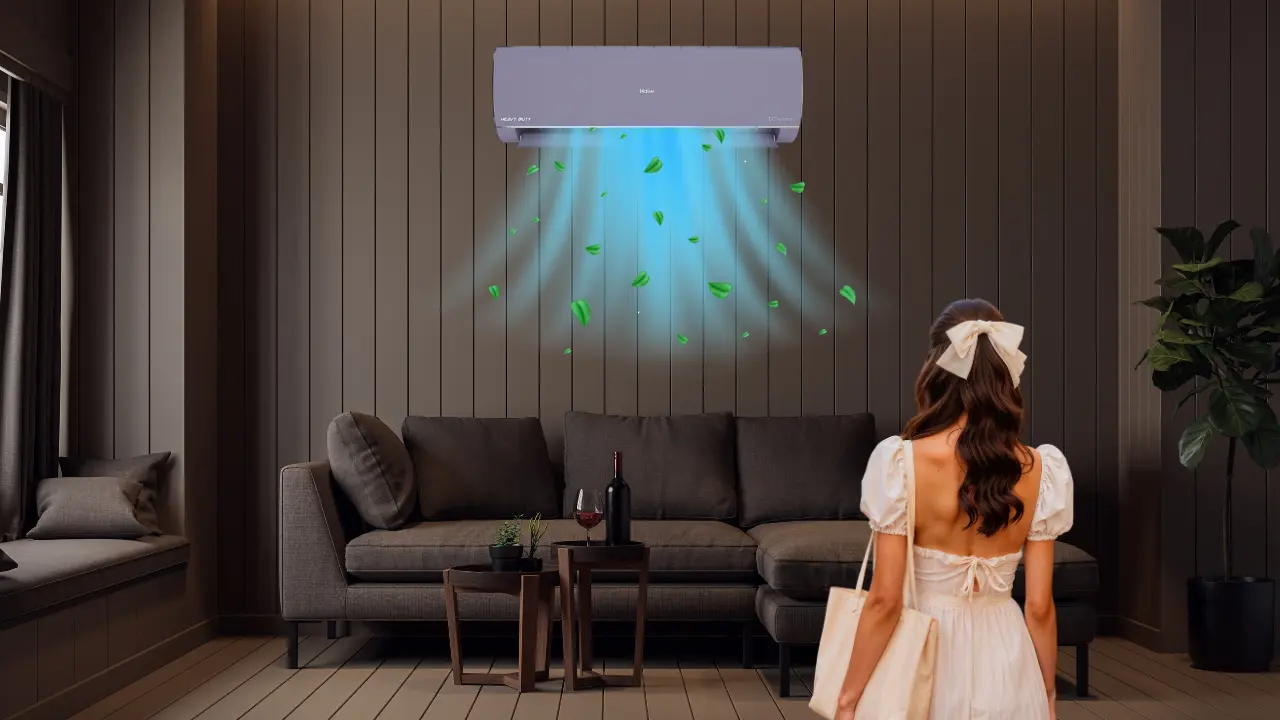

AI pre-cooling prepares your room before you arrive by predicting your routine, sensing proximity, and starting cooling at the right moment so comfort is already in place when you step in.
Instead of waiting for hot air to be pushed out after you switch on the AC, the room is already balanced, calm, and ready. Less waiting. Less energy waste. More ease.
That is the simple answer.
The real story is about how comfort has quietly changed in Indian homes.
Why does coming home still feel like a temperature shock?
It is 7:30 pm.
You shut the door behind you.
The house has been closed all day.
The air feels heavy.
The sofa feels warm.
The room takes time to settle.
So you do what everyone has done for years.
You switch on the AC and wait.
This moment reveals a hidden assumption in how cooling has worked for decades.
Cooling has always been reactive.
It responds after discomfort begins.
AI pre-cooling flips that system.
The difference between cooling air and preparing a room
Traditional ACs focus on one task.
Blow cold air when asked.
AI pre-cooling focuses on a different goal.
Prepare the space before the person arrives.
That shift sounds small.
It is not.
Because rooms are systems, not switches.
Walls hold heat.
Furniture absorbs warmth.
Airflow takes time to circulate.
By the time cold air reaches you, energy has already been spent fighting resistance.
AI pre-cooling works upstream.
What AI pre cooling actually does
AI pre-cooling uses learned patterns and location signals to start cooling in advance, not on a fixed timer, but based on human movement and habit.
In systems like Haier’s AI Atmox powered ACs, the process follows a clear logic:
- The system learns daily routines over time
- It identifies when arrival usually happens
- A geofence triggers action when the user enters a defined distance
- Cooling begins gradually, not aggressively
- The room temperature stabilises before occupancy
According to Haier’s AI Atmox, AI pre cooling can activate automatically when a user enters a preset 100 metre geofence, anticipating room occupancy and starting cooling in advance without manual input
This is not about speed.
It is about timing.
Why waiting for cooling wastes energy
Most people believe switching on the AC earlier wastes power.
The opposite is often true.
When a room is already overheated, the AC has to work harder to bring temperatures down quickly. That leads to:
- Higher compressor load
- Longer high power cycles
- Overcooling once comfort is reached
AI pre-cooling avoids this spike.
By starting earlier at a controlled pace, the system reduces peak load and avoids temperature overshoot.
Comfort becomes smoother.
Energy use becomes steadier.
The Indian home context matters here
Indian homes do not cool evenly.
Bedrooms face different directions.
Living rooms hold heat from the afternoon sun.
Apartments trap warmth differently than independent houses.
Add to that:
- Long workdays
- Irregular commute times
- Shared spaces with family members
- Monsoon humidity or dry summer heat
Manual timers break down in this environment.
AI pre-cooling adapts because it learns context, not just clock time.
Three common ways people try to solve this problem
Before AI pre-cooling, households relied on three imperfect solutions.
Option one: Switch on the AC remotely
This works sometimes.
But it assumes you remember.
It assumes your schedule is predictable.
It assumes network connectivity is stable.
It still places the burden on you.
Option two: Set fixed timers
Timers assume life runs on schedule.
Indian life rarely does.
Traffic changes.
Meetings stretch.
Plans shift.
Fixed cooling often runs when no one is home.
Option three: Just wait it out
This is the most common option.
It costs comfort.
It costs patience.
It often costs more power than expected.
AI pre-cooling exists because all three options ask humans to manage a system that should manage itself.
AI pre cooling as a lifestyle upgrade, not a feature
The real benefit shows up in small moments.
You walk in after grocery shopping.
The kitchen is already cool.
Your child enters the room after playtime.
The temperature feels balanced, not harsh.
You lie down after a long day.
The bed does not radiate stored heat.
These moments feel invisible when done right.
That is the point.
How AI pre cooling works with other AI cooling layers
AI pre-cooling is not a standalone trick.
It works best as part of a system.
In Haier’s AI Atmox ecosystem, it connects with:
- AI Climate Control that adapts cooling by season and environment
- AI Target Cooling that focuses airflow where needed
- AI Eco 2.0 modes that optimise power once comfort is reached
Pre-cooling sets the stage.
Other AI layers maintain balance.
The system moves from reaction to orchestration.
Why this matters more for smaller households
Solo professionals and young couples often live in compact homes.
In these spaces:
- Temperature changes are felt immediately
- Overcooling becomes uncomfortable quickly
- Energy efficiency matters more per square foot
AI pre-cooling avoids the blast effect.
Cooling begins gently.
The room settles evenly.
The experience feels intentional.
A simple way to think about it
Think of a pressure cooker.
You do not put rice in after the water boils violently.
You prepare the conditions first.
Good systems prepare environments, not just outcomes.
AI pre-cooling follows the same principle.
The hidden emotional benefit of prepared spaces
There is a reason hotels feel calmer than homes.
Rooms are prepared before arrival.
Lights are balanced.
The temperature is stable.
The space is ready to receive you.
AI pre-cooling brings a version of that thoughtfulness into everyday living.
Without staff.
Without effort.
Without conscious planning.
What this signals about the future of home technology
The most important shift is not smarter machines.
It reduces decision fatigue.
Homes are becoming environments that respond to presence, not commands.
Cooling will not ask.
It will be anticipated.
That is not convenient.
That is respect for attention.
The bigger pattern at work
Across appliances, the same system is emerging.
- Refrigerators adjust cooling based on usage
- TVs adapt picture and sound automatically
- Washing machines learn load behaviour
ACs were the last to change because comfort is personal.
AI pre-cooling shows that personalisation does not need constant input.
It needs pattern recognition and restraint.
The takeaway worth remembering
Comfort should not begin after discomfort.
When systems learn your rhythm, effort disappears.
AI pre-cooling is not about colder air.
It is about better timing.
And timing, more than power, defines how spaces feel when you finally arrive home.
That is the quiet upgrade modern homes are making.
Frequently Asked Questions
I’m tired of constantly deciding when to switch on my AC. Is AI pre-cooling meant for people like me?
Yes. AI pre-cooling removes that mental load by learning your routine and preparing the room automatically, so comfort doesn’t depend on remembering or planning.
Does AI pre-cooling really make homes feel calmer, or is that just marketing language?
The calm comes from prepared spaces. When temperature is already stable, your body doesn’t experience thermal shock the same reason hotels feel relaxing when you enter.
Will AI pre-cooling work during monsoons when humidity is high?
Yes, especially when combined with AI climate systems that account for humidity. Pre-cooling stabilises both temperature and moisture levels before occupancy.
Isn’t switching on the AC earlier a waste of electricity?
Surprisingly, no. Cooling an already overheated room requires more power. AI pre-cooling starts gently, reducing peak load and avoiding energy spikes.
Does AI pre-cooling prevent overcooling?
Yes. Because it stabilises temperature before arrival, the system avoids overshooting and excessive compressor cycles.