
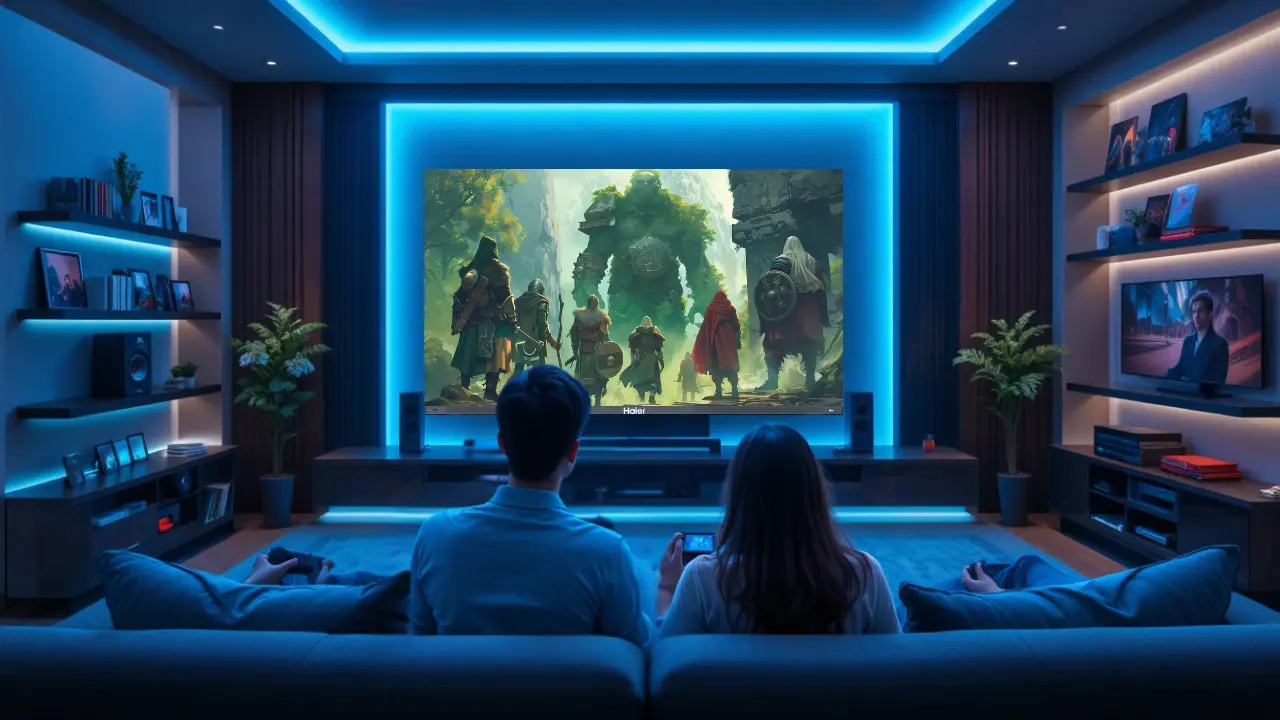

Gaming on a big screen transforms play into presence.
It moves gaming out of a corner and places it at the centre of the home. Bigger visuals. Cleaner motion.
Sound that wraps around the room. Not to impress. To immerse. To focus. To make every session feel intentional instead of rushed.
That is the short answer.
The longer answer is about how Indian homes are changing, how gaming habits are maturing, and why the television is quietly becoming the most important gaming upgrade you can make.
When gaming stopped being a private hobby?
It usually happens on an ordinary evening.
Work is done. Notifications slow down. The console powers on. What used to be a small-screen escape now fills the living room.
And the experience changes.
Gaming stops feeling like something squeezed between tasks. It starts feeling like an event.
Across Indian households, gaming has moved out of bedrooms and into shared spaces. It now sits alongside cricket matches, weekend movies, and family downtime.
That shift is not accidental.
Where gaming lives changes how seriously we take it.
Why gaming feels different on a big screen

This is not about bragging rights or screen size alone.
It is about how the human eye works.
A larger screen fills more of your field of view. Details feel closer. Motion feels more physical. Depth becomes easier to read.
Three practical changes stand out immediately:
1. Faster reactions through visibility
Enemies, maps, and movement cues become clearer. You react sooner because you see more.
2. Stronger immersion through scale
Open worlds feel expansive. Racing games feel faster. Sports titles feel broadcast-grade.
3. Sound finally earns its place
On a big screen, audio stops being background noise. It becomes directional and meaningful.
This is why serious gamers gravitate towards living room setups.
Not for luxury. For clarity.
The system behind smooth gameplay
Most people describe gaming TVs using one word.
Fast.
But speed alone does not create smooth gameplay. Consistency does.
Gaming performance depends on multiple elements working together:
- Refresh rate
- Frame synchronisation
- Input latency
- Processing power
If one element falls behind, the illusion breaks.
Modern big-screen TVs now support high refresh rates like 120Hz and 144Hz, allowing frames to update more frequently. Motion stays clean. Blur reduces.
Technologies such as VRR and AMD FreeSync Premium Pro help synchronise the TV with the console or GPU, eliminating screen tearing and stuttering.
Smooth gaming is not about raw speed. It is about alignment.
Why display technology matters more than size
A common assumption goes like this.
Buy a bigger TV. Gaming improves automatically.
Sometimes it does not.
Because games challenge a screen differently than movies.
Games demand:
- Rapid scene changes
- Constant motion
- Bright highlights beside deep shadows
- Instant response to input
This is where advanced display technology makes a real difference.
What QD Mini LED changes for gamers
QD Mini LED panels combine quantum dot colour with precise local dimming.
The result is practical, not cosmetic.
- Dark scenes stay dark without losing detail
- Bright scenes stay vivid without washing out colours
- Fast motion remains sharp
For gaming, this means horror games feel tense, racing games stay readable at speed, and sports titles show texture instead of blur.
This is one reason premium large-format TVs like the Haier New M96 Series 254cm (100) QD Mini LED AI Smart Google TV (H100M96FUX) stand out for gaming-focused households. The panel is built to handle motion, contrast, and brightness together rather than in isolation .
The living room becomes the new gaming zone
Indian homes are shared environments.
Screens serve multiple purposes across the day:
- News in the morning
- Cartoons in the afternoon
- Gaming after work
- Movies at night
A gaming setup that requires isolation does not scale.
Big-screen TVs work because they adapt.
Modern AI-powered televisions automatically detect gaming inputs, switch to low-latency modes, and optimize picture settings without forcing users into menus.
That matters when gaming fits between work calls, family conversations, and daily routines.
Good technology removes friction instead of adding steps.
Sound is the most underestimated gaming upgrade
Visuals get the attention. Sound decides outcomes.
Directional audio changes how games are played. Footsteps, reloads, environmental cues. These details guide decisions.
Large TVs with Dolby Atmos support and advanced speaker configurations create spatial audio that moves through the room instead of firing straight ahead.
Some high-end models integrate finely tuned speaker systems that reduce the need for external soundbars for most users.
When sound placement improves, reaction time follows.
You hear before you see.
Console, PC, and cloud gaming on one screen
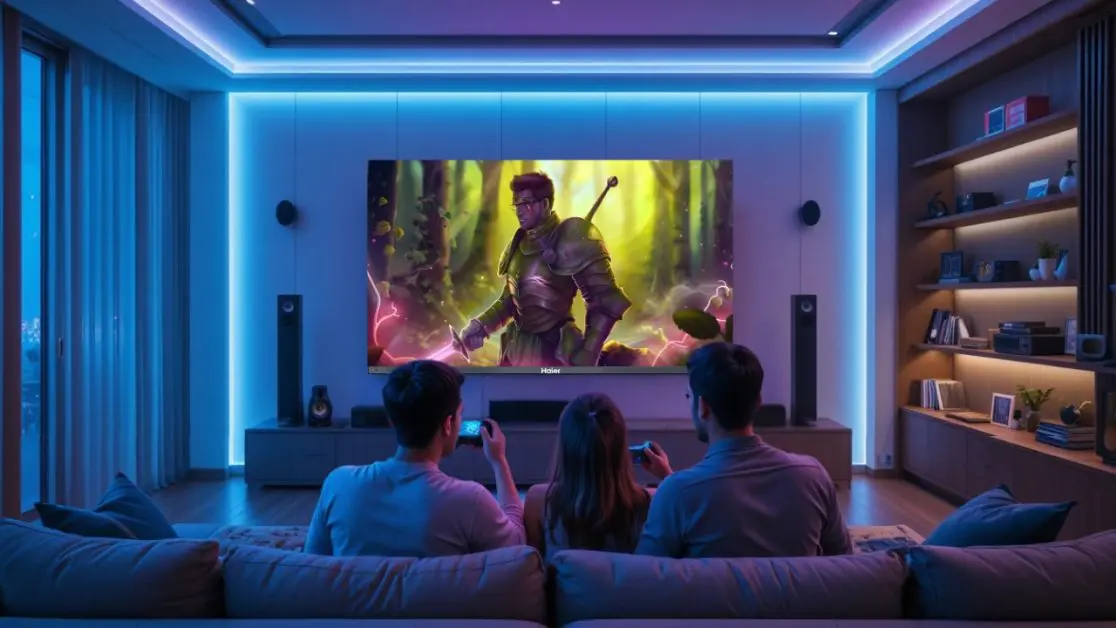
Gaming today is not limited to a single setup.
Most households rotate between three formats:
1. Console gaming
PlayStation and Xbox benefit from HDMI 2.1, high refresh rates, and low input lag.
2. PC gaming on TV
Increasingly common, especially in compact homes. A powerful PC connected to a large screen offers flexibility.
3. Cloud gaming
Streaming games rely heavily on processing, motion handling, and consistent display performance.
A big-screen TV that supports all three becomes future-ready.
It removes the need to choose between formats.
What parents notice first
Parents are often sceptical about gaming upgrades.
Until they see the difference.
On a large screen in a shared space:
- Gaming becomes visible instead of hidden
- Screen clarity reduces eye strain
- Time limits become easier to manage
- Energy-saving modes control consumption
When gaming moves into common areas, conversations follow naturally.
Boundaries become clearer. Participation becomes possible.
Visibility changes behaviour.
AI in gaming TVs is about responsibility
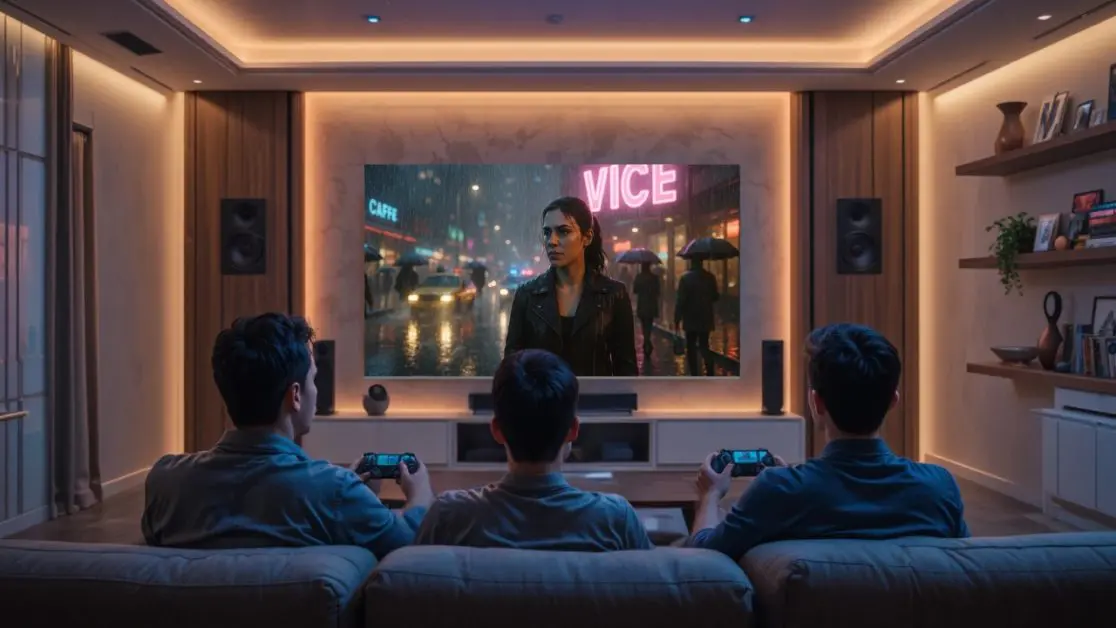
AI in modern TVs is not about novelty.
It is about decision-making.
Advanced processors analyse scenes in real time. They adjust brightness, contrast, motion, and sound based on what is happening on screen.
For gaming, this means:
- Automatic game mode activation
- Reduced input lag without manual toggles
- Scene-by-scene optimisation
In systems like the AI engine used in the Haier New M96 Series 254cm (100) QD Mini LED AI Smart Google TV (H100M96FUX), picture, sound, and gaming performance are coordinated as one system rather than separate features .
The TV takes responsibility.
You stay immersed.
Design matters when the screen is always visible
A gaming TV is also furniture.
Ultra-slim profiles, clean wall mounting, hidden wiring. These details matter when the screen lives in a shared space.
A well-designed TV blends into the room when switched off.
When switched on, it transforms the space.
That balance defines modern living.
Energy efficiency enables longer sessions
Long gaming sessions raise practical questions.
Heat. Power consumption. Sustainability.
Modern TVs now include adaptive energy-saving modes that manage brightness without compromising clarity. Standby power drops. Panels handle heat better.
This makes extended gaming realistic, even in Indian weather conditions.
Efficiency enables indulgence without guilt.
What big screen gaming really changes
It is not about higher scores.
It is about intent.
- Gaming becomes social
- Gaming becomes immersive
- Gaming becomes deliberate
You plan sessions. You sit comfortably. You finish games.
Distraction reduces. Engagement rises.
The bigger picture
Big screen gaming reflects a broader shift in how homes are designed.
Experiences matter more than devices. Systems matter more than features. Intelligence replaces manual control.
A TV is no longer just a display. It is a context-aware system that adapts to how you live.
Gaming simply reveals that shift more clearly than anything else.
The future of gaming is not about pixels. It is about presence.
And in that future, the most meaningful upgrade is not the console.
It is the screen that brings everything together.
Frequently Asked Questions
I already have a decent TV. Do I really need to upgrade for gaming?
If your current TV lacks 120Hz refresh rate, HDMI 2.1, low input lag, or VRR support, you’re not seeing what modern consoles can actually deliver. The difference isn’t just size it’s smoothness, clarity, and responsiveness. If gaming feels slightly laggy or blurry during fast motion, your TV may be the bottleneck.
Is a bigger screen just hype, or will I actually feel the difference?
You will feel it. A larger screen fills more of your field of view, which improves immersion and spatial awareness. Reaction timing improves because details are easier to spot. Open-world games feel expansive. Racing feels faster. Sports games feel broadcast-like.
I’m a parent. Will a bigger screen make gaming worse for my kids?
Surprisingly, no when placed in a shared living space.
Big-screen gaming in the living room increases visibility. You see what they’re playing. Conversations happen naturally. Screen time becomes easier to manage because it’s not hidden in a bedroom.
Does a larger screen strain the eyes more?
Not necessarily. In fact, better clarity, brightness control, and higher refresh rates can reduce strain. QD Mini LED panels maintain deep contrast and avoid washed-out highlights, which makes scenes easier to process visually.
My console says 120Hz, but my games still don’t feel smooth. Why?
Because refresh rate alone doesn’t guarantee smooth gameplay. You need:
120Hz or 144Hz panel
HDMI 2.1 support
VRR (Variable Refresh Rate)
Low input latency
If one element is missing, motion can still stutter or tear.
What exactly does VRR or AMD FreeSync Premium Pro do for me?
They synchronize your console/GPU with the TV’s refresh rate.
Result: No screen tearing. No inconsistent motion. Cleaner gameplay during fast scenes.
What does QD Mini LED actually change during gameplay?
It improves three things simultaneously:
Dark scenes stay detailed (great for horror/stealth games)
Bright explosions don’t wash out
Fast motion stays sharp
On models like the Haier M96 Series, local dimming + quantum dot color work together instead of fighting each other.