
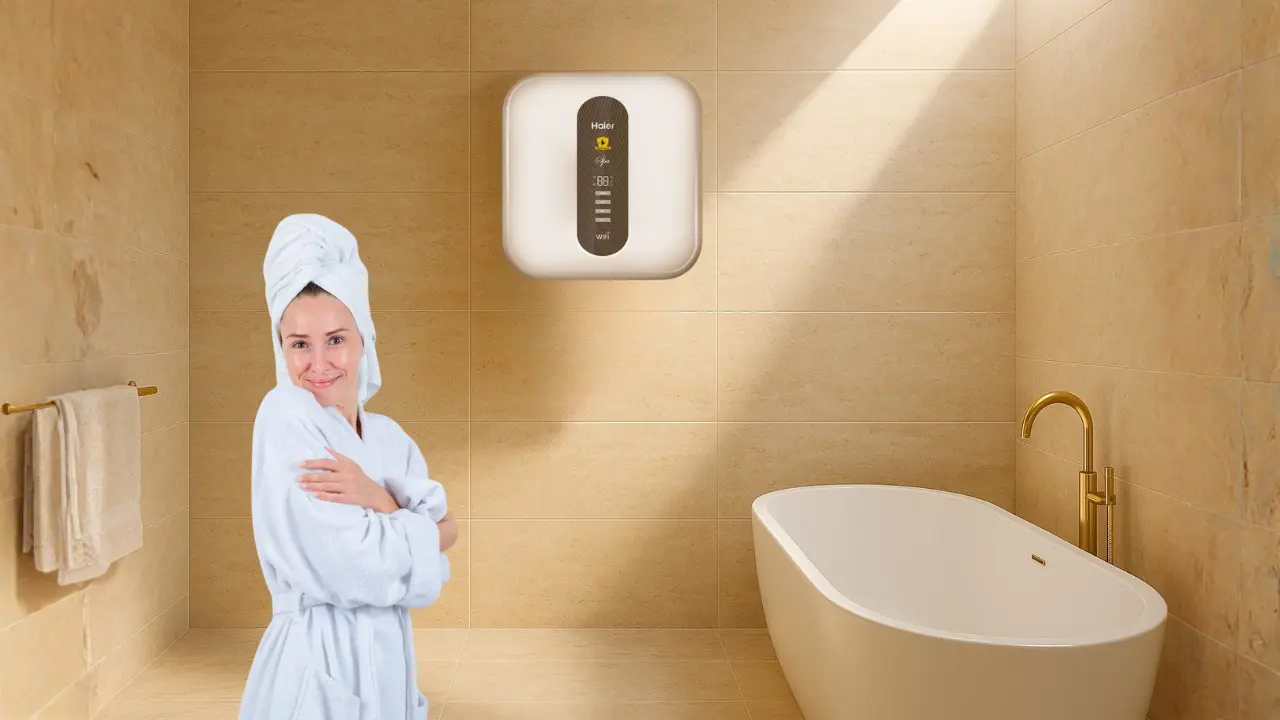

Haier water heaters are built for safe everyday use by combining shock protection, dual thermal cut-offs, bacteria-resistant heating modes, high-pressure tolerance, and corrosion-resistant materials into one tightly engineered system.
They are not designed just to heat water.
They are designed to reduce risk.
Electrical risk. Pressure risk. Hygiene risk. And the slow risk of wear over time.
Because in Indian homes, safety is not dramatic. It is daily.
A bathroom is the most electrically sensitive room in your home.
Step inside your bathroom.
Wet floors. Bare feet. Metal taps. Enclosed walls. Humidity hanging in the air.
Now add an electrical appliance filled with water.
This is why water heater safety is not a luxury. It is architecture.
Across urban India, storage water heaters remain the most common solution for winter comfort. According to industry data, a large majority of households rely on them daily during colder months.
The real question is not:
“Does it heat water?”
It is:
“Does it protect my home every single day without asking for attention?”
Haier water heaters are built around that second question.
Shock protection is not a feature. It is a mindset.

Electrical leakage is one of the biggest concerns with any water heater.
Haier integrates Shock Proof technology that reduces rated voltage to safer levels in case of leakage. Instead of passing unsafe current through the system, the appliance lowers risk internally.
That is critical in Indian homes where:
- Voltage fluctuations are common
- Bathrooms are compact
- Appliances run on shared electrical lines
Add to this IPX4 water resistance and voltage fluctuation protection, and you get layered defense.
| Risk Factor | Everyday Concern | Haier Response |
| Leakage current | Shock exposure | Shock Proof voltage reduction |
| Water splash | Internal short circuit | IPX4 water resistance |
| Voltage fluctuation | Component damage | Voltage protection system |
Safety should not depend on reflexes. It should depend on design.
When systems absorb risk before users feel it, homes feel calmer.
Dual thermal protection prevents the silent failures
Overheating rarely announces itself.
A thermostat ages.
Hard water builds scale.
Temperature rises beyond safe limits.
Haier water heaters use Dual Thermal Proof technology with two independent overheat protections.
- The first layer stops heating around 75°C.
- The second layer cuts off power around 95°C if the first layer fails.
Redundancy.
Airplanes use redundancy. Hospitals use redundancy. Safe appliances use redundancy.
The safest systems assume something will fail and prepare for it.
This approach protects:
- The heating element
- Internal wiring
- The tank structure
- And most importantly, the user
Clean water is part of safety
Safety is not only about electricity.
It is also about hygiene.
In humid Indian climates, stagnant water inside tanks can encourage bacterial growth, especially in homes where bathrooms are not used daily.
Haier water heaters include a Bacteria Proof System mode that heats water up to 80°C to inhibit bacteria.
This matters for:
- Families with children
- Elderly parents
- Guest bathrooms that remain unused for days
- Homes in high-humidity cities
Water safety is invisible until it becomes visible.
Prevention is always quieter than cure.
Pressure resilience is urban India’s hidden requirement

High-rise living has changed plumbing realities.
In tall apartment buildings, water pressure increases significantly. A water heater that cannot handle that pressure becomes a liability.
Haier water heaters are designed with 8 bar rated pressure capability, making them suitable for high-rise installations.
Add to that the MUV valve system, which combines:
- Pressure relief
- Anti-vacuum function
- Non-return valve
- Water drainage
Now pressure is controlled at multiple levels.
One component alone is protection.
Multiple components together are safe.
Durability is safety stretched over time
Most failures do not happen in year one.
They happen in year five.
Corrosion builds slowly.
Hard water deposits accumulate.
Internal metal weakens.
Haier addresses this through material science:
- Glass-lined tank for corrosion resistance
- Incoloy 800 stainless steel heating element
- Magnesium rod to reduce internal rusting
Each layer serves a purpose.
| Component | Safety Role | Long-Term Benefit |
| Glass-lined tank | Reduces corrosion | Strong tank structure |
| Incoloy 800 element | Resists oxidation and scaling | Longer element life |
| Magnesium rod | Absorbs corrosive reactions | Reduced internal rust |
When structure stays strong, safety remains consistent.
Durability is not about lifespan alone.
It is about maintaining safety performance across years.
Fast heating reduces risky alternatives
Here is something we rarely admit.
When water takes too long to heat, people improvise.
Immersion rods.
Gas stove heating.
Bucket transfers.
Unsafe habits begin with inconvenience.
Haier water heaters use high-power heating elements, up to 2000W in certain models, enabling faster heating.
Combine that with superior PUF insulation that retains heat longer, and you reduce:
- Reheating cycles
- Energy waste
- Thermal stress
Convenience is a safety feature when it removes unsafe behavior.
Smart features add predictability
Modern Haier water heaters integrate:
- LED display
- Smart timer
- Smart memory
- Remote control capability
Timers prevent unnecessary heating cycles.
Memory retains preferred settings.
Remote access reduces the need to adjust controls in wet conditions.
Small frictions often lead to small mistakes.
Reducing friction increases safety.
Three real-life use cases
Different homes. Different priorities. Same safety logic.
1. The Working Professional Living Solo
Long hours. Irregular schedules.
Smart timers and memory reduce decision fatigue.
Cost: Slightly higher upfront investment.
Benefit: Lower energy waste. Higher predictability.
2. The Family with Children
Morning rush. Shared bathrooms.
Shock protection and dual thermal cut-offs add reassurance during peak usage.
Cost: Routine servicing.
Benefit: Reduced risk exposure.
3. The High-Rise Apartment Couple
Strong water pressure. Compact bathrooms.
8 bar rating and MUV valve become essential, not optional.
Cost: Proper installation planning.
Benefit: Structural safety under pressure.
Different lifestyles.
Same invisible system.
Warranty reflects engineering confidence
Long warranties are signals.
Many Haier water heaters offer extended coverage, including multi-year product warranties and longer tank warranties.
Manufacturers rarely promise what they cannot support.
Warranty length reflects confidence in:
- Tank durability
- Heating element strength
- Structural reliability
Trust is built on what lasts.
Safety is not dramatic. It is designed.
We live in a world that celebrates visible innovation.
Screens.
Apps.
Connectivity.
But the most meaningful innovation is invisible.
Thermostats.
Pressure valves.
Insulation layers.
Material science.
Haier water heaters are built on layered protection:
- Shock Proof technology
- Dual thermal cut-offs
- Bacteria-resistant heating modes
- High-pressure tolerance
- Corrosion-resistant construction
- Energy-retaining insulation
Each layer protects a different risk.
Together, they create everyday safety.
A water heater sits quietly on your wall.
It does not demand attention.
It does not ask for applause.
But it interacts with your skin every single day.
And when an appliance touches your body daily, safety is not a feature.
It is the foundation.
The best appliances are the ones you never worry about.
Frequently Asked Questions
I’m overwhelmed by specs. How do I know if a Haier water heater is actually safer or just marketed that way?
Look for layered safety systems, not single features. Haier models combine Shock Proof voltage reduction, dual thermal cut-offs, pressure-rated tanks (8 bar), and corrosion-resistant materials. Safety isn’t one checkbox, it’s multiple independent protections working together.
I live alone and just want something reliable. Do I really need all these safety layers?
Yes. Electrical leakage, overheating, and pressure fluctuations don’t depend on family size. Layered protection reduces daily risk even in solo households, especially in compact urban bathrooms.
I keep delaying buying a new heater because I can’t decide. What should I prioritize first, speed, safety, or durability?
Prioritize safety architecture first (shock protection + dual thermal cut-offs), then pressure compatibility (8 bar for high-rises), and finally heating speed and smart features. Speed is comfort, safety is foundation.
I don’t use my guest bathroom for days. Does water sitting inside the tank become unsafe?
Stagnant water in humid climates can encourage bacterial growth. Haier’s Bacteria Proof mode heats water up to 80°C, helping inhibit bacteria buildup during low-usage periods.
I have elderly parents at home. Is overheating a real concern?
Yes. Aging thermostats and scale buildup can silently increase temperature. Dual Thermal Proof technology cuts heating at ~75°C and fully shuts off around 95°C if needed, adding redundancy for safety-sensitive households.
My bathroom is always humid. Does that increase electrical risk?
Humidity increases sensitivity to leakage and short circuits. Haier’s IPX4 water resistance and internal voltage reduction mechanisms reduce that environmental risk.
Get impatient when water heats slowly and sometimes use immersion rods. Is that risky?
Yes. Improvised heating methods increase electrical and burn risks. Haier’s 2000W heating elements reduce wait time, discouraging unsafe alternatives.
Does faster heating damage the heater faster?
Not if the element is built for it. Incoloy 800 stainless steel elements resist scaling and oxidation, balancing speed with durability.
I reheat water multiple times a day. Is that inefficient?
It can be. Superior PUF insulation reduces heat loss, minimizing reheating cycles and thermal stress on components.
I forget to switch my heater off. Will smart features actually help?
Yes. Smart timers and memory functions reduce unnecessary heating cycles and energy waste, especially for irregular schedules.