

Modern water heaters prevent accidental overheating using dual thermostats, thermal cut-offs, pressure control valves, shock-proof systems, and high-retention insulation that automatically stop heating before temperatures become unsafe.
They are not just heating devices.
They are safety systems with a heating function.
And in Indian homes where mornings are tightly scheduled and bathrooms are shared, that difference matters.
Overheating does not happen dramatically. It builds quietly.
Picture a weekday morning.
One person rushing for work.
Another getting children ready.
Someone switches on the water heater and forgets.
Life moves.
The appliance keeps running.
According to India’s Bureau of Energy Efficiency, water heating can account for nearly one-fifth of a household’s electricity usage. When heating continues unchecked, internal temperatures rise beyond optimal levels. Pressure increases. Components strain.
Overheating creates three silent risks:
- Excessive water temperature beyond safe bathing levels
- Increased internal tank pressure
- Accelerated wear on heating elements
The danger is not loud. It is cumulative.
That is why protection against accidental overheating is not optional in modern water heaters. It is foundational.
What Actually Causes Accidental Overheating?
Overheating rarely comes from one dramatic breakdown. It comes from layered stress.
Here are the common triggers:
1. Single thermostat failure
One sensor fails to cut power.
2. High-rise pressure variation
Multi-storey buildings often experience higher water pressure.
3. Voltage fluctuations
Sudden spikes push heating elements harder than intended.
4. Repeated reheating cycles
Poor insulation forces frequent heating, increasing thermal stress.
The pattern is clear.
Risk multiplies when control systems are limited.
So modern water heaters respond with layered protection.
Dual Thermal Protection: Two Levels of Intelligence
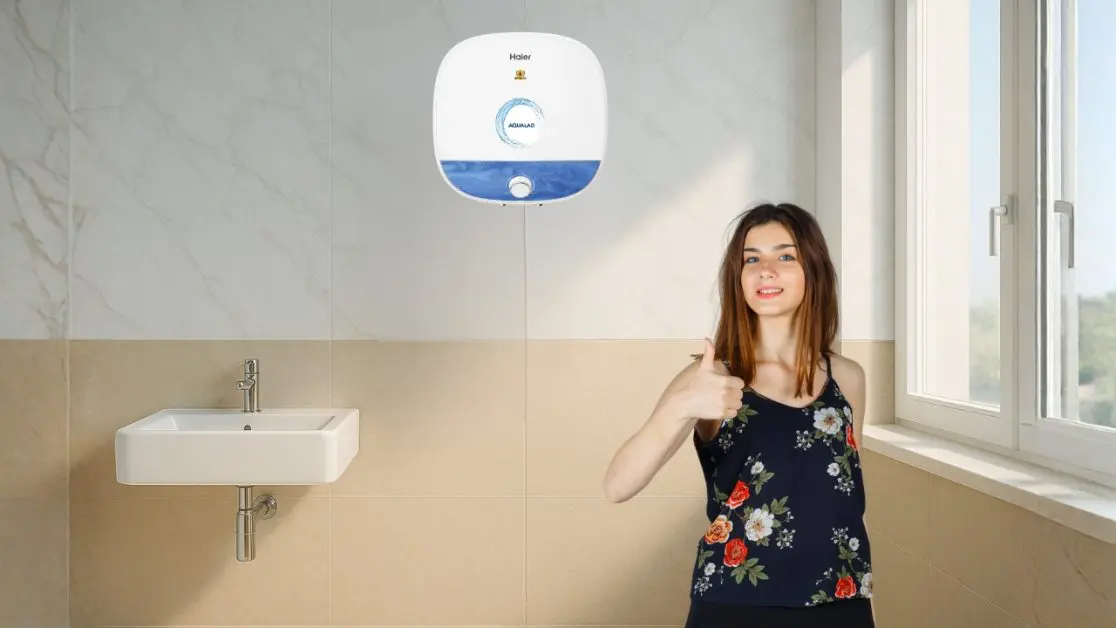
Let us look at the Haier 15L Square AQUALAD PRO 5 Star Water Heater (ES15V-AQUALAD PRO).
It features Dual Thermal Proof technology with two independent sensors.
Here is what that means in practical terms:
- First overheat protection cuts heating at 75°C
- Second emergency cut-off activates at 95°C
If the first control point fails, the second takes over.
That redundancy is not an upgrade.
It is disciplined engineering.
The Haier 25L Square AQUALAD PRO 5 Star Water Heater (ES25V-AQUALAD PRO) uses the same dual safety mechanism.
Two sensors. Two checkpoints.
One goal: prevent accidental overheating.
Systems that assume failure build resilience.
Systems that assume perfection break under pressure.
Shock Proof Technology: Safety Beyond Temperature
Bathrooms combine electricity and water. That alone demands caution.
The Shock Proof system built into both AQUALAD PRO models converts rated voltage into safer levels in case of leakage .
This protects against:
- Electrical leakage shocks
- Wet-environment voltage risks
- Sudden current irregularities
It works automatically. No switches. No manual reset.
The benefit is peace of mind.
The cost is a slightly more complex internal design.
Is it worth it? Every time.
MUV Valve: Managing Pressure Before It Escalates
Water expands when heated. That expansion increases internal tank pressure.
In high-rise Indian apartments, water pressure can reach significant levels. Both the Haier 15L Square AQUALAD PRO 5 Star Water Heater (ES15V-AQUALAD PRO) and the Haier 25L Square AQUALAD PRO 5 Star Water Heater (ES25V-AQUALAD PRO) are rated for 8 bar working pressure .
The MUV valve performs multiple roles:
- Pressure relief system
- Anti-vacuum device
- Non-return valve
- Controlled drainage support
It regulates expansion before it becomes stressed.
Think of it as a safety vent in a pressure cooker.
It allows controlled release instead of explosive build-up.
Protection against accidental overheating is incomplete without pressure management.
Bacteria Proof System: High Heat, Controlled Heat
The BPS mode heats water up to 80°C to deactivate bacteria .
At first glance, this sounds unrelated to overheating protection. It is not.
There is a difference between controlled high heat and uncontrolled overheating.
- Controlled high heat sanitises.
- Uncontrolled overheating damages.
Modern water heaters are designed to handle high temperatures safely because they regulate those temperatures precisely.
That is the difference between power and discipline.
Adjustable Power: Slowing Down the Heat Curve

Both models offer 1/2/3 kW rated power options .
Why does adjustable power matter for overheating?
Because speed affects stress.
One option is 3 kW
Faster heating. Ideal for rushed mornings.
The second option is 2 kW
Balanced heating for regular use.
The third option is 1 kW
Energy-efficient. Reduced thermal load.
Lower power means slower temperature rise.
Slower rise means lower stress on elements and thermostats.
The cost-benefit trade-off:
- High power: quicker heating, higher load
- Lower power: slower heating, gentler system performance
Choice reduces strain.
Reduced strain lowers overheating risk.
Insulation: The Silent Overheating Protector
Both models use PUF insulation to retain heat longer .
Insulation is often marketed for energy savings. That is only half the story.
Better insulation means:
- Fewer reheating cycles
- Reduced thermal expansion stress
- Lower electrical load bursts
Frequent reheating increases element wear.
Stable retention reduces overheating risk over time.
Efficiency and safety often travel together.
Comparison: Basic Heater vs Protected Heater
| Feature | Basic Heater | Haier AQUALAD PRO Models |
| Thermostat | Single | Dual Thermal Proof |
| Overheat Cut-Off | One level | 75°C + 95°C |
| Pressure Rating | 6 bar typical | 8 bar rated |
| Shock Protection | Limited | Shock Proof system |
| Power Control | Fixed | 1/2/3 kW adjustable |
| Insulation | Standard | PUF high retention |
Protection against accidental overheating is not one feature.
It is a coordinated system.
Why This Matters in Real Homes
Parents look for safety.
Working professionals look for predictability.
New homeowners look for reliability.
Protection against accidental overheating solves all three.
It reduces risk.
It extends appliance life.
It stabilises energy usage.
And most importantly, it works without demanding attention.
The best safety systems are invisible.
What Should You Check Before Buying?
Ask five clear questions:
1. Does the water heater have dual thermostats?
2. Is there an automatic cut-off beyond 75°C?
3. Is it rated for at least 8 bar pressure?
4. Does it include a multi-function safety valve?
5. Can the power level be adjusted?
If the answer is yes, you are looking at modern protection.
If not, you are relying on hope.
The Bigger Principle
Accidental overheating is not a dramatic event. It is a gradual escalation.
Modern water heaters like the Haier 15L Square AQUALAD PRO 5 Star Water Heater (ES15V-AQUALAD PRO) and the Haier 25L Square AQUALAD PRO 5 Star Water Heater (ES25V-AQUALAD PRO) prevent that escalation through layered safeguards.
Two sensors.
Pressure regulation.
Shock protection.
Controlled power.
Stable insulation.
Good systems assume stress will come.
Great systems prepare for it in advance.
Sometimes safety is not about reacting quickly.
It is about designing so nothing unsafe happens at all.
Frequently Asked Questions
I’m buying a water heater for the first time. Do I really need dual thermostats or is that just marketing?
Dual thermostats aren’t marketing, they’re redundancy.
In models like the Haier 15L Square AQUALAD PRO 5 Star Water Heater and Haier 25L Square AQUALAD PRO 5 Star Water Heater, two independent sensors monitor temperature:
First cut-off at 75°C
Emergency cut-off at 95°C
If one fails, the second prevents overheating. That’s layered protection, not branding.
Is 8 bar pressure rating really necessary for my apartment?
If you live in a multi-storey building or high-rise, yes.
Higher floors often experience pressure variation. An 8-bar rated tank handles expansion safely, reducing internal strain and long-term damage.
Think of it as future-proofing against plumbing unpredictability.
I don’t want to overthink this. What are the 5 must-check safety features before I buy?
Ask yourself:
Does it have dual thermostat protection?
Is there an automatic cut-off beyond 75°C?
Is it rated for 8 bar pressure?
Does it include a multi-function safety (MUV) valve?
Can I adjust power (1/2/3 kW)?
If yes you’re choosing modern protection, not basic heating.
I switched on my geyser and forgot it for hours. Is that dangerous?
In older single-thermostat heaters, it could cause:
Excessive water temperature
Rising internal pressure
Heating element stress
In dual-protection systems, heating stops automatically before unsafe levels.
Overheating doesn’t explode dramatically. It builds quietly.
Modern safety systems interrupt that buildup.
Does heating water to 80°C for bacteria mode increase overheating risk?
No, not when it’s controlled.
BPS (Bacteria Proof System) mode heats up to 80°C intentionally and safely.
There’s a difference between:
Controlled high heat (sanitisation)
Uncontrolled overheating (system stress)
Modern systems regulate temperature precisely; that’s the key distinction.
My kids use the bathroom alone sometimes. Can the water get dangerously hot?
With dual cut-off systems, temperatures are capped automatically.
The first protection stops heating at safe limits. The second acts as backup.
This reduces scalding risk especially important for children and elderly users.