
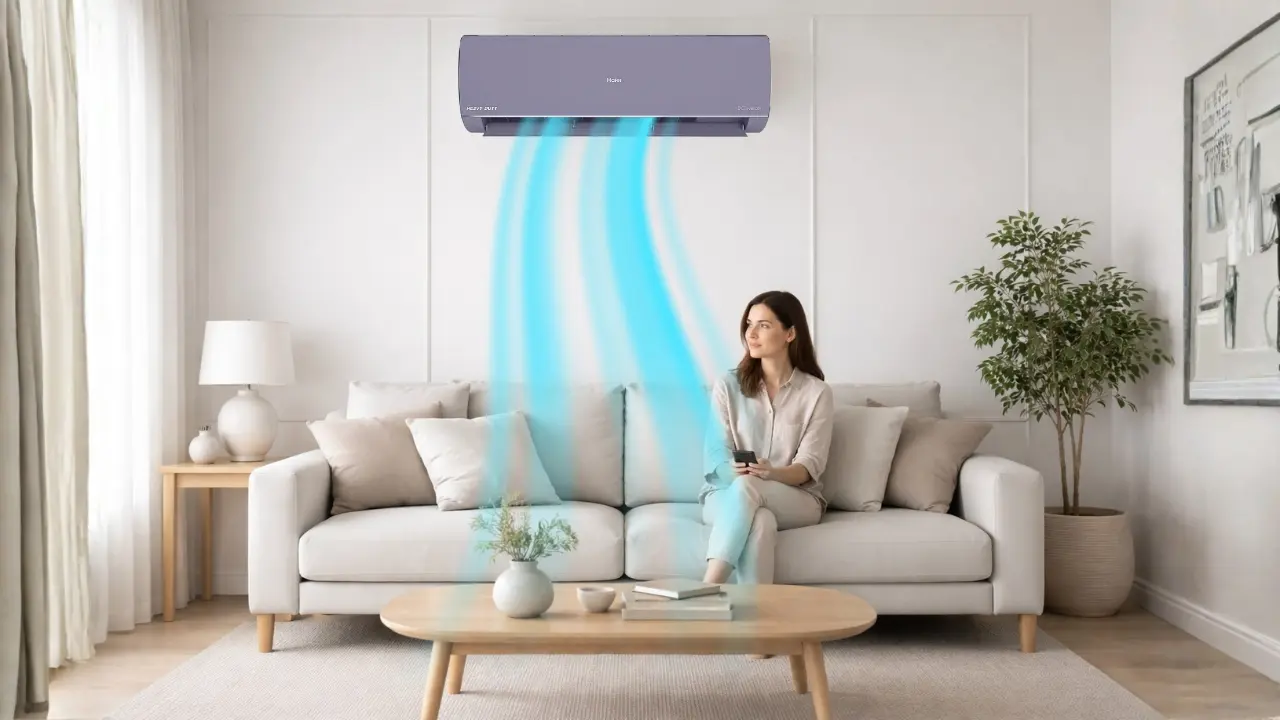

Targeted cooling feels more comfortable because it directs cool air exactly where it is needed instead of chilling the entire room.
This reduces temperature imbalance, cuts energy waste, and helps the body cool faster. In Indian homes, where rooms are multi-purpose and electricity costs matter, targeted cooling creates comfort without excess.
That is the short answer.
Now let us talk about why it feels so different in real life.
Comfort is not about degrees. It is about direction.
Walk into a typical Indian living room in May.
The AC is on. The display reads 24°C.
But one person near the window feels warm. Another under the vent pulls a shawl over their shoulders. Someone on the sofa adjusts the swing again.
Same temperature. Different experiences.
This is the hidden system most people ignore.
Traditional air conditioning cools volume.
Human comfort depends on location.
According to the Bureau of Energy Efficiency, room air conditioners account for nearly 40 percent of peak residential electricity demand in Indian summers. Yet studies by ASHRAE show that perceived comfort depends more on air movement and direction than just room temperature.
The gap between cooling air and cooling people is where targeted cooling lives.
Why Whole-Room Cooling Often Feels Uneven
Most conventional ACs operate on a simple logic.
- Sense average room temperature
- Cool until that target is reached
- Stop
- Repeat
The assumption is that rooms behave uniformly.
They do not.
Indian homes especially do not.
- Sunlight shifts across balconies
- Kitchens release heat during cooking
- Doors open and close constantly
- Families move between rooms
A 2023 Central Electricity Authority report notes that urban Indian homes experience voltage and load variation during peak hours. That variation affects compressor cycles and airflow consistency.
Which means comfort fluctuates.
Targeted cooling solves a different problem. It asks: Where is the person? Not just: What is the room temperature?
That shift changes everything.
What Is Targeted Cooling in Simple Terms?
Targeted cooling directs airflow toward a specific zone instead of spreading it evenly across the entire space.
On systems like the Haier AI Atmox powered AC platform, AI Target Cooling uses installation data and AI cloud services to deliver cooling directly to the desired area for enhanced comfort.
Instead of flooding the whole room, the system adjusts airflow direction intelligently.
It cools the person first.
Then balance the room.
That sequence feels faster.
And more natural.
Three Ways Cooling Strategies Shape Comfort
There are usually three approaches inside Indian homes.
One option is Lowering the Temperature
Set the AC to 20°C.
Benefits:
- Quick perceived cooling
- Simple to operate
Costs:
- Higher electricity bills
- Uneven cooling
- Overcooling certain spots
According to the International Energy Agency, every 1°C lower setting increases electricity consumption by 6 percent.
Lower temperature feels powerful. It is expensive power.
The second option is Increasing Fan Speed
Push more air.
Benefits:
- Faster air movement
- Short term relief
Costs:
- Noise
- Draft discomfort
- Still uneven distribution
More air is not always smarter air.
The third option is Targeted Cooling
Direct air precisely where needed.
Benefits:
- Faster comfort
- Reduced energy waste
- Balanced airflow
Costs:
- Requires smarter sensing
- Depends on correct installation
It is economically efficient and requires less aggressive cooling.
And that is why it feels better.
Why the Body Responds Faster to Directed Airflow
Comfort is biological.
When cool air hits exposed skin, the body’s heat dissipation improves immediately. Research from thermal comfort studies shows that localized airflow increases perceived cooling without requiring large drops in ambient temperature.
In simpler words:
Your body reacts to movement before it reacts to numbers.
Targeted cooling leverages that.
Systems like AI Target Cooling adjust airflow position using installation data and cloud intelligence.
That is not a gimmick.
It is a physics meeting software.
Indian Homes Demand Adaptive Cooling
Indian households are rarely static environments.
Morning:
Work calls in the bedroom.
Afternoon:
Kids studying in the living room.
Evening:
Cricket match on TV.
Night:
One person sleeping, another scrolling.
The same room hosts multiple climates in a single day.
According to industry data from Statista, India’s residential AC penetration continues to rise, especially in Tier 2 cities where compact apartments amplify cooling imbalance.
Targeted cooling becomes practical here.
It reduces the need to freeze the entire room for one person’s comfort.
That is efficient design.
Energy Savings Are a Comfort Multiplier
Comfort is emotional too.
When electricity bills arrive in summer, they influence how freely families use their ACs.
AI Eco 2.0 systems, as described in Haier AI Atmox shift automatically between L1, L2, and L3 modes depending on the temperature gap.
When targeted cooling works with such intelligent eco adjustments, the system avoids overcooling empty spaces.
This matters.
India’s average urban household spends a significant portion of its summer electricity bill on cooling. According to the Ministry of Power, cooling demand will triple by 2037.
Targeted cooling reduces that burden.
Comfort that respects cost lasts longer.
A Simple Comparison
| Cooling Approach | Speed of Comfort | Energy Use | Room Balance | Long-Term Cost |
| Lower Temp Only | Medium | High | Uneven | High |
| High Fan Mode | Fast | Medium | Uneven Draft | Medium |
| Targeted Cooling | Fast | Optimized | Balanced | Lower |
The table tells a quiet story.
Precision beats intensity.
The Hidden System Behind Why It Feels Personal
Most discomfort comes from mismatch.
Room size mismatch.
Airflow mismatch.
Occupancy mismatch.
AI Climate Control systems combine environmental data, human detection, and usage learning to adjust performance automatically.
This learning matters.
It tracks mode usage, duration, and power data to build a personalized model.
When the AC adapts to how your family actually lives, comfort feels intuitive.
Not mechanical.
Targeted Cooling and the Future of Indian Living
Here is the bigger picture.
India is urbanizing rapidly. Compact apartments, hybrid work, rising electricity demand, and climate variability are reshaping how homes function.
Cooling systems can either respond reactively or think proactively.
Targeted cooling represents a shift from volume based thinking to presence based thinking.
From cooling space to cooling experience.
That difference defines the next decade of home design.
What This Means for Everyday Decisions
When choosing cooling systems, the question is not:
“How powerful is it?”
The better question is:
“How intelligently does it direct power?”
One option chases lower temperatures.
The second pushes more air.
The third directs air precisely.
Only one respects both comfort and cost.
The Memorable Insight
Comfort is not about making the room colder. It is about making the right spot cooler.
That is the line worth remembering.
Targeted cooling feels more comfortable because it aligns technology with human presence.
In real Indian homes, that alignment matters.
Less overcooling.
Less argument over remote settings.
Lower bills.
Quieter evenings.
And a home that feels sorted without anyone noticing why.
That is not just smarter air.
That is smarter living.
Frequently Asked Questions
Why does my AC say 24°C but I still feel warm?
Because comfort depends on airflow direction and skin exposure, not just average room temperature. If cool air isn’t reaching you directly, your body won’t cool efficiently even if the display looks ideal.
Should I just set my AC to 20°C to cool faster?
Lowering the temperature can create quick relief, but it increases electricity consumption significantly (about 6% more energy per 1°C drop, according to the International Energy Agency). It may also overcool certain areas while leaving others warm.
Why do we keep fighting over the remote in my living room?
Because traditional ACs cool volume, not people. One person under the vent feels cold, another near the window feels warm. Targeted cooling reduces this imbalance by directing airflow to occupied zones.
How do I choose between more power and smarter airflow?
More power increases cooling intensity. Smarter airflow increases cooling precision. Precision typically delivers faster comfort with lower long-term cost.
Is targeted cooling worth it for my compact apartment?
Yes, especially in Indian urban homes where rooms are multi-purpose and airflow patterns shift throughout the day.