
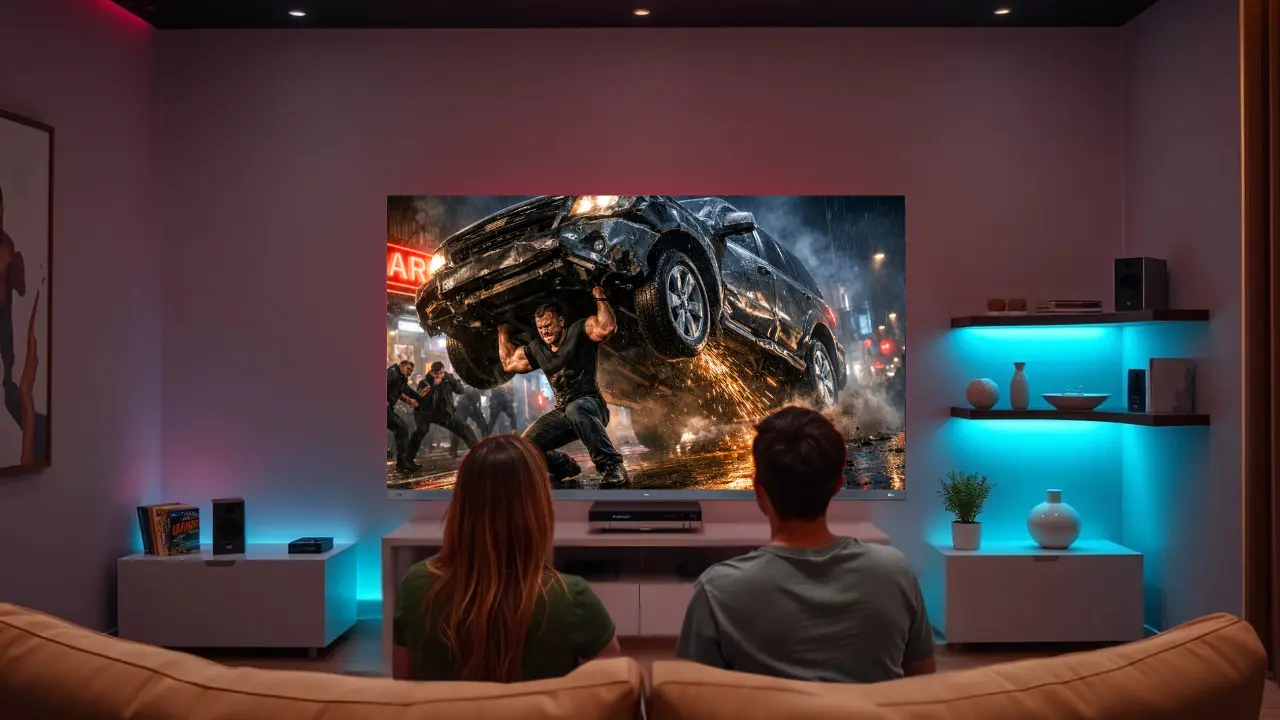

Designed for cinematic storytelling means televisions built to reproduce movies, sports, and shows the way creators intended.
It combines large displays, intelligent picture processing, immersive sound, and smooth motion so everyday viewing feels closer to a theater experience inside a normal living room.
That is the simple answer.
But the real story starts somewhere familiar.
A Friday evening.
The lights dim slightly. Someone opens Netflix. Someone else brings chai and a bowl of roasted peanuts. A cricket highlight begins. Or a new movie trailer.
And suddenly the living room becomes a small cinema.
The question is not whether people love stories.
The question is whether our screens are built to respect those stories.
Because cinematic storytelling demands more than just a big screen.
Why cinematic storytelling matters inside modern homes
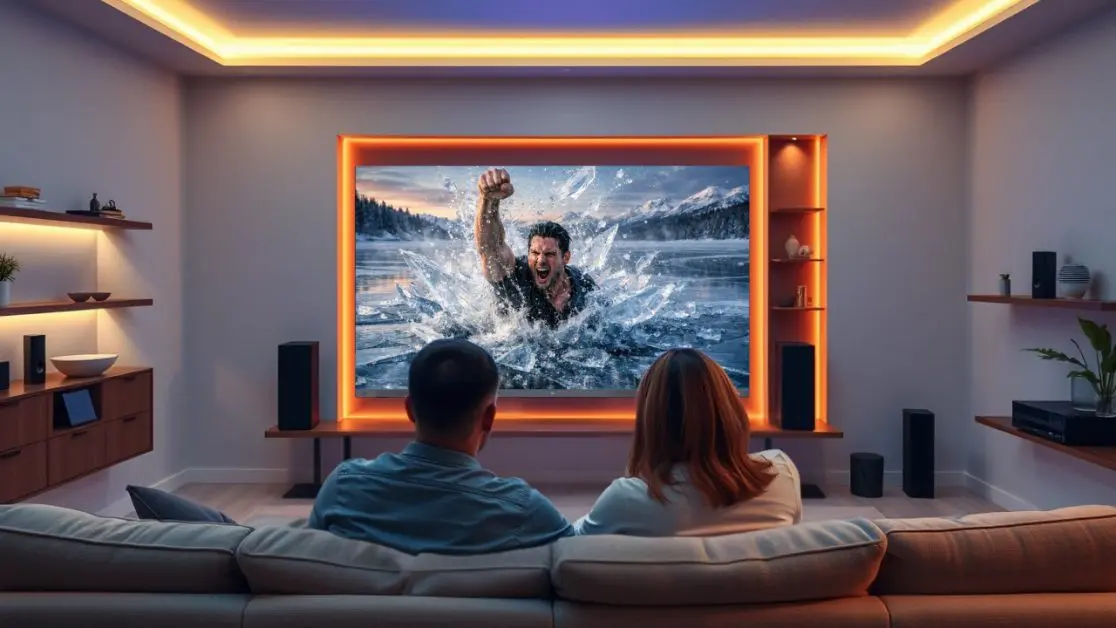
Stories shape evenings.
Look closely at how Indian households use their televisions today.
Morning news during chai.
Kids watching animated shows after school.
IPL matches fill the room with commentary and excitement.
Late night streaming after work.
Television is no longer an occasional device. It is infrastructure.
When viewing time rises, expectations rise with it.
People want:
- Sharper images
- Better motion for sports
- Deeper sound for movies
- Simpler control for everyday use
This is where cinematic storytelling enters the conversation.
A cinematic TV does not simply show content.
It interprets it.
The hidden system behind cinematic televisions
A cinematic viewing experience depends on multiple technologies working together.
Not one feature.
A system.
Let us break it down.
1. The screen that controls light
Light defines cinema.
In traditional displays, brightness spreads evenly across the screen. That creates washed out blacks and less contrast.
Modern technologies such as QD Mini LED displays solve this by using hundreds or even thousands of tiny lighting zones that adjust brightness independently.
For example, the Haier Mini LED televisions in the M92 series use hundreds of local dimming zones to control light precisely.
What does that mean in everyday life?
- Dark scenes stay deep and detailed
- Bright explosions remain vivid
- Subtle shadows stay visible
In cinema terms, contrast creates emotion.
Without contrast, drama disappears.
2. The processor that understands scenes
Movies change constantly.
One moment a quiet dialogue scene.
Next moment a chase through crowded streets.
Modern TVs now use AI processors that analyze every frame.
Haier’s AI Ultra Sense Processor recognizes scenes and automatically adjusts color, motion, and contrast in real time.
The result is subtle but powerful.
A cricket ball remains clear during a fast delivery.
Night scenes keep detail instead of turning grey.
The processor becomes the quiet editor behind the screen.
3. Motion that keeps up with the action
Fast motion reveals weak displays instantly.
Think about:
- A football match
- A Formula 1 race
- A Marvel action scene
Without high refresh rates, images blur.
Modern cinematic TVs use 144Hz refresh rates, allowing the screen to redraw images 144 times per second.
The difference is dramatic:
| Scenario | Standard TV | Cinematic TV |
| Sports motion | Slight blur | Clear ball movement |
| Action scenes | Judder or lag | Smooth tracking |
| Gaming | Frame tearing | Fluid gameplay |
Motion clarity is not luxury.
It is storytelling accuracy.
Sound is half the story
Cinema never relied on visuals alone.
Sound creates tension.
Footsteps echo in a hallway.
Rain falls quietly behind dialogue.
A crowd roars in a stadium.
Many televisions treat sound as an afterthought.
But cinematic storytelling requires layered audio.
Modern TVs now integrate high fidelity speaker systems designed by audio specialists such as Sound by KEF to produce richer sound with clearer bass and separation.
Some large screens go even further.
The Haier 254cm(100) Mini LED television uses a 6.2.2 channel speaker configuration, creating horizontal, vertical, and bass layers of sound.
That creates something unusual.
Sound moves around the room.
Not just forward from the screen.
Dolby Vision and Dolby Atmos: the cinema language
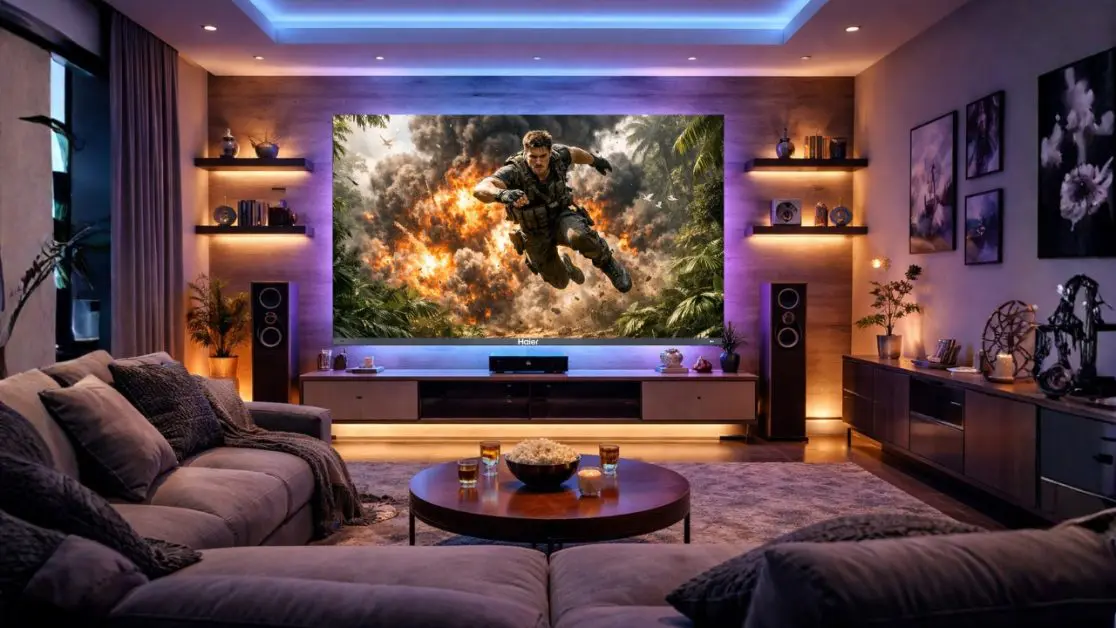
Film studios master movies using specialized standards.
Two of the most important are:
- Dolby Vision for visuals
- Dolby Atmos for sound
Dolby Vision dynamically adjusts brightness and color scene by scene.
Dolby Atmos creates three dimensional sound placement around the viewer.
Together they replicate theater quality at home.
This is why many streaming platforms now produce shows in these formats.
Because storytelling today assumes the viewer’s screen can support it.
The role of size in cinematic storytelling
Cinema relies on scale.
A dramatic landscape scene loses power on a small screen.
This explains why television sizes in India are growing quickly.
Industry retail trends show:
- 140cm (55) and 165cm (65) TVs dominate urban homes today
- 189cm(75) and 254cm(100) screens are rapidly expanding in premium segments
Large displays such as the 189cm(75) and 254cm(100) Haier QD Mini LED televisions push storytelling closer to theater scale while still fitting into living rooms.
But size alone is not enough.
A large screen without good processing simply magnifies flaws.
Cinematic design requires balance between:
- screen size
- picture processing
- lighting control
- sound architecture
Three ways televisions shape everyday storytelling
Most people think TVs simply show content.
In reality they shape how stories feel.
Consider three viewing patterns common in Indian homes.
1. Family viewing
Example: Sunday movie night.
Benefits of cinematic TVs:
- wide viewing angles for multiple people
- powerful speakers filling the room
- deeper contrast for dark scenes
Cost:
- larger screen size requires thoughtful room placement.
But the payoff is obvious.
Shared viewing becomes immersive.
2. Solo streaming
Example: a young professional unwinding after work.
Benefits:
- AI picture adjustments reduce manual settings
- personalized content recommendations through Google TV
- Voice control simplifies navigation.
Cost:
- requires stable internet and streaming subscriptions.
But convenience transforms daily downtime.
3. Gaming and sports
Example: late night gaming session or IPL match.
Benefits:
- high refresh rates
- AMD FreeSync Premium Pro reduces screen tearing.
Cost:
- gaming consoles or high quality streams reveal more benefits.
But motion clarity becomes noticeably better.
The living room is becoming the new cinema hall
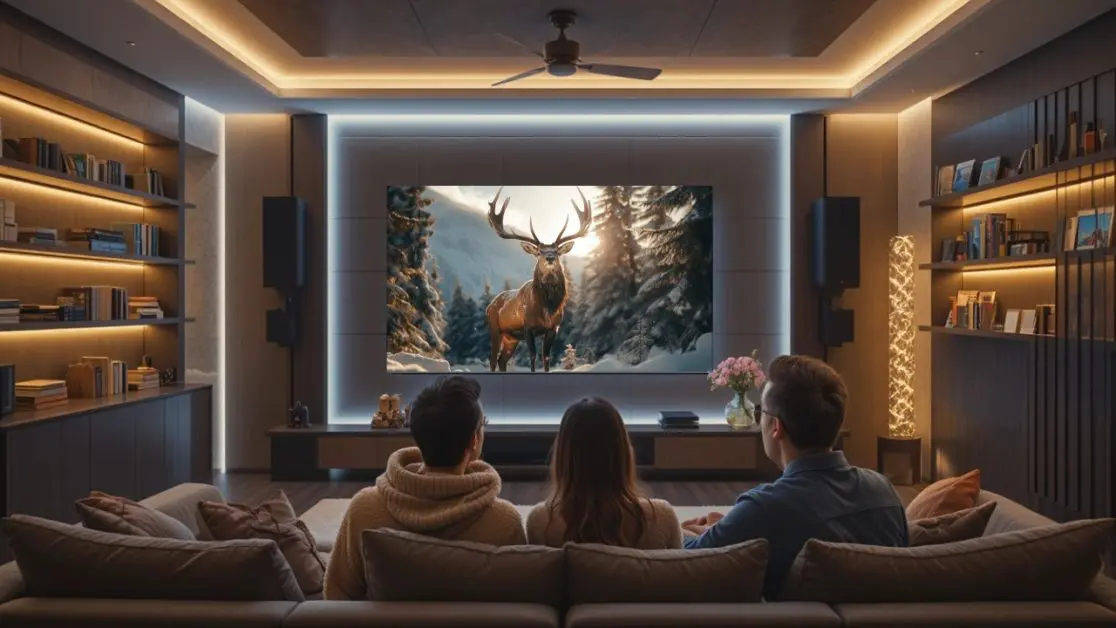
Cinema halls still exist.
But home cinema is evolving fast.
Three shifts explain why.
Shift 1: Streaming libraries
India’s OTT ecosystem now hosts thousands of movies and original shows, many released directly online.
Theater quality content now arrives directly in living rooms.
Shift 2: Bigger homes, smarter layouts
Modern apartments often feature open living areas.
The TV becomes the visual centerpiece.
Shift 3: AI driven displays
AI now adjusts brightness, contrast, and motion automatically.
Technology fades into the background.
The experience becomes effortless.
The principle behind cinematic storytelling
Technology changes quickly.
But the principle remains simple.
A screen should never interrupt the story.
That is the real goal of cinematic design.
When technology works well, viewers stop noticing the screen.
They notice the characters.
The music.
The tension of a final over in cricket.
The screen becomes invisible.
What this means for modern Indian homes
Homes today carry many roles.
Workspace.
Relaxation zone.
Family gathering space.
The television sits quietly in the middle of it all.
Designed well, it becomes something larger than a device.
It becomes the storyteller of the home.
A place where:
- a child watches their first animated movie
- a couple finishes a late night series
- a family cheers during a final match
Stories shape memory.
And technology, when designed thoughtfully, simply helps those stories arrive the way they were meant to be seen.
Clear.
Immersive.
And cinematic.
Frequently Asked Questions
I just want a good TV for movies and cricket. Do I really need a ‘cinematic’ TV?
If you mostly watch casually, a standard TV works. But if you notice blurry cricket balls, flat sound, or dull dark scenes, a cinematic TV fixes exactly those frustrations. It’s less about luxury, more about consistency.
Should I go for a bigger screen or better picture quality?
If forced to choose, go for better picture quality. A bad large screen just makes flaws bigger. The ideal is balance.
I don’t watch movies daily. Is cinematic tech wasted on me?
Not really. Even news, YouTube, and IPL benefit from better clarity, motion, and sound. You’ll notice it more than you expect.
Will these smart features slow down over time?
Over years, some slowdown is possible, but regular updates and good hardware reduce this significantly.
I hate adjusting settings. Will the TV do it for me?
Yes. AI processors automatically adjust brightness, contrast, and motion depending on what you’re watching.
I turned on Dolby Vision, but it looks dim. Why?
Dolby Vision prioritizes accuracy over brightness. In bright rooms, you may need to adjust brightness settings slightly.