
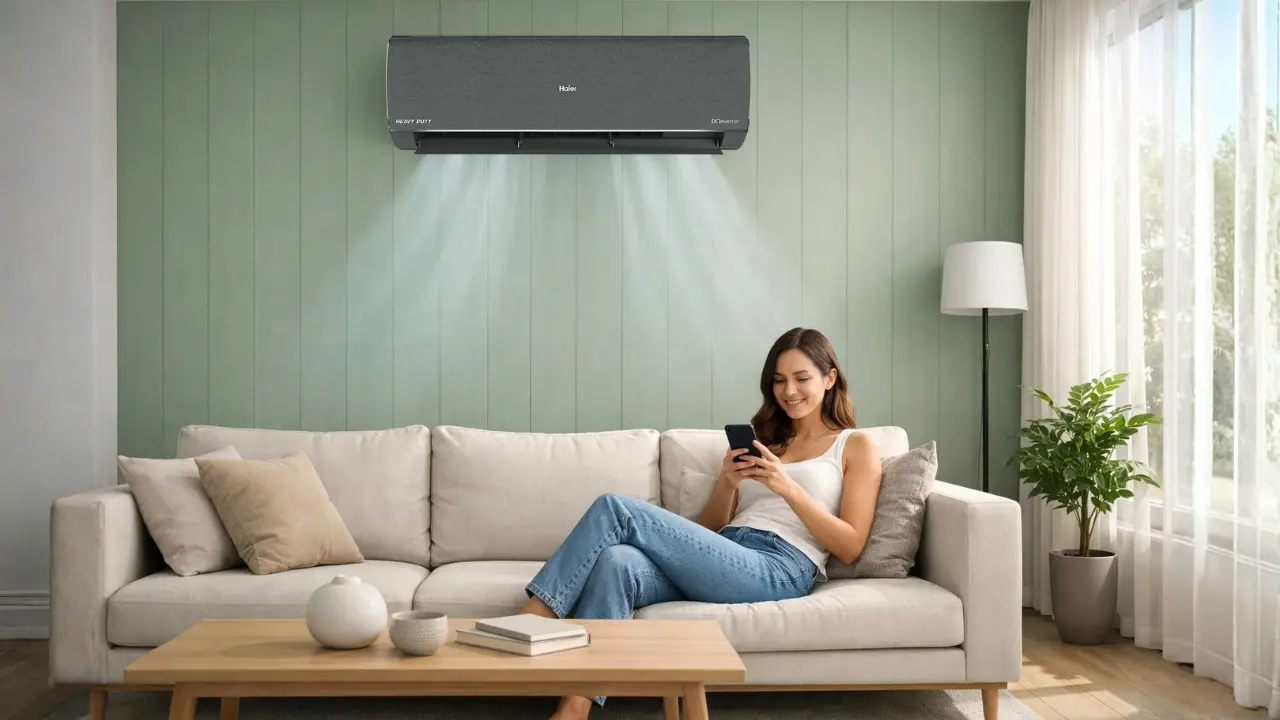

Efficient airflow = directing cool air exactly where you want it rather than mindlessly cooling your entire living room.
Air conditioners are getting smarter.
Using intelligent sensors, airflow mapping, and AI technology, they can pinpoint cool air right where you need it most onto beds, sofas, desks, or seating areas.
What happens? You get cool comfort faster. Save energy. And enjoy rooms that feel evenly conditioned, not hot and stale.
Because efficient cooling isn’t about temperature alone. It’s about coverage.
Why does cooling comfort depend on airflow, not just temperature?
Walk into two different homes during peak summer.
Both rooms show 24°C on the AC display.
Yet one feels perfect.
The other feels oddly warm.
Why?
Because cooling comfort depends on air distribution, not just numbers.
Think about a movie theatre.
The air does not blast randomly from one corner. It circulates across the entire hall so every seat feels the same comfort.
Homes work the same way.
If airflow misses the bed, sofa, or desk where people actually sit, the room may technically be cool but the experience still feels uneven.
Temperature sets the target.
Airflow delivers comfort.
The Hidden Problem in Many Indian Homes
Modern Indian homes have evolved quickly.
Apartments are taller. Living rooms are wider. Bedrooms double as workspaces. Work-from-home setups sit beside beds and wardrobes.
But many cooling systems still follow an old assumption.
They cool the room evenly.
The problem is simple.
People do not sit evenly across a room.
They gather in specific zones.
- A couple relaxing on the sofa
- A child studying at the desk
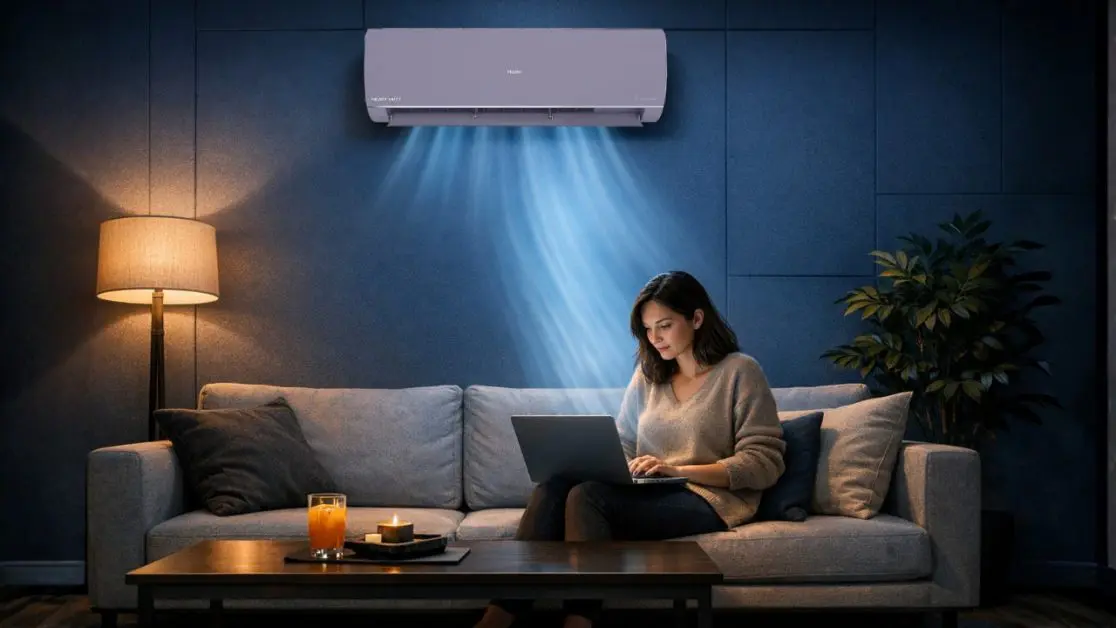
- Someone working late on a laptop
- Parents sleeping near the wall instead of the center
Cooling an entire room evenly wastes energy.
Precision airflow solves this mismatch.
Three Rooms. Three Different Airflow Needs
Every space inside a home behaves differently.
The bedroom needs gentle airflow.
The living room needs wider circulation.
The workspace needs focused cooling.
Let us look at how airflow behaves in each.
Bedrooms Need Calm, Directed Cooling
Bedrooms follow a simple rule.
Comfort matters more than speed.
Nobody wants strong air blowing directly on their face while sleeping.
What bedrooms actually need is controlled airflow near the sleeping zone.
This usually means cooling around the bed area without aggressive air movement.
Many modern systems now adjust airflow based on sleeping patterns or temperature changes through the night.
Some AC technologies even analyze surrounding conditions and automatically adjust cooling levels to maintain comfort without constant manual control.
That is where intelligent airflow design becomes useful.
It quietly shifts between stronger cooling during evening heat and softer circulation during sleep hours.
Bedroom Airflow Priorities
| Factor | Why It Matters |
| Soft airflow | Prevents cold drafts during sleep |
| Even circulation | Eliminates warm corners near beds |
| Smart temperature adjustments | Maintains comfort through the night |
| Low noise operation | Improves sleep quality |
The goal is not aggressive cooling.
The goal is stable comfort.
Living Rooms Need Wide Air Distribution
Living rooms behave differently.
People move constantly.
Someone watches TV. Someone walks to the kitchen. Someone sits near the balcony.
Airflow here must cover a larger zone.
Instead of focusing on one area, the cooling must spread across the room evenly.
Long throws of airflow and directional movement of air play a role here. Old-style air conditioners blast the air forward.
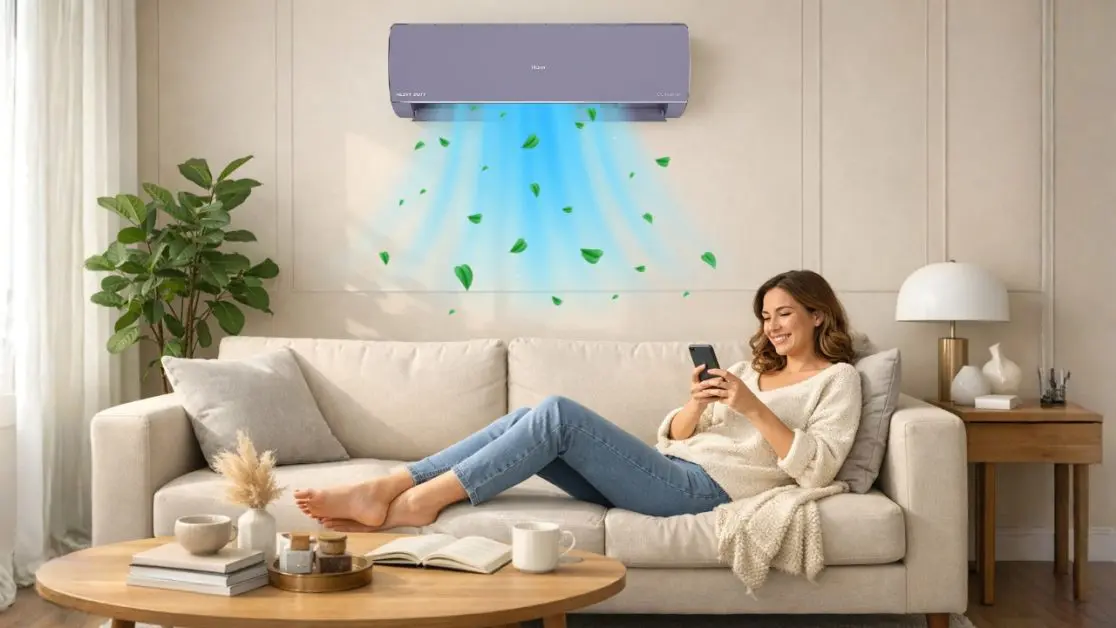
Some intelligent units can vary the direction of airflow based on seating positions.
AI enabled ACs can use installation information, and data modeled in the cloud, to provide pinpoint cooling to areas such as the sofa or seating areas.
Living Room Cooling Strategy
- Wide airflow coverage
- Faster cooling response
- Dynamic direction control
- Balanced circulation across seating zones
Living rooms are social spaces.
Airflow must follow people, not just room size.
Workspaces Demand Focused Cooling
Work-from-home has quietly changed the role of the AC.
The same room that once cooled for sleeping now also cools for long work hours.
And workspaces have a unique requirement.
Focus.
Too much airflow creates distraction.
Too little airflow causes fatigue.
What workspaces need is precision airflow directed toward the work zone.
Think about a desk setup.
Laptop heat. Monitor heat. Body heat from sitting for hours.
These small heat pockets accumulate around the desk area.
A smart cooling system that directs airflow toward the workspace improves both comfort and concentration.
Workspace Airflow Benefits
| Benefit | Impact |
| Targeted cooling | Maintains desk comfort |
| Reduced overcooling | Saves electricity |
| Stable airflow | Prevents distraction |
| Faster response | Helps during long work sessions |
Productivity and comfort often share the same invisible ally.
Good airflow.
The Rise of Precision Cooling in Smart ACs
Air conditioning is entering a new phase.
Earlier systems followed a simple formula.
Cool the room. Wait. Repeat.
Smart systems follow a different approach.
They observe.
They adapt.
They learn.
AI-powered climate systems now analyze environmental data and user behavior to automatically adjust cooling patterns without manual input.
This shift changes everything.
Instead of fixed cooling patterns, modern systems dynamically balance:
- temperature
- occupancy
- airflow direction
- power consumption
The result is something subtle but powerful.
Cooling that feels personal.
Precision Airflow Also Saves Energy
Here is an insight most homeowners miss.
Cooling efficiency depends less on power and more on airflow accuracy.
When cooling reaches the right place faster, the system works less.
That reduces electricity use.
Smart energy systems now monitor cooling patterns and automatically adjust performance to prevent unnecessary energy consumption while maintaining comfort.
How Precision Airflow Reduces Electricity Bills
- Faster comfort delivery
Air reaches people quicker, reducing compressor workload. - Reduced overcooling
Only active zones are cooled aggressively. - Smart power management
Systems automatically shift between efficiency levels based on temperature gaps. - Occupancy detection
Some models detect room activity and reduce cooling when the room is empty.
Cooling smarter often means cooling less.
And that saves power.
The New Rule of Home Cooling
For years, air conditioning followed one belief.
Bigger cooling meant better comfort.
Today the rule has changed.
Smarter airflow creates better comfort.
Not louder compressors.
Not lower temperatures.
Just better air movement.
How Modern Indian Homes Are Quietly Changing Cooling Expectations
Watch how people use their homes today.
A student studies late at night.
Parents stream shows on the sofa.
Someone joins a video call in the corner.
Homes are no longer single-purpose spaces.
They are multi-zone environments.
And multi-zone environments require smarter airflow.
The Three Cooling Modes Modern Homes Need
1. Sleep Comfort Mode
Gentle airflow designed for bedrooms.
2. Social Cooling Mode
Wider air distribution for living rooms.
3. Focus Cooling Mode
Directed airflow for desks and workspaces.
One air conditioner now supports multiple lifestyles.
Where Haier’s AI Climate Systems Fit In
Some modern AC platforms are already designed around this philosophy.
For example, Haier’s AI-powered climate technologies analyze environmental conditions and user behavior to automatically adjust cooling patterns, airflow direction, and energy use for optimal comfort.
Features such as AI Target Cooling and AI Climate Control allow the system to deliver cooling precisely where it is needed rather than cooling the entire room inefficiently.
The benefit is subtle but powerful.
Airflow adapts to how people actually live inside their homes.
A Final Thought: Comfort Is Directional
A bookstore smells comforting because the scent travels through the room.
A theatre feels immersive because sound reaches every seat.
Comfort always depends on how things move through space.
Air works the same way.
Temperature alone cannot define comfort.
Direction matters.
Movement matters.
Precision matters.
The homes that feel effortless in summer are rarely the ones with the strongest cooling.
They are the ones with the smartest airflow.
Because when air reaches the right place at the right moment, something simple happens.
The room stops feeling like a machine-controlled space.
It starts feeling like home.
Frequently Asked Questions
I set my AC to 24°C but my room still feels warm. What am I doing wrong?
You’re likely facing an airflow issue, not a temperature problem. If cool air isn’t reaching where you sit or sleep, the room can feel uneven despite the correct setting. Adjust airflow direction toward your active zones.
Should I lower the temperature or change airflow direction first?
Change airflow direction first. Lowering temperature increases energy use, but redirecting airflow can immediately improve comfort without extra power consumption.
Why does my living room cool slower than my bedroom even with the same AC?
Living rooms need wider air distribution due to movement and larger layouts. Bedrooms need focused, calm airflow. Same AC, different airflow needs.
I feel like I’m wasting electricity cooling empty parts of my room. Is that true?
Yes. Traditional cooling treats the room uniformly, but people occupy specific zones. Precision airflow reduces this waste by targeting occupied areas.
What does “AI cooling” actually do in an AC?
AI systems analyze room conditions, user behavior, and temperature patterns to adjust airflow direction, speed, and cooling automatically.
How does precision airflow work in modern ACs?
Sensors and algorithms detect where cooling is needed (bed, sofa, desk) and direct airflow accordingly instead of cooling the entire room evenly.
Can an AC really detect where I’m sitting?
Some advanced systems use occupancy sensors or pre-set mapping to approximate where cooling should be focused.
Is smart airflow actually useful or just marketing?
It’s practical especially in multi-use rooms. It improves comfort while reducing unnecessary energy use.
How is Haier using AI in air conditioners?
Haier integrates features like AI Climate Control and AI Target Cooling, which adjust airflow direction and cooling intensity based on real-time conditions and usage patterns.