
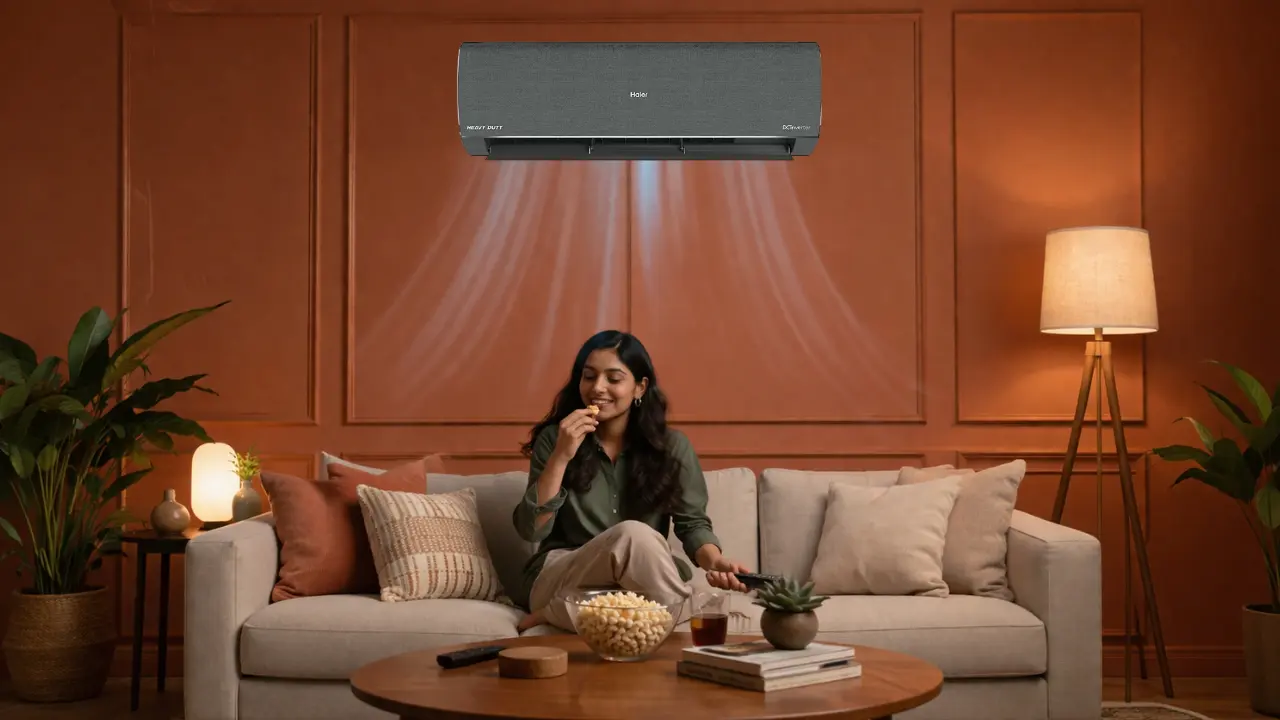

Human presence detection improves cooling by making air conditioners respond to people, not just temperature.
It detects occupancy, adjusts airflow direction, and reduces power when a room is empty. The result is faster comfort, lower electricity bills, and cooling that feels personal instead of mechanical.
The real problem is not cooling. It is wasted cooling.
Walk into a typical Indian living room at 8:30 pm.
The AC is running.
The room is cool.
But no one is there.
Someone left for dinner. Someone else moved to the bedroom. The TV is off. The lights are dim.
Yet the AC continues working as if nothing has changed.
This is how most homes operate.
Cooling does not follow people.
People move. Machines stay fixed.
And that mismatch creates two quiet costs:
- Electricity waste
- Uneven comfort
According to industry estimates, air conditioners account for nearly 40 percent of household electricity usage during peak summers in India. When cooling runs in empty rooms, that number quietly rises.
Cooling is not expensive because of the heat.
It becomes expensive because of misalignment.
What is human presence detection in an AC?
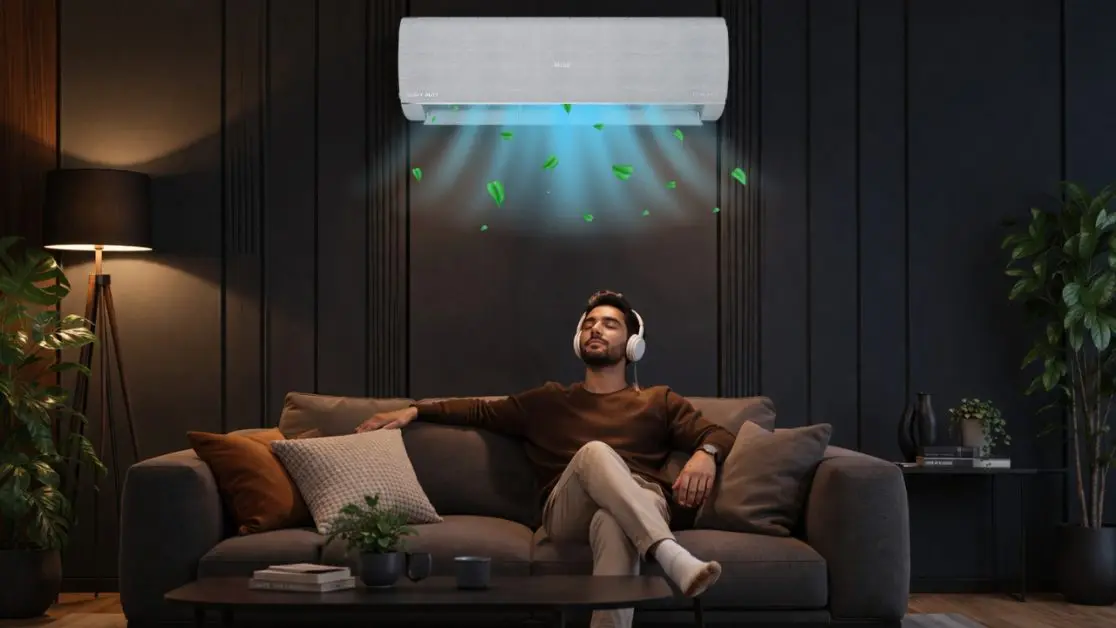
A simple idea with a powerful shift
Human presence detection is exactly what it sounds like.
The AC senses whether someone is in the room.
Then it decides what to do next.
Modern technology like those powered by Haier’s AI platform take it further. They use sensors and AI logic to track movement, detect absence, and adjust cooling automatically.
How it works in real life
- Sensors detect motion or human presence within a range of up to 12 meters
- If no activity is detected, the AC reduces cooling gradually
- After a set time, it shifts to energy-saving mode or switches off
- When someone enters again, cooling resumes instantly
It feels invisible.
Because the technology works before you notice the problem.
Cooling works best when it follows behavior
Why traditional cooling feels inefficient
Traditional ACs follow a simple rule.
You set a temperature. The machine maintains it.
That works only if life is predictable.
But modern homes are not predictable.
Think about a normal day:
- Morning: Kitchen activity, AC off
- Afternoon: Empty house, AC accidentally left on
- Evening: Everyone returns, room is hot again
- Night: People shift between rooms
Static cooling cannot keep up.
It treats every moment the same.
Which means it wastes energy when no one is there, and struggles when comfort is actually needed.
Human presence detection solves three invisible problems
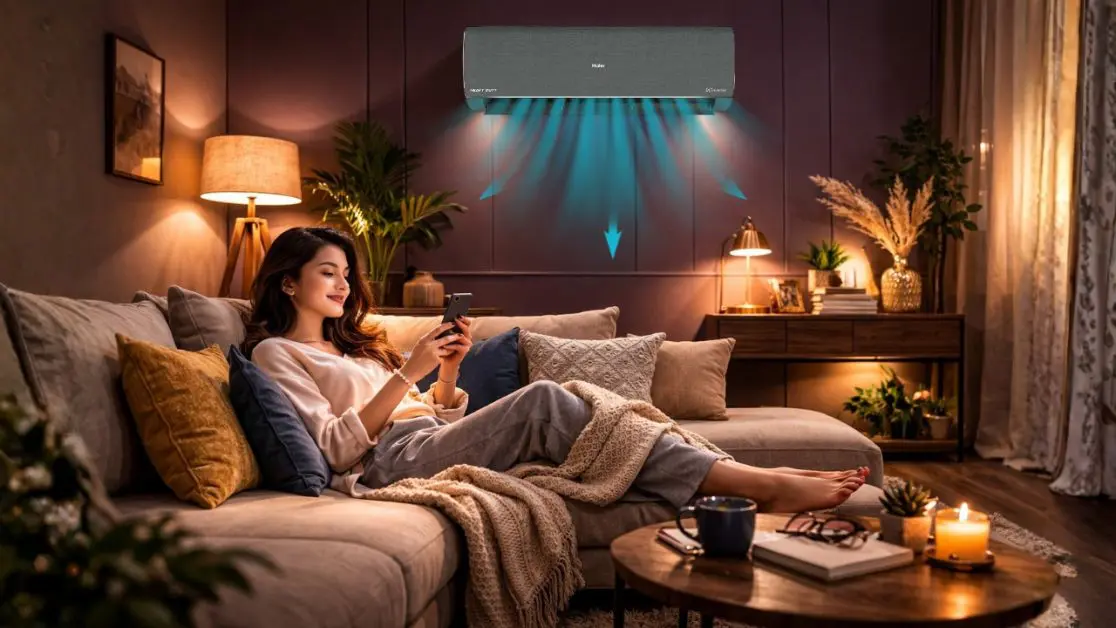
1. Cooling empty spaces
This is the biggest inefficiency.
Cooling an empty room is like leaving a tap running in an empty sink.
Human detection fixes this instantly.
- Detects absence
- Reduces compressor load
- Switches to eco mode
Cost: Slight delay in switching modes
Benefit: Significant electricity savings over time
2. Delayed comfort when you enter
You walk into a room.
It feels warm.
You switch on the AC.
Then you wait.
Human presence detection changes this pattern when combined with AI technology.
- Detects entry
- Activates cooling immediately
- Adjusts airflow toward you
Insight: Comfort should begin when you arrive, not after you wait.
3. Uneven cooling inside the room
Not all parts of a room matter equally.
The sofa matters. The bed matters. The work desk matters.
Walls and corners do not.
With human detection working alongside targeted cooling:
- Airflow moves toward occupied zones
- Unused areas receive less cooling
- Energy is focused, not spread
This is how technology like AI-powered climate control combine presence detection with directional cooling to improve efficiency and comfort together.
The shift from reactive to Pre-cooling
Cooling used to respond. Now it anticipates.
Older technology follows commands.
New technology follows patterns.
That difference changes everything.
| Cooling Type | How It Works | Outcome |
| Reactive Cooling | Waits for manual input | Delayed comfort, higher energy use |
| Timed Cooling | Runs on schedule | Works sometimes, fails often |
| Human Detection Cooling | Responds to presence | Balanced comfort and efficiency |
| AI + Presence Detection | Learns behavior patterns | Pre-cooling, seamless cooling |
The real upgrade is not just sensing people.
It is understanding patterns.
A small sensor. A big financial impact.
Why energy savings feel invisible but add up
Most people do not track AC usage daily.
But the numbers are real.
Let’s break it down.
- Average AC usage in summer: 8 to 10 hours per day
- Estimated waste due to empty-room cooling: 15 to 25 percent
- Monthly electricity bill impact: ₹800 to ₹2000 depending on usage
Now multiply that across a season.
Human presence detection quietly removes that waste.
Energy efficiency is not about using less. It is about using only when needed.
Where human detection matters most in Indian homes
Not all homes benefit equally. Some benefit massively.
One. Working professionals living alone
- Leave home daily
- Forget to switch off AC
- Return to overheated rooms
Impact: High energy savings + better comfort
Two. Families with children
- Kids move between rooms
- AC runs in unused spaces
Impact: Better energy control + balanced cooling
Three. Hybrid work households
- Irregular schedules
- Unpredictable room usage
Impact: Adaptive cooling that fits real life
Four. Elderly households
- Prefer stable temperatures
- Avoid manual adjustments
Impact: Automated comfort without constant control
Why this technology feels like common sense once you use it
Because it mirrors human behavior.
We switch lights off when we leave a room.
We turn fans on only when needed.
But ACs never learned that logic.
Until now.
Human presence detection brings that same instinct into cooling technology.
Machines start behaving like people.
That is the real shift.
How Haier’s AI ecosystem makes this smarter
It is not just detection. It is coordination.
Human detection becomes powerful when combined with other intelligent features.
From the AI Atmox platform:
- AI Climate Control adjusts based on environment and usage
- AI Target Cooling directs airflow to occupied areas
- AI Eco 2.0 reduces power consumption dynamically
- AI Human Detection senses occupancy and optimizes usage
This creates a technology where:
- Cooling begins before discomfort
- Energy reduces without manual action
- Comfort stays consistent across changing routines
It is not one feature.
It is a connected technology.
The trade-offs most people never consider
Every smart technology has a cost. Here is the real picture.
Benefit side:
- Lower electricity bills
- Reduced manual effort
- Faster comfort
- Better airflow efficiency
Cost side:
- Slightly higher upfront investment
- Dependency on sensors and AI logic
But here is the pattern.
You pay once for intelligence. You save every day from it.
The deeper insight: comfort is becoming contextual
Cooling is no longer about temperature.
It is about context.
- Who is in the room
- Where they are sitting
- When they arrive
- When they leave
Human presence detection turns cooling into a situational response.
Not a fixed setting.
And that changes how homes feel.
The future of cooling is simple
Not more power.
Not more features.
Better awareness.
When appliances understand presence, behavior, and patterns, they stop being tools.
They become technology.
And technology does one thing well.
They remove friction.
The takeaway that stays
The best cooling technology is not the one that runs the longest. It is the one that runs at the right time.
Human presence detection makes that possible.
It aligns machines with real life.
And once that alignment happens, everything else improves quietly.
Bills go down.
Comfort goes up.
And the home starts feeling just a little more effortless.
That is the kind of upgrade people do not talk about loudly.
But they feel it every single day.
Frequently Asked Questions
Do I really need human presence detection in my AC, or is it just a gimmick?
If your AC often runs in empty rooms or you forget to turn it off, this feature directly saves electricity and improves comfort. It’s not a gimmick, it solves a real inefficiency.
I already have an inverter AC. Will this make any real difference?
Yes. Inverter ACs optimize compressor speed, but they still run continuously. Presence detection adds context, reducing operation when no one is around.
Is the higher upfront cost actually worth it for me?
If you use AC daily in summer, the energy savings (₹800–₹2000/month) can offset the extra cost over time.
I leave my AC on when I step out for dinner. Does this feature fix that?
Yes. It detects no movement and gradually reduces cooling or switches to eco/off mode.
My family keeps moving between rooms. Will the AC adjust automatically?
Yes. It tracks presence and redirects airflow or reduces cooling in unused spaces.
I don’t want to keep adjusting settings all day. Will this reduce that?
Absolutely. It automates decisions you normally make manually.
How does the AC actually know if someone is in the room?
It uses sensors (like infrared/motion detection) to detect movement within ~12 meters.
What happens if I stay still for a long time? Will it think I left?
Advanced systems use pattern detection, not just motion, so they reduce false absence detection.
Does it learn my routine over time?
With AI integration, yes. It can anticipate usage and even pre-cool rooms.
Is this the same as a motion sensor light?
Similar concept, but more advanced it combines sensing with AI-based cooling decisions.