
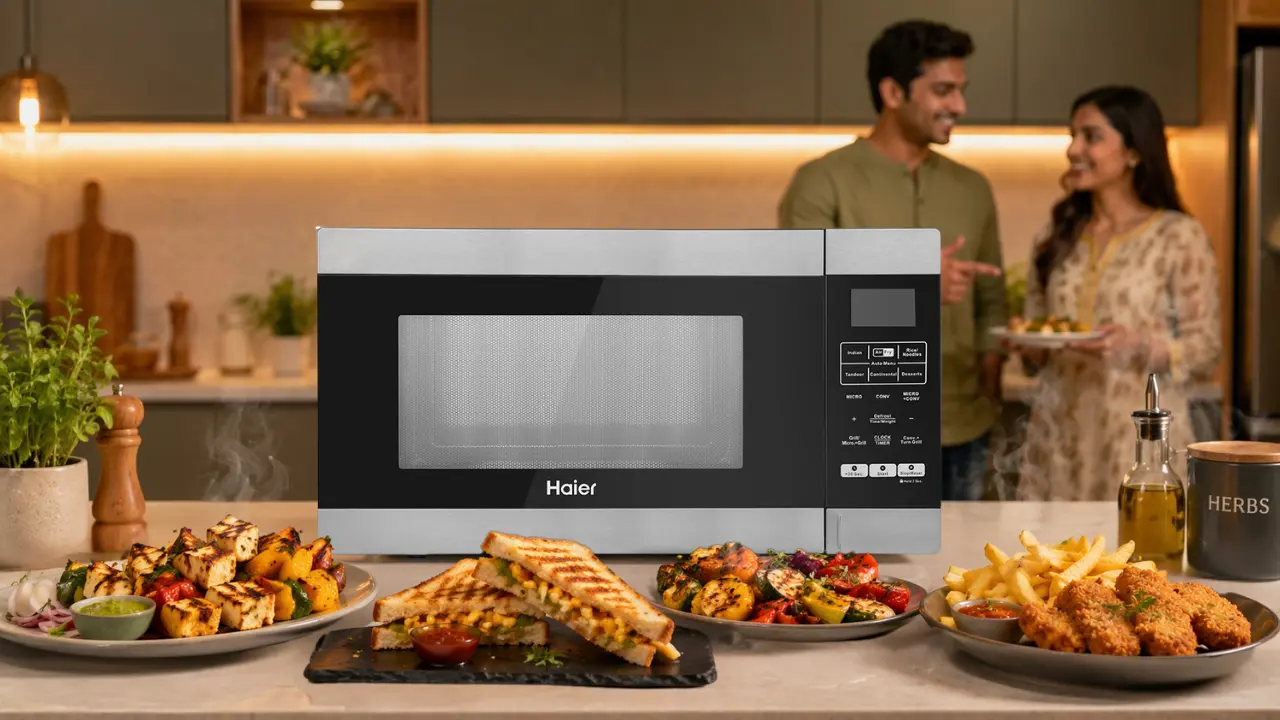

The right microwave for grilling and roasting is a convection microwave with grill mode, adjustable power levels, and enough capacity for your cooking style.
Look for features like combination cooking, rotisserie, and preset menus that simplify real Indian recipes, not just reheating.
The problem isn’t the microwave. It’s the expectation.
It’s 9:30 pm.
You’ve marinated paneer. Maybe chicken. Maybe just vegetables with a little spice and optimism.
You want that slight char. That roasted edge. That feeling of “this tastes like outside food, but better.”
But the microwave?
It heats. It softens. It is disappointing.
That gap between expectation and reality is where most buying decisions go wrong.
Because not all microwaves are built for grilling and roasting.
What actually matters for grilling and roasting in a microwave?
Most people assume “microwave is microwave.”
It isn’t.
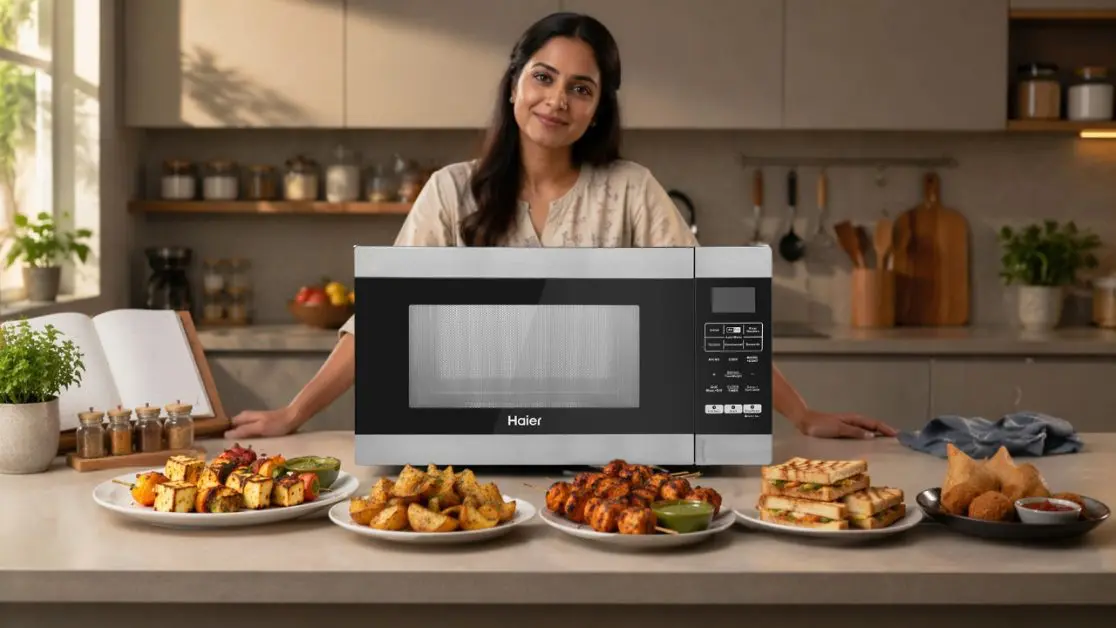
Grilling and roasting demand a different system. One that combines heat, airflow, and timing.
Here’s the simple truth
- Microwave mode heats from inside
- Grill mode heats from outside
- Convection mode circulates hot air for even cooking
Roasting needs all three working together.
That’s why convection microwaves exist.
One decision changes everything: Solo vs Grill vs Convection
One option is: Solo Microwave
- What it does: Reheats, defrosts, basic cooking
- What it cannot do: Grill or roast
- Best for: Students, basic kitchens
Cost: Lowest
Benefit: Simplicity
Limitation: No crisp, no browning
The second option is: Grill Microwave
- What it does: Adds top heating element for grilling
- What it can do: Basic tikkas, sandwiches
- What it struggles with: Even roasting
Cost: Moderate
Benefit: Entry-level grilling
Limitation: Uneven heat distribution
The third option is: Convection Microwave
- What it does: Combines microwave, grill, and convection
- What it enables: Baking, roasting, grilling
- What it unlocks: Real cooking
Cost: Higher upfront
Benefit: Complete cooking system
Limitation: Slight learning curve
Insight: If you want restaurant-style results, convection is not optional. It’s fundamental.
Why convection matters more in Indian kitchens
Indian cooking is not subtle.
It’s layered. Spiced. Textured.
Think about it:
- Paneer tikka needs surface charring
- Chicken roast needs internal cooking plus outer crispness
- Naan needs heat from all directions
- Even aloo needs that roasted edge
A convection microwave solves this by circulating heat evenly.
In models like the Haier 25L Convection Microwave Oven (HIL2501CBSH), combination cooking blends microwave, grill, and convection to reduce cooking time by up to 30 percent while maintaining texture
That’s not just faster cooking. That’s better cooking.
Capacity is not about size. It’s about intention.

People choose capacity based on kitchen space.
But capacity reflects how you cook.
A simple framework
| Household Type | Ideal Capacity | Why it matters |
| Solo living | 20L | Compact, quick meals |
| Couples | 20 to 25L | Balanced usage |
| Families | 25 to 30L+ | Batch cooking, roasting |
| Hosting often | 30L+ | Multiple dishes |
For example:
- A 20L convection microwave like Haier’s mirror glass model offers 66 auto cook menus and essential grilling features for everyday cooking
- A 30L convection microwave with air fryer expands possibilities with rotisserie and large dishes
Insight: Capacity is not about today’s meals. It’s about tomorrow’s possibilities.
Features that actually change your cooking experience
Most feature lists look impressive.
Few actually matter.
Here’s what to look for when grilling and roasting are your priority:
1. Combination Cooking
- Combines microwave + grill + convection
- Ensures inside cooks while outside crisps
Why it matters: Saves time without sacrificing texture
2. Quartz Grilling or High-Power Grill
- Provides intense top heat
- Helps achieve golden, crispy surfaces
Example: Quartz grilling ensures evenly browned results instead of uneven patches
3. Rotisserie Function
- Rotates food for uniform grilling
- Perfect for chicken, kebabs
Available in larger models like 30L variants
Insight: Rotation is the difference between cooked and evenly cooked.
4. Auto Cook Menus
- Pre-set cooking programs
- Removes guesswork
Example: Up to 305 auto cook menus in advanced models
Benefit: Speed and consistency
5. Stainless Steel Cavity
- Reflects heat efficiently
- Easier to clean
Impact: Better cooking, longer durability
6. Multi Power Levels
- Control heat intensity
- Prevent overcooking
Insight: Control is what turns cooking into confidence.
The hidden system: Why some microwaves feel effortless
Walk into two kitchens.
Both have microwaves.
In one, cooking feels like trial and error.
On the other hand, it feels predictable.
The difference is not skill.
It’s a system.
A good grilling microwave does three things automatically
- Adjusts heat stages
- Maintains airflow
- Balances internal and external cooking
That’s why features like multi-stage cooking exist, allowing the microwave to shift between modes automatically
Insight: The best appliance is the one that removes decisions you shouldn’t have to make.
Grilling vs Roasting: Know what you’re optimizing for
People use these words interchangeably.
They are not the same.
Grilling
- High heat
- Direct exposure
- Focus on surface texture
Roasting
- Moderate heat
- Even circulation
- Focus on overall cooking
What your microwave needs
| Cooking Type | Required Feature |
| Grilling | Strong grill element |
| Roasting | Convection fan |
| Both | Combination cooking |
Insight: Grilling is about the outside. Roasting is about the system.
Energy, time, and real-life efficiency
In Indian households, usage patterns matter more than specs.
- Evenings see peak cooking
- Weekend cooking is heavier
- Festive cooking demands flexibility
A convection microwave helps by:
- Reducing cooking time through combination modes
- Minimizing oil usage with features like oil-free cooking
- Allowing multiple dishes in sequence
Result: Less effort. More control. Better outcomes.
So, how do you actually choose? A simple decision framework
Instead of overthinking specs, use this:
Ask yourself three questions
1. What do I cook most often?
- Mostly reheating → Solo
- Occasional grilling → Grill
- Regular cooking and experimenting → Convection
2. How many people do I cook for?
- 1 to 2 → 20L
- 2 to 4 → 25L
- 4+ → 30L
3. Do I want convenience or control?
- Convenience → Auto menus
- Control → Manual settings
- Both → Combination + presets
A practical way to think about it
Buying a microwave for grilling and roasting is like buying a gym membership.
- Some people want access
- Some want results
- Some want transformation
Choose accordingly.
The bigger shift: Cooking is becoming system-driven
Modern kitchens are changing.
- Less time
- More variety
- Higher expectations
Appliances are no longer tools.
They are systems.
A good convection microwave:
- Reduces effort
- Improves consistency
- Expands what’s possible
That’s why features like air frying, rotisserie, and auto menus are becoming standard, not premium.
The one insight that changes how you choose
Most people buy a microwave for what they do today.
The better decision is to buy what you want to cook tomorrow.
Because once the system is in place, behavior changes.
You experiment more. Cook better. Waste less time.
And that’s when an appliance stops being a purchase and starts becoming part of your lifestyle.
Frequently Asked Questions
How do I know if I need a convection microwave or just a grill one?
If you want proper roasting (like chicken, paneer tikka, naan), you need convection. Grill-only models can brown the surface but won’t cook evenly inside.
Why does my microwave fail at grilling even though it has a grill mode?
Grill mode only heats from the top. Without convection airflow, heat doesn’t circulate, so food cooks unevenly.
Is a convection microwave really worth the higher price?
Yes, if you want real cooking (grilling, roasting, baking). Otherwise, you’ll outgrow a basic model quickly.
What’s the biggest mistake people make when buying a microwave?
Expecting all microwaves to grill and roast. Only convection models can truly do both well.
Are auto cook menus useful or just gimmicks?
Useful for beginners they remove guesswork and improve consistency.
Do I really need a rotisserie function?
Only if you cook whole chicken or kebabs often. Otherwise optional.
Why is a stainless steel cavity better?
It reflects heat evenly and is easier to clean.
Does convection cooking take longer than microwave mode?
Slightly but combination mode reduces total time while improving texture.
What is combination cooking and why does it matter?
It blends microwave + grill + convection, so food cooks inside and crisps outside simultaneously.
Will higher power levels ruin my food while grilling?
Yes, if not controlled. Multi-power levels help avoid overcooking.