
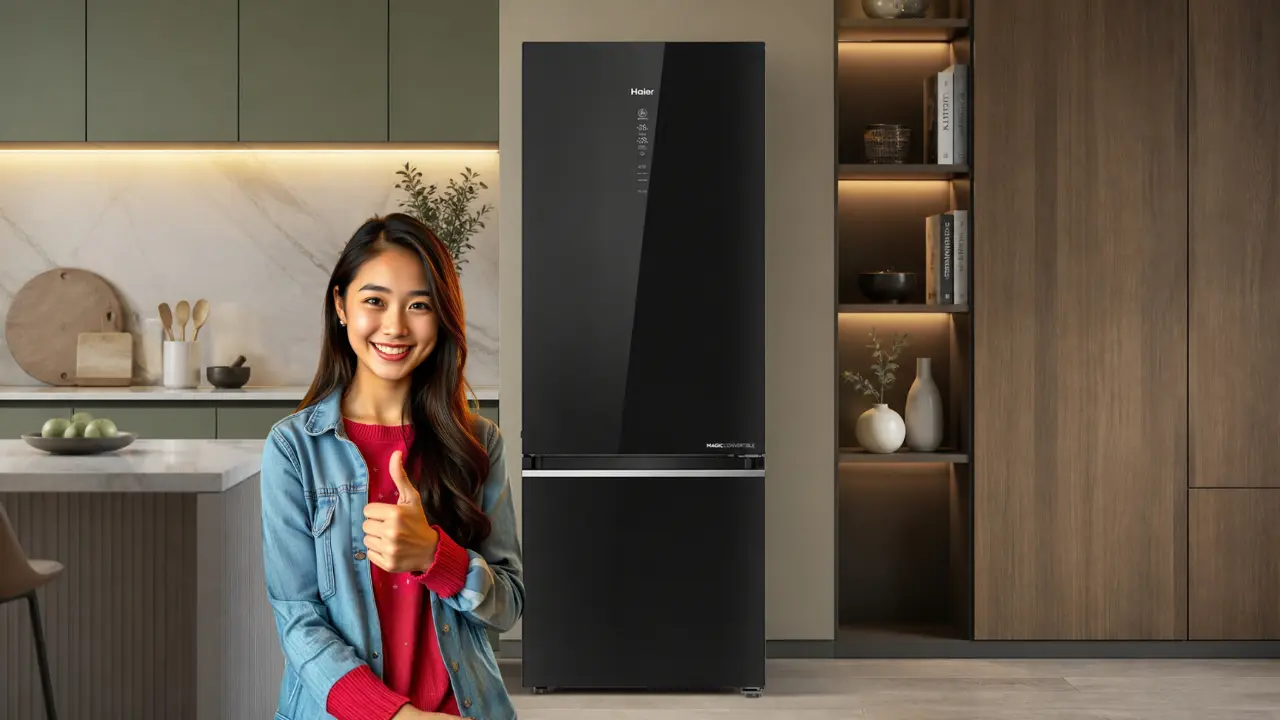

A bottom mounted fridge is different, in one way, it keeps what you use daily at eye level and moves less often used things down. Haier Bottom Mounted Refrigerators do this and more.
They have cooling, use less energy and are designed to make life easier.
These fridges quietly make daily tasks simpler.They put the things you need every day in front of you.Haier fridges make it easy to get what you need.
They are designed to be helpful.
The fridge keeps your needs at eye level.
It moves the things you use often to a lower level.
Haier Bottom Mounted Refrigerators are a choice.
Why does your fridge still make you bend every day?
It is early morning.
You open the fridge. Milk. Fruits. Yesterday’s sabzi.
You bend. Again.
It feels small. But repeat that motion 10 times a day, 365 days a year. It adds up.
Design is not about looks. It is about reducing invisible effort.
This is where bottom mounted refrigerators flip the logic.
- Frequently used items move up
- Less-used frozen items move down
- Your body adjusts less
Haier calls this “Jhukna Mat” thinking. Reduce bending by up to 90 percent.
Not a feature. A daily relief.
What actually makes Haier Bottom Mounted Refrigerators different?
Let’s move beyond marketing language.
What are the real systems working underneath?
1. The cooling system is no longer one-dimensional
Most refrigerators treat cooling like a single job. Cool everything. Equally.
That does not work in Indian homes.
- Fresh vegetables need humidity
- Leftovers need consistent cooling
- Ice needs speed
Haier solves this with Triple Inverter and Dual Fan Technology.
What it does:
- Adjusts compressor speed dynamically
- Maintains consistent temperature
- Reduces power fluctuations
What it means for you:
- Vegetables stay fresh longer
- Electricity bills stay predictable
- Noise stays low
Insight: Good cooling is invisible. You only notice it when food lasts longer.
2. 14-in-1 Convertible Modes adapt to your life
Indian households are not static.
One week you are stocking for guests. Next week you are barely home.
This is where rigid storage systems fail.
Haier introduces 14-in-1 Convertible Modes.
Think of it like this:
- One mode for heavy grocery storage
- One for party prep
- One for minimal weekly use
Options become systems:
- One option is maximum fridge space for vegetables
- The second option is balanced cooling for mixed use
- The third option is freezer-heavy mode for storage
Cost-benefit clarity:
- Benefit: Flexibility across seasons and lifestyles
- Cost: Slight learning curve initially
Insight: A smart appliance is not one that does more. It is one that adapts.
3. The freezer moves down for a reason
Most people use the freezer less frequently than the fridge.
Yet, in traditional designs, it sits at eye level.
That is backwards.
Bottom mounted refrigerators correct this.
What changes:
- Fresh food is always visible
- Frozen items stay accessible but secondary
- Daily usage becomes effortless
This is not innovation. It is a correction.
4. Bigger vegetable storage is not a luxury in India

Indian kitchens are different.
Weekly sabzi runs. Bulk greens. Seasonal fruits.
A small vegetable box breaks this system.
Haier solves it with a 2X Bigger Vegetable Box.
Why it matters:
- Stores bulk groceries without overcrowding
- Reduces multiple fridge openings
- Keeps airflow intact for freshness
Real scenario:
Sunday mandi shopping.
Spinach, tomatoes, cauliflower, coriander.
Everything fits. Nothing gets crushed.
Insight: Storage is not about space. It is about how well space handles reality.
5. Speed matters when cooling meets lifestyle
There are moments when waiting does not work.
Guests arrive. Drinks need chilling. Ice is missing.
Haier’s 1 Hour Icing Technology solves this.
What it does:
- Produces ice within an hour
- Maintains consistent freezing speed
Add-on: Twist Ice Maker for easy access
Cost-benefit:
- Benefit: Convenience during peak usage moments
- Cost: Slightly higher energy draw during rapid cooling cycles
Insight: Speed is not a feature. It is a stress reducer.
What about energy and power stability?
Indian homes deal with voltage fluctuations.
This is where appliances quietly fail over time.
Haier integrates Stabilizer Free Operation.
What it does:
- Protects against voltage fluctuations
- Eliminates need for external stabilizers
- Improves long-term durability
Combine this with Inverter Compressor Technology:
- Faster cooling
- Lower energy consumption
- Longer lifespan
Data point: Energy consumption around 265 units annually in 445L models
Insight: Efficiency is not about saving power today. It is about avoiding failure tomorrow.
How does Haier handle real Indian cooking loads?
Let’s talk about pressure.
Heavy utensils. Big containers. Leftovers.
Most fridges struggle here.
Haier uses Toughenede Glass Shelves.
What this changes:
- Supports heavy Indian cookware
- Spill-proof design prevents mess spread
- Easy cleaning
Add to that:
- 336L fresh food capacity
- 109L freezer capacity
- Frost-free operation
Insight: Durability is not tested in labs. It is tested during festival cooking.
The small features that quietly change everything
Big features sell. Small features stay.
Here are the ones that matter over time:
1. Digital Control Panel
- Adjust settings without opening the door
- Maintains internal temperature stability
2. Removable Anti-Bacterial Gasket
- Prevents odor build-up
- Easy to clean
3. Home Inverter Connectivity
- Maintains cooling during power cuts
- Critical for Indian conditions
Insight: The best features are the ones you stop noticing because they always work.
Quick comparison: Traditional vs Bottom Mounted Refrigerators
| Feature | Traditional Fridge | Bottom Mounted Refrigerator |
| Daily Access | Requires bending | Eye-level convenience |
| Freezer Placement | Top | Bottom |
| Ergonomics | Strain over time | Reduced physical effort |
| Storage Logic | Fixed | Adaptive and flexible |
| Real-life usability | Average | High |
Which type of user benefits the most?
Not everyone needs the same refrigerator.
Let’s break it down.
1. Working professionals living solo
- Need quick access
- Prefer low maintenance
- Benefit from inverter efficiency
2. Families with weekly grocery cycles
- Need larger storage
- Benefit from convertible modes
- Appreciate vegetable space
3. Couples setting up new homes
- Value design and ergonomics
- Prefer long-term efficiency
- Look for future-ready appliances
Insight: The right appliance is not the most powerful one. It is the one that matches your rhythm.
A real example to bring this together
Take the Haier 445L Bottom Mounted Refrigerator (HRB-4952CKGA-P / HRB-4952BGKA-P).
What it combines:
- 14-in-1 convertible modes
- Triple inverter technology
- 2X vegetable storage
- 1-hour icing
- Stabilizer-free operation
This is not feature stacking.
This is system thinking applied to daily life.
What does this shift actually mean for Indian homes?
Most people think appliances solve tasks.
They do not.
They remove friction.
A better refrigerator does not just store food.
It changes how often you shop.
How long your groceries last.
How much effort your day requires.
One refrigerator. Multiple invisible upgrades.
The bigger idea hiding in plain sight
Every home runs on systems.
- Cooking systems
- Cleaning systems
- Storage systems
When one system improves, everything around it shifts.
A bottom mounted refrigerator looks like a design change.
It is not.
It is a behavioral upgrade.
Final thought: Convenience is cumulative
No single feature will change your life.
But ten small improvements, repeated daily, will.
Less bending.
Faster cooling.
Smarter storage.
Stable power usage.
Convenience compounds.
And over time, it becomes the difference between a house that works for you and one you keep adjusting to.
That is the quiet promise behind Haier Bottom Mounted Refrigerators.
Not more features.
A better system for living.
Frequently Asked Questions
Why does a bottom mounted refrigerator feel more comfortable to use every day?
Because the fridge section stays at eye level, which reduces constant bending. Items like milk, vegetables, leftovers, and fruits become easier to access multiple times a day.
Is a bottom mounted fridge actually better for daily use or just a design trend?
For most households, it improves usability because fresh food is accessed more often than frozen food. The layout matches real usage patterns.
Why do people say bottom mounted refrigerators reduce physical strain?
Traditional refrigerators force repeated bending for daily items. Bottom mounted models shift frequently used storage upward, reducing body movement over time.
Does the “Jhukna Mat” concept really make a difference?
Yes. Small repetitive actions add up across years. Reducing bending multiple times a day can noticeably improve kitchen comfort.
Will I take time to adjust to the freezer being at the bottom?
Usually only for a few days. Once habits shift, most users find the arrangement more natural.
What is 1 Hour Icing Technology?
It rapidly produces ice within about an hour for situations where quick cooling is needed.
Is fast icing useful in daily life?
Yes, especially during gatherings, summer months, or unexpected guests.
Does rapid cooling consume more electricity?
Temporarily yes, but the convenience often outweighs the short-term increase in energy use.
What is a Twist Ice Maker?
It allows users to release ice cubes quickly without manually removing trays.
Is quick cooling just a luxury feature?
For many households, it becomes a practical stress-reduction feature during busy moments.