
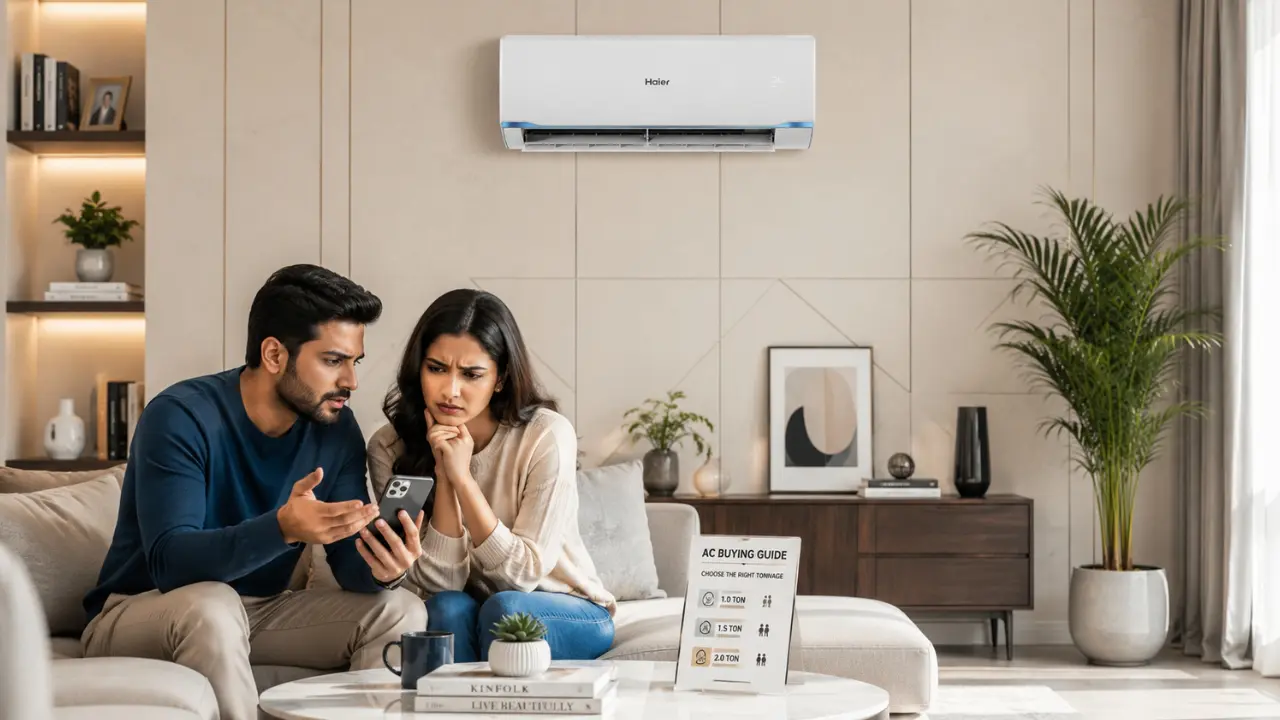

Choosing the wrong AC tonnage creates two problems at once
An AC with lower tonnage struggles to cool the room and keeps running longer. An oversized AC cools too fast, wastes electricity, and often leaves the room feeling uneven.
The right AC tonnage is not about buying “more power.” It is about matching cooling capacity to how your room actually lives and breathes.
A living room at 4 pm explains everything.
Sunlight hits the curtains directly. The television is running. Three people are talking. Someone walks in from outside heat and lowers the AC temperature to 18°C.
And suddenly the room feels uncomfortable despite the AC working hard.
This is where most AC buying decisions quietly fail.
People think tonnage is about room size alone.
It is not.
Tonnage is about heat behaviour.
How much heat enters the room.
How long people stay inside.
How many appliances run together.
How air moves and escapes.
Cooling is not just machinery. It is environmental math disguised as comfort.
Mistake #1: Choosing AC tonnage only by room size
This is the most common mistake in Indian homes.
Someone hears:
- “1 ton is enough for small rooms.”
- “1.5 tons work everywhere.”
- “2 tons means luxury.”
So they buy based on a shortcut.
But two rooms with the same square footage can behave completely differently.
Why identical room sizes cool differently
A 140 sq ft bedroom on the shaded side of a building behaves differently from:
- A west-facing room
- A top-floor apartment
- A room with glass windows
- A room with poor insulation
The second room absorbs far more heat.
That changes the cooling requirement completely.
| Room Condition | Cooling Impact |
| Direct sunlight | Higher tonnage needed |
| Multiple occupants | More heat generation |
| Large windows | Faster heat gain |
| Top floor location | Higher roof heat absorption |
| Closed shaded room | Lower cooling load |
A room is not a box.
It is a climate system.
That is why modern AC selection increasingly depends on usage patterns, not just dimensions.
Mistake #2: Assuming bigger tonnage always means better cooling
This sounds logical.
More tonnage should mean faster cooling. Right?
Only partially.
An oversized AC creates short cooling cycles. The room cools rapidly, but humidity often remains trapped. The result feels strange. Cold, but sticky.
Many Indian households experience this during the monsoon season.
What oversized ACs actually do
One option is underpowered cooling:
- AC runs continuously
- Electricity bills rise
- Cooling feels weak
The second option is oversized cooling:
- AC shuts on and off repeatedly
- Humidity control suffers
- Compressor efficiency drops
The third option is balanced tonnage:
- Stable temperature
- Better energy efficiency
- Consistent comfort
Comfort is not speed.
Comfort is stability.
That distinction changes everything.
Mistake #3: Ignoring how the room is actually used
A bedroom and a living room cannot be treated the same way.
But many people do exactly that.
Bedrooms need a different cooling philosophy
Bedrooms prioritize:
- Silent operation
- Long-hour cooling
- Stable temperatures
- Lower night-time energy usage
Living rooms prioritize:
- Fast cooling
- Wide airflow
- Handling multiple occupants
- Managing heat spikes
This is why a 1.5 ton AC may feel perfect in one room and weak in another.
Usage changes tonnage logic.
That is also why smart inverter systems matter more today than fixed assumptions from older AC buying habits.
For example, modern inverter ACs like the Haier 1.8 Ton 5 Star Desert Rose Air Conditioner (HSA20DSD-NAI5NB-I) use AI-driven convertible cooling that adjusts capacity dynamically between 40% to 110% depending on room conditions.
This reduces the traditional problem of fixed tonnage mismatch.
The shift matters because Indian homes no longer behave predictably.
Work-from-home changed occupancy patterns.
Streaming devices increased indoor heat loads.
Larger windows became fashionable.
Urban summers became harsher.
The room changed.
Most buying advice did not.
Mistake #4: Ignoring sunlight and floor position
Top-floor apartments in Indian summers behave differently.
Anyone who has lived under a concrete terrace in May already knows this.
By afternoon, walls radiate stored heat back into the room. Even after sunset.
The hidden heat sources people forget
Many buyers calculate only carpet area.
But actual cooling load also depends on:
- Floor level
- Window direction
- Wall exposure
- Kitchen proximity
- Electronics usage
Here is a simple reality:
| Home Type | Typical Cooling Challenge |
| Top floor apartment | Roof heat retention |
| Studio apartment | Combined appliance heat |
| Large hall with balcony | Continuous heat entry |
| Compact shaded bedroom | Lower cooling demand |
Heat enters from places people rarely notice.
A refrigerator compressor.
A gaming console.
A west-facing glass panel.
Even repeated door opening.
Small systems create large discomfort over time.
Mistake #5: Thinking lower tonnage saves electricity
This is one of the costliest myths.
People assume smaller ACs automatically reduce bills.
But underpowered ACs often consume more electricity because they never reach efficient cooling cycles.
The compressor keeps working harder for longer durations.
The real relationship between tonnage and electricity
Electricity consumption depends on:
- Runtime
- Compressor efficiency
- Inverter intelligence
- Ambient temperature
- Heat leakage
Not tonnage alone.
This is where inverter technology changed the conversation.
Older AC systems operated like light switches. Full power or nothing.
Modern inverter systems behave more like car accelerators. They continuously adjust output depending on demand.
For example, the Haier 1.8 Ton 5 Star Gold Desert Rose Air Conditioner (HSA20DSD-GAI5NB-I) features Hexa Inverter technology designed to optimize cooling while reducing unnecessary energy usage.
Combined with AI ECO monitoring, the system can intelligently track rising electricity consumption and optimize performance automatically.
The lesson is simple.
Efficiency is not about smaller machines.
It is about smarter balancing.
Mistake #6: Ignoring future lifestyle changes
Most AC decisions assume today’s lifestyle stays permanent.
It rarely does.
A guest room becomes a work-from-home office.
A couple becomes a family of four.
A gaming setup enters the room.
Curtains change. Furniture shifts. Usage expands.
Suddenly the old tonnage assumption breaks.
Why flexibility matters now
This is where convertible AC systems quietly become useful.
Not because they sound futuristic.
But because modern homes are fluid.
A convertible AC allows capacity adjustments depending on season, occupancy, or room demand. The Haier 1.8 Ton 5 Star Desert Rose Air Conditioner (HSA20DSD-NAI5NB-I) offers Intelli Convertible 7 in 1 modes that dynamically adjust cooling capacity from 40% to 110% based on changing room conditions.
That flexibility matters in Indian weather where:
- April heat differs from July humidity
- Bedroom usage differs during exams
- Festive gatherings overload living rooms
Static assumptions fail dynamic homes.
Mistake #7: Treating tonnage like a specification instead of a system
Most buyers focus on one number.
1 ton.
1.5 tons.
2 tons.
But tonnage works together with:
- Air throw
- Compressor efficiency
- Humidity control
- Smart sensing
- Insulation quality
- Maintenance habits
This is why two ACs with identical tonnage can feel completely different.
The system behind effective cooling
Effective cooling depends on alignment.
| Component | Why It Matters |
| Correct tonnage | Prevents overload |
| Inverter technology | Optimizes runtime |
| Long air throw | Improves room coverage |
| Smart sensors | Reduce waste |
| Regular servicing | Maintains efficiency |
The best cooling systems do not fight the room.
They adapt to it.
That idea is reshaping modern air conditioning.
For instance, AI-enabled systems like the Haier 1.8 Ton 5 Star Gold Desert Rose Air Conditioner (HSA20DSD-GAI5NB-I) use AI Human Detection and AI Climate Control to optimize cooling based on occupancy and room conditions.
The future of cooling is not maximum power.
It is an intelligent adjustment.
So how should people actually choose AC tonnage?
Start with honesty.
Not an aspiration.
Ask:
- How hot does the room actually get?
- How many people stay there regularly?
- Does sunlight hit directly?
- Is cooling needed all night or occasionally?
- Is the room closed often or constantly opened?
Then think about flexibility.
One option is fixed-capacity cooling for predictable spaces.
The second option is inverter cooling for balanced daily use.
The third option is AI-enabled convertible cooling for changing lifestyles and extreme weather conditions.
Each has different costs. Different benefits. Different rhythms.
That is the real system behind AC tonnage decisions.
The bigger insight most people miss
An AC does not cool square feet.
It cools behaviour.
It cools routines.
Habits.
Occupancy patterns.
Heat movement.
Urban architecture.
The mistake is not buying the wrong tonnage.
The mistake is assuming cooling is only about the machine.
Because the best AC decisions happen when people stop asking:
“What is the most powerful AC?”
And start asking:
“What kind of room am I actually trying to live in?”
That single shift changes comfort, electricity bills, sleep quality, and even how a home feels during peak Indian summer.
And often, the smartest appliance is not the biggest one.
It is the one that understands the room better than we do.
Frequently Asked Questions
My room is 120 sq ft. Is a 1 ton AC always enough?
Not always. A 120 sq ft shaded bedroom may cool perfectly with 1 ton, but a west-facing top-floor room with large windows may need 1.5 ton cooling. Room size is only one part of the equation. Sunlight, insulation, and occupancy matter just as much.
Why does my friend’s 1.5 ton AC cool better than mine even though our rooms are the same size?
Because rooms behave differently. Your room may receive more afternoon sunlight, trap roof heat, or have more electronics generating heat. AC tonnage depends on heat load, not just square footage.
I bought a bigger AC for “future safety.” Why does the room still feel uncomfortable?
Oversized ACs often cool too quickly without removing enough humidity. The room may feel cold but sticky, especially during Indian monsoons.
Can two identical apartments need different AC tonnage?
Yes. Floor position, window direction, insulation quality, and even nearby kitchens can change cooling requirements dramatically.
My AC runs continuously. Does that mean the tonnage is too low?
Possibly. If your AC struggles to reach the set temperature even after a long runtime, the cooling capacity may be insufficient for the room’s heat load.
Why does my AC turn on and off repeatedly every few minutes?
That often happens with oversized ACs. The room cools too quickly, causing short cooling cycles that reduce efficiency and comfort.