
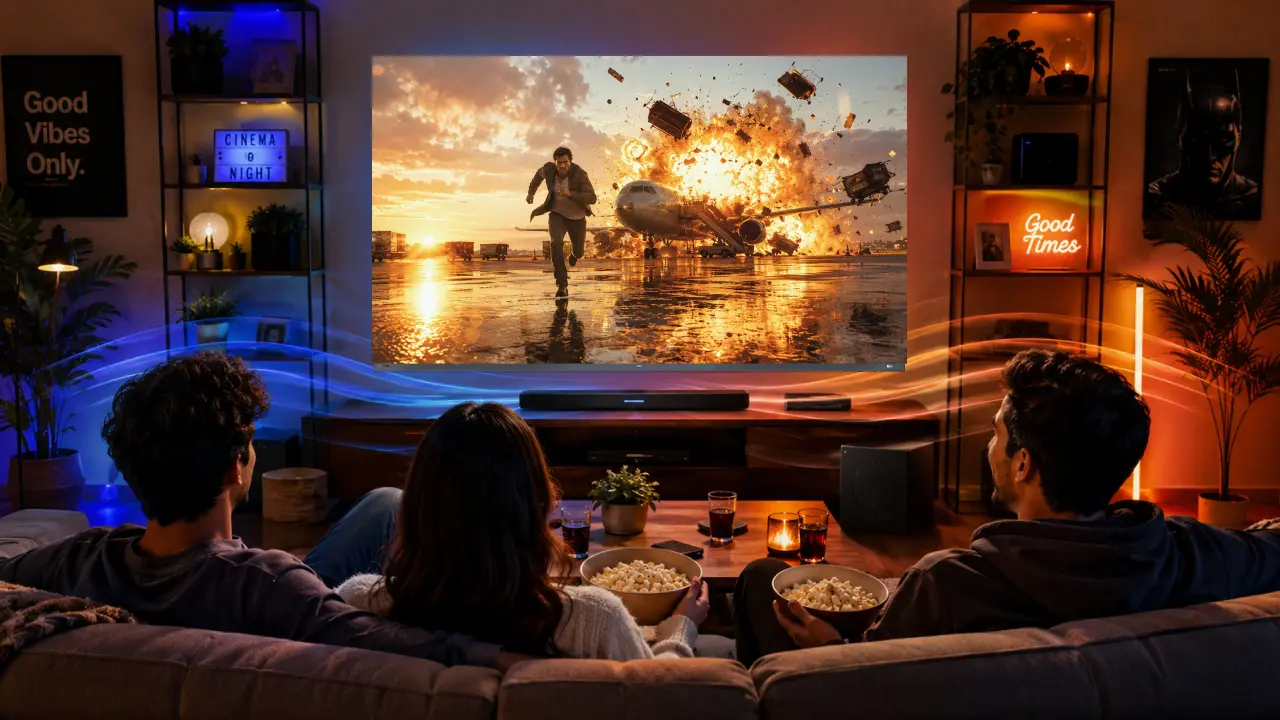

Bigger screens do not just change what you watch. They change how you feel while watching.
A cricket match on a compact screen feels functional. The same match on a large immersive display feels cinematic. That difference matters more than most people realise. Screen size changes emotion, focus, memory, and even the way families spend time together.
Modern Indian homes are no longer treating televisions as background appliances. They are becoming experience centres.
And immersion sits at the centre of that shift.
The living room has quietly become the new theatre.
Ten years ago, people planned weekends around movie halls.
Today, they plan them around comfort.
Food delivery arrives. Curtains close. The lights dim. Someone opens a streaming app. Suddenly, the living room feels bigger than it did an hour ago.
That is what immersive screens do. They reshape ordinary spaces.
A Larger Screen Pulls You Into The Story
Think about what usually breaks immersion on smaller displays:
- Subtitles become harder to follow
- Action scenes feel compressed
- Sports lose spatial detail
- Facial expressions disappear
- Background distractions stay visible
The room never disappears fully.
A larger display changes that relationship. It occupies more of your visual field. Your attention narrows naturally. The outside world softens for a while.
Immersion is not about watching harder. It is about forgetting the screen exists at all.
That is why larger televisions are growing rapidly across Indian homes, especially among younger buyers creating modern entertainment spaces.
Screen Size Impacts Attention More Than People Think
People often say attention spans are shrinking.
That is partially true.
But the environment shapes behaviour more than people admit.
Small Screens Encourage Distracted Watching
Phones and smaller displays encourage multitasking:
- Scroll during movies
- Reply to messages mid-scene
- Half-watch cricket while cooking
- Treat content as background noise
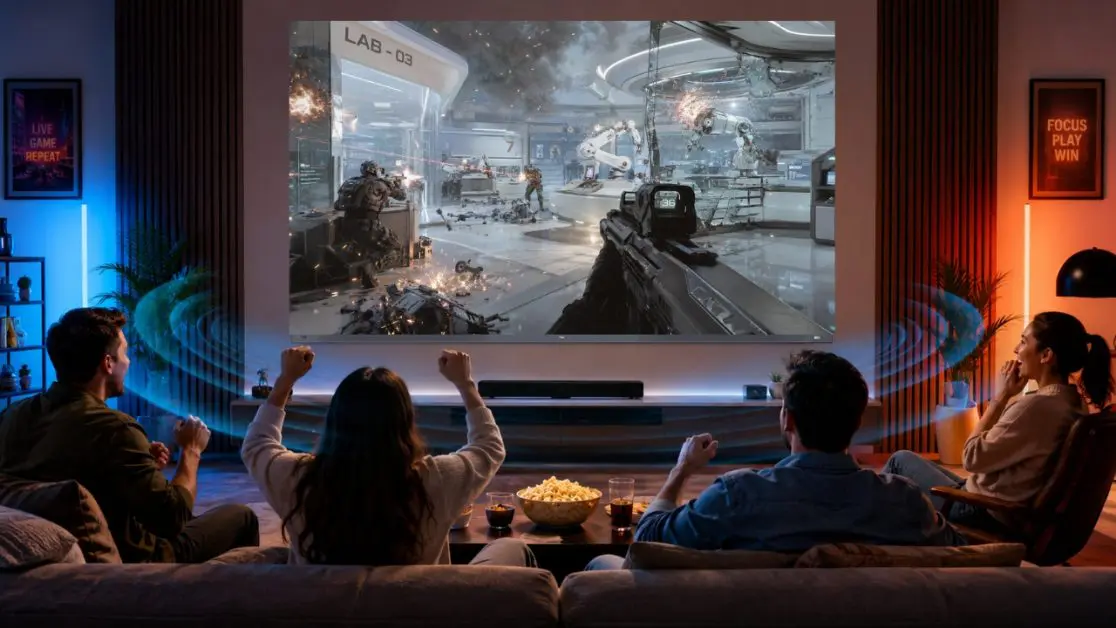
Large displays create a different contract.
You sit differently in front of them. Conversations pause naturally. Even silence feels intentional.
Scale changes behaviour.
That is why stadiums feel emotional. The size itself commands focus.
And increasingly, Indian households want that same energy at home.
Why Sports Feel More Emotional On Larger Displays
Cricket is a perfect example.
On smaller screens:
- Field placements feel crowded
- Crowd atmosphere gets lost
- Fast bowling loses intensity
- Tactical movement becomes harder to notice
On a larger immersive television:
- You notice player positioning
- Stadium lighting feels dramatic
- Crowd energy becomes part of the experience
- Replays feel cinematic instead of informational
The match stops feeling like “content.” It starts feeling like an occasion.
That distinction matters.
Especially in homes where entertainment is often shared across generations.
Immersion Depends On Distance Too
Most people obsess over specifications:
- 4K
- Refresh rates
- AI processors
- HDR formats
All important.
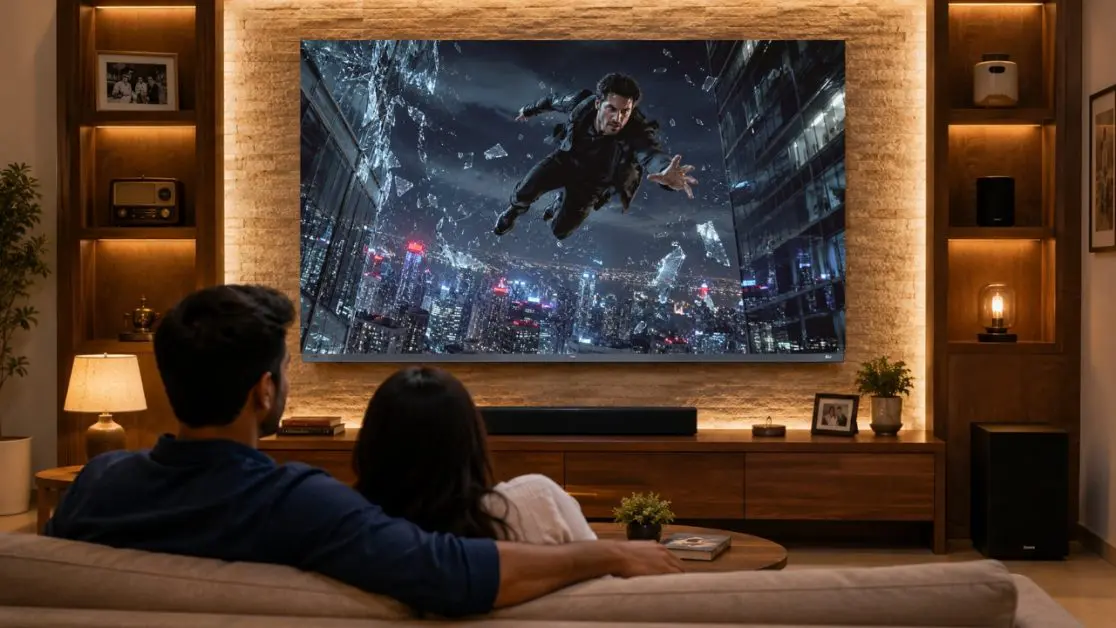
But viewing distance quietly changes everything.
A screen that feels too small for the room creates emotional distance. Quite literally.
The Right Screen Size Depends On How The Room Behaves
One option is a compact setup for solo bedroom viewing.
The second option is a balanced mid-sized display for apartments with closer seating arrangements.
The third option is a large-format immersive screen designed for open living spaces and shared entertainment.
Each setup creates different viewing habits.
- Smaller displays encourage casual consumption
- Mid-sized screens balance comfort and utility
- Larger screens create destination experiences
That last category is where premium home entertainment is moving rapidly.
Not because bigger automatically means better.
Because presence changes perception.
The Best Screen Technology Disappears Into The Experience
Nobody talks about television specifications after a memorable movie night.
They talk about the movie.
That is the point.
The best technology becomes invisible.
Why Larger Screens Demand Better Display Technology
As screen sizes increase, flaws become easier to notice:
- Motion blur
- Weak contrast
- Uneven brightness
- Colour inconsistency
- Poor sound separation
That is why premium display technologies matter more at larger scales.
For example, televisions like the Haier H100M96FUX 254 cm (100) QD-Mini LED 4K Smart Google TV focus heavily on cinematic brightness, AI-powered picture optimisation, and immersive contrast because large displays magnify every detail.
Similarly, the Haier H75M80FUX 189 cm (75) Mini LED 4K Google TV and Haier H85M80FUX 215 cm (85) Mini LED 4K Google TV are designed to combine immersive visuals with tuned audio performance because sound and scale must work together.
People do not remember resolution numbers.
They remember how the experience felt.
Sound Completes What The Screen Starts
A massive display with weak audio feels incomplete.
Like watching fireworks silently.
Immersion Is Multi-Sensory
The brain builds immersion through layers:
- Screen scale
- Contrast depth
- Audio clarity
- Motion smoothness
- Room lighting
- Viewing distance
Remove one layer and the illusion weakens quickly.
This is why premium television experiences increasingly focus on audio integration alongside display technology.
Modern households want cinematic experiences without turning the living room into a complicated technical setup.
Especially younger Indian buyers furnishing homes for the first time.
What Most Families Actually Want
Not complexity.
Not endless cables.
Not confusing settings menus.
They want:
- Smooth streaming
- Better sports viewing
- Strong sound clarity
- Easy smart connectivity
- Family-friendly entertainment
- Gaming responsiveness
The real shift is not technological.
It is behavioural.
People want technology that reduces effort while increasing emotional payoff.
Larger Screens Quietly Change Family Behaviour
Something interesting happens when homes upgrade to larger immersive displays.
People gather more often.
Not always intentionally.
The Television Becomes Social Infrastructure
Friday IPL screenings.
Late-night movie marathons.
Anime binges with siblings.
Parents watching devotional concerts on YouTube.
Friends bringing gaming consoles during weekends.
Children replaying animated films repeatedly.
The television becomes a shared anchor point.
That is not just entertainment behaviour. It is spatial behaviour.
The room reorganises itself around the experience.
And in urban Indian homes where every square foot matters, multi-purpose technology becomes more valuable than ever.
One Screen. Multiple Roles.
A modern large-format television now functions as:
- A home theatre
- A gaming display
- A music hub
- A family gathering space
- A productivity screen
- A sports-viewing centre during tournaments
People are no longer simply purchasing a television.
They are redesigning how the room feels.
Gaming Accelerated The Shift Toward Larger Displays
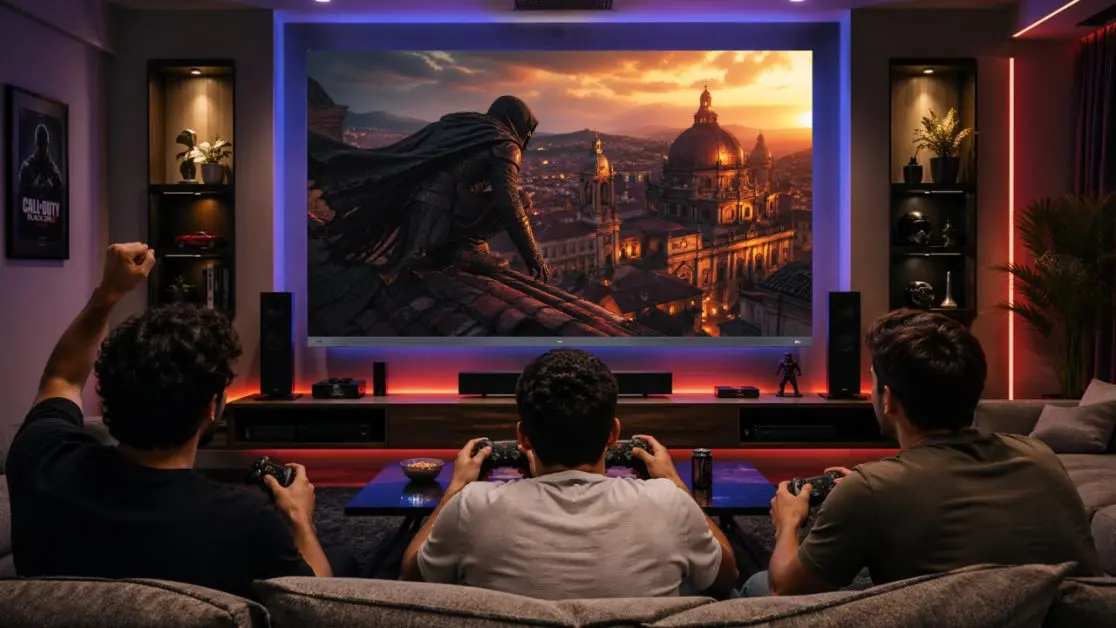
Gaming changed the screen conversation dramatically.
Especially for Gen Z users.
Games Reward Visual Scale
Competitive gaming depends heavily on visibility:
- Faster reactions
- Wider environmental awareness
- Better motion tracking
- Improved visual depth
Large displays amplify those experiences.
But only when paired with responsive performance.
A laggy large screen feels frustrating. A responsive large display feels transportive.
That difference matters more than marketing slogans.
Because immersion without responsiveness becomes fatigue.
There Is Such A Thing As “Too Big”
This is where many buying conversations become unrealistic.
Bigger is not endlessly better.
Context matters.
The Ideal Screen Matches The Room
A television should feel immersive, not overwhelming.
Questions worth asking:
- How far is the seating area?
- How much daylight enters the room?
- Is the TV mainly for movies, sports, gaming, or mixed use?
- Will the experience mostly be solo or family-driven?
Good decisions come from alignment.
Not excess.
A thoughtfully chosen screen always outperforms an oversized impulse purchase.
Why Indian Homes Are Moving Toward Larger Screens
Three shifts are happening simultaneously.
1. Streaming Has Changed Viewing Habits
People now watch intentionally instead of passively following schedules.
That increases emotional investment.
2. Homes Have Become Experience Spaces
Post-pandemic lifestyles changed how people use their homes.
Entertainment now happens inside more often.
3. Premium Viewing Feels More Accessible
Large-format televisions once felt distant and aspirational.
Today, they feel achievable for many upwardly mobile households.
That changes buying psychology completely.
People no longer ask:
“Do we need a larger TV?”
They ask:
“What kind of experience do we want inside this room?”
That is a far more meaningful question.
The Future Of Immersion Is Surprisingly Human
The industry talks constantly about AI engines, processing speeds, display zones, and refresh rates.
Useful advancements. Absolutely.
But the deeper story is simpler.
People want moments that feel fuller.
A cricket match that feels stadium-like.
A film that actually feels cinematic.
A family evening that feels less distracted.
A home that feels calmer after long working days.
That is why immersion matters.
Not because technology became larger.
Because life became noisier.
And immersive experiences help people disappear into something meaningful for a little while.
That is the hidden system behind screen size.
The larger the experience feels, the smaller everyday distractions become.
Frequently Asked Questions
Does a bigger TV really make a difference, or is it mostly marketing?
A larger screen can significantly increase immersion because it occupies more of your field of view. This helps reduce distractions and makes movies, sports, and games feel more engaging rather than simply larger.
How do I know if my TV is too small for my room?
If you struggle to notice details, read subtitles comfortably, or feel disconnected from the action during movies and sports, your screen may be too small for your viewing distance.
Can a TV be too big for a room?
Yes. An oversized TV can feel overwhelming, cause eye strain, and make viewing uncomfortable if seating is too close.
Should I prioritize screen size or picture quality?
Ideally both. However, larger screens make display flaws more visible, so picture quality becomes increasingly important as screen size increases.
Why do movies feel more cinematic on larger screens?
Larger displays fill more of your visual field, helping your brain focus on the content rather than the surrounding room.
Why do I feel more emotionally connected during sports on a bigger TV?
Larger screens make stadium details, player movement, crowd reactions, and replays more visible, creating a stronger sense of presence.