

The Smarter Way to Cook Complete Meals
Don’t you hate it when you cook sometimes?
Rice is ready but water’s not yet absorbed. Gravy is barely warm but rice is crunchy. Vegetables are mushy but the spice mix isn’t roasted. You pause, scrape, modify settings, restart only to repeat the process from step 1.
Sound familiar? Odds are you’ve done this many times in Indian households.
The problem isn’t always the recipe. It’s that different ingredients take different amounts of time and heat to cook through. Which is why multi-stage cooking is quickly becoming one of the handiest functions on newer convection microwaves.
Rather than having you babysit every stage of the cooking process, your microwave figures out the steps for you. It switches modes, changes power settings and finishes cooking with minimal supervision required.
This handy function is a boon for lazy chefs who live in households where convenience is king.
What Exactly Is Multi-Stage Cooking?
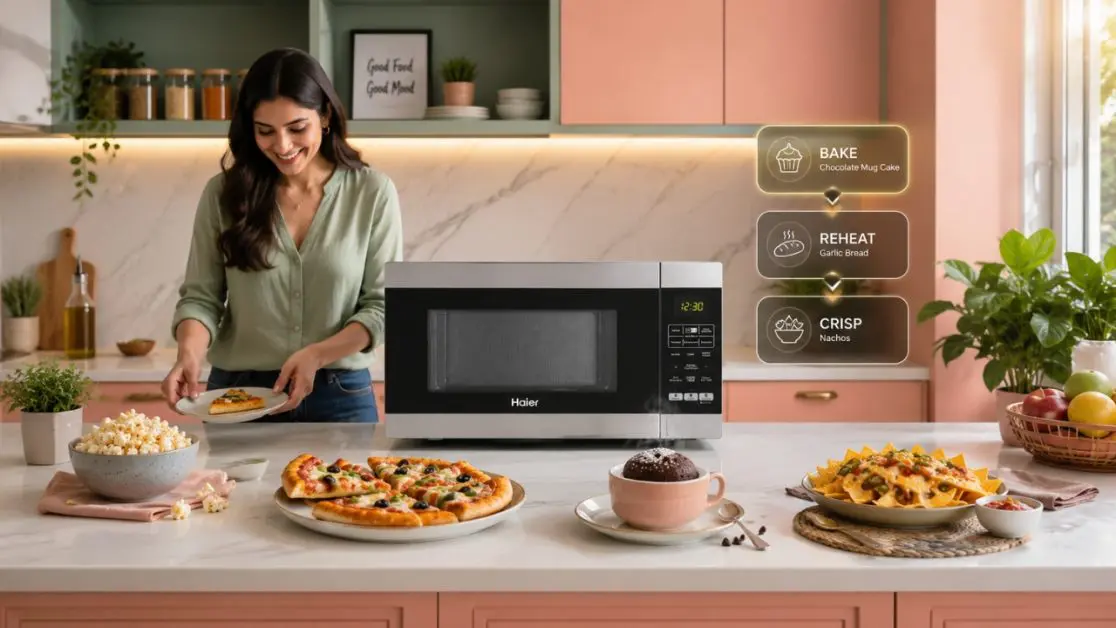
Multi-stage cooking allows a microwave oven to execute multiple cooking steps within a single program.
Rather than stopping after one cycle, the appliance automatically moves from one cooking stage to the next using pre-set temperatures, power levels or cooking modes.
A typical cooking sequence may look something like this:
| Cooking Stage | What Happens |
| Stage 1 | Defrost frozen ingredients |
| Stage 2 | Microwave cooking begins |
| Stage 3 | Grill or convection finishes the dish |
| Final Stage | Cooking ends automatically |
Instead of pressing multiple buttons throughout the cooking process, you simply configure or choose a program once.
The microwave does the rest.
Why Different Foods Need Different Cooking Stages
Think about preparing paneer tikka.
You wouldn’t normally cook it at full microwave power from start to finish.
Ideally, you would:
- Heat the marinated paneer gently
- Cook it thoroughly
- Finish it under grill or convection mode for slight browning
The same applies to many Indian favourites.
Some common examples include:
| Dish | Why Multi-Stage Cooking Helps |
| Biryani | Even heating without drying the rice |
| Lasagna | Interior cooks before cheese browns |
| Pizza | Crispy crust with properly melted toppings |
| Paneer Tikka | Tender inside with grilled finish |
| Baked Pasta | Uniform cooking followed by golden top layer |
| Kebabs | Internal cooking before surface roasting |
Instead of manually changing settings between every stage, the microwave performs each transition automatically.
How Multi-Stage Cooking Actually Works
While it sounds sophisticated, the concept is surprisingly simple.
The microwave follows a programmed sequence.
For example:
- Defrost at lower power.
- Microwave at medium power.
- Switch to convection.
- Finish using grill mode.
Because every stage has already been planned, food receives the right type of heat at the right time.
No interruptions.
No guesswork.
No standing beside the microwave waiting for each cycle to finish.
Benefits That Make Everyday Cooking Easier
Multi-stage cooking isn’t designed only for complicated recipes.
It also improves everyday meals.
Consistent Cooking
Different ingredients finish together instead of cooking unevenly.
Better Texture
Grilling or convection can be applied at the end instead of throughout cooking, helping maintain moisture while creating a crisp finish.
Less Manual Monitoring
You don’t have to remember when to change modes or adjust power.
Faster Meal Preparation
Everything happens in one continuous process.
Better Results for Beginners
Even if you’re not confident in the kitchen, automated cooking stages reduce the chances of overcooking or undercooking.
Common Foods That Benefit from Multi-Stage Cooking
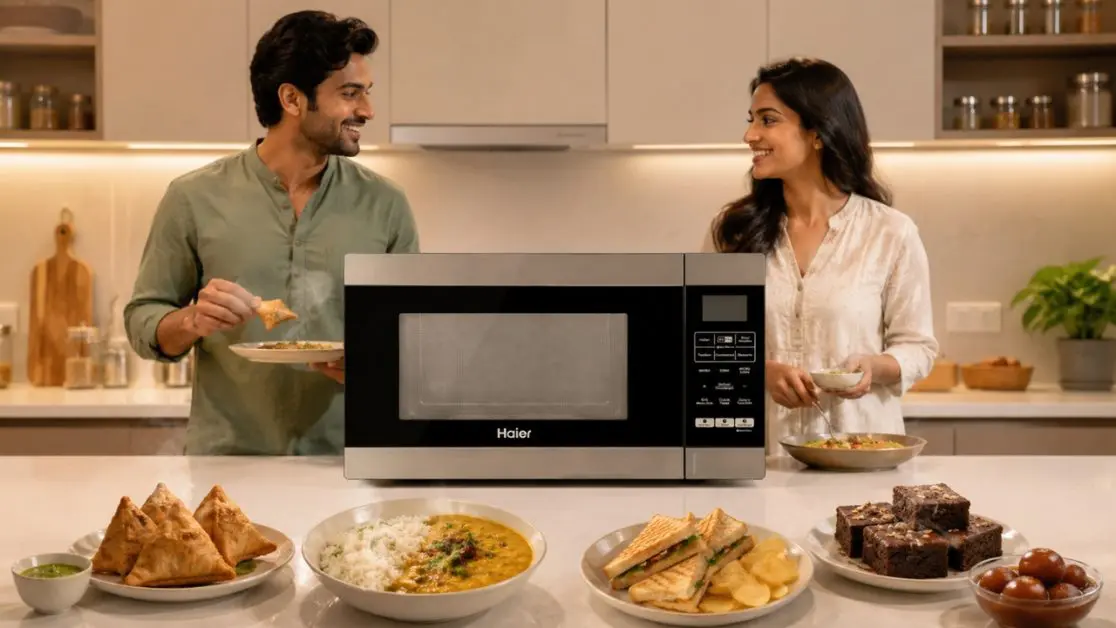
Here’s where this feature becomes especially useful in Indian homes.
Family dinners
- Baked vegetables
- Pasta
- Rice casseroles
Evening snacks
- Garlic bread
- Pizza
- Stuffed sandwiches
Weekend cooking
- Chicken roast
- Paneer tikka
- Kebabs
- Fish preparations
Desserts
- Brownies
- Cakes
- Baked puddings
Recipes involving multiple textures often produce noticeably better results when cooking stages change automatically.
Multi-Stage Cooking vs Single-Stage Cooking
| Single-Stage Cooking | Multi-Stage Cooking |
| One cooking mode only | Multiple cooking modes in one cycle |
| Manual intervention required | Automatic stage transitions |
| Greater chance of uneven cooking | More balanced cooking results |
| Better for reheating | Suitable for complete recipes |
| Requires monitoring | Minimal supervision |
As recipes become more elaborate, multi-stage cooking becomes increasingly useful.
Where Haier Makes the Difference
Technology becomes valuable only when it simplifies everyday life.
That’s where Haier convection microwaves stand apart.
Models like the Haier 25L Convection Microwave Oven (HIL2501CBSH) include an advanced Multi-Stage Cooking function that automatically adjusts cooking stages so meals are prepared more efficiently with less manual effort. The model also offers 305 Auto Cook Menus, Combination Cooking, Memory Function, Bread Basket programmes, Oil-Free Cooking, Deodorizer and a Stainless Steel Cavity for enhanced convenience.
For families looking for even greater versatility, the Haier 30L Convection Microwave with In-Built Air Fryer (HIL3001ARSB) expands cooking possibilities further.
Some of its standout features include:
- In-Built Air Fryer with dedicated air fryer menus
- Motorised Rotisserie for uniform grilling
- 305 Auto Cook Menus
- Combination Cooking
- Stainless Steel Cavity
- Multiple Power Levels
- Touch Control Panel
- 5-in-1 Cooking functionality combining Microwave, Grill, Convection, Air Fryer and Rotisserie
These features work together to reduce cooking complexity while giving you greater flexibility across a wide variety of recipes.
Tips for Getting Better Results with Multi-Stage Cooking
A few practical habits can help you make the most of this feature.
Use microwave-safe cookware
Not every utensil performs equally across microwave, grill and convection modes.
Avoid overloading the cavity
Leaving enough space around the food encourages more even heat circulation.
Follow recipe quantities
Auto programmes and cooking stages generally perform best when food quantities are close to recommended levels.
Arrange food evenly
Uniform placement helps different ingredients cook consistently throughout the cycle.
Allow standing time
After cooking finishes, letting food rest for a minute or two often improves flavour distribution and texture.
Is Multi-Stage Cooking Suitable for Everyday Use?
Absolutely.
Most assume that it’s only for complicated baking or restaurant quality dishes.
The truth is it’s just as handy for normal cooking.
Making breakfast before work, whipping up leftovers in a new way, preparing after-school snacks for the kids or cooking an entire meal for your family. Meal stages take many of the redundant steps out of cooking.
You spend less time running back and forth to the machine and more time eating.
Final Thoughts
Cooking today is not just about speed. It’s about cooking with confidence, knowing you’ll get great results every time without having to babysit the settings.
Multi-stage cooking takes care of one of home cooking’s most common problems: preparing multiple foods with different cooking methods by automatically switching between cook stages in one programme cycle. You get added convenience, more consistent results and less hassle when it comes to cooking day-to-day meals.
Multi-stage cooking paired with smart features such as a comprehensive Auto Cook Menus, Combination Cooking, Stainless Steel Cavities, Oil Free Cooking Options and innovative cooking technologies makes Haier convection microwave ovens an easy, intelligent choice for meal preparation.
If you want your microwave to do more than just heat food, check out Haier’s range of Convection Microwave Ovens that offer the versatility and precision you need to cook entire meals at the touch of a button HIL25O1CBSH and HIL3001ARSB, specifically designed keeping modern Indian kitchens in mind.
Frequently Asked Questions
What is Multi-Stage Cooking in a microwave?
Multi-Stage Cooking is a feature that allows a microwave to automatically switch between different cooking modes, power levels, or temperatures during a single cooking cycle. This helps prepare recipes that require more than one stage without manual intervention.
How does Multi-Stage Cooking improve cooking results?
By automatically changing cooking methods at the right time, Multi-Stage Cooking helps food cook more evenly, improves texture, reduces the risk of overcooking or undercooking, and delivers more consistent results for complex recipes.
Which recipes are best suited for Multi-Stage Cooking?
Multi-Stage Cooking is ideal for recipes such as paneer tikka, pizza, lasagna, baked pasta, garlic bread, biryani, kebabs, roasted vegetables, cakes, brownies, and other dishes that require different cooking stages.
Do I need to change the settings during Multi-Stage Cooking?
No. Once the cooking program is selected, the microwave automatically progresses through each stage, such as defrosting, microwave cooking, convection baking, or grilling, without requiring you to adjust the settings manually.
Which Haier convection microwave models offer Multi-Stage Cooking?
The Haier 25L Convection Microwave Oven (HIL2501CBSH) features Multi-Stage Cooking along with 305 Auto Cook Menus, Combination Cooking, a Bread Basket function, Memory Function, and Oil-Free Cooking. The Haier 30L Convection Microwave with In-Built Air Fryer (HIL3001ARSB) also offers Combination Cooking and advanced cooking functions for versatile meal preparation.
Is Multi-Stage Cooking suitable for everyday family meals?
Yes. Multi-Stage Cooking is useful for both everyday and special-occasion cooking. It simplifies preparing complete meals by automatically managing different cooking stages, making it ideal for busy households that want consistent results with less effort.