
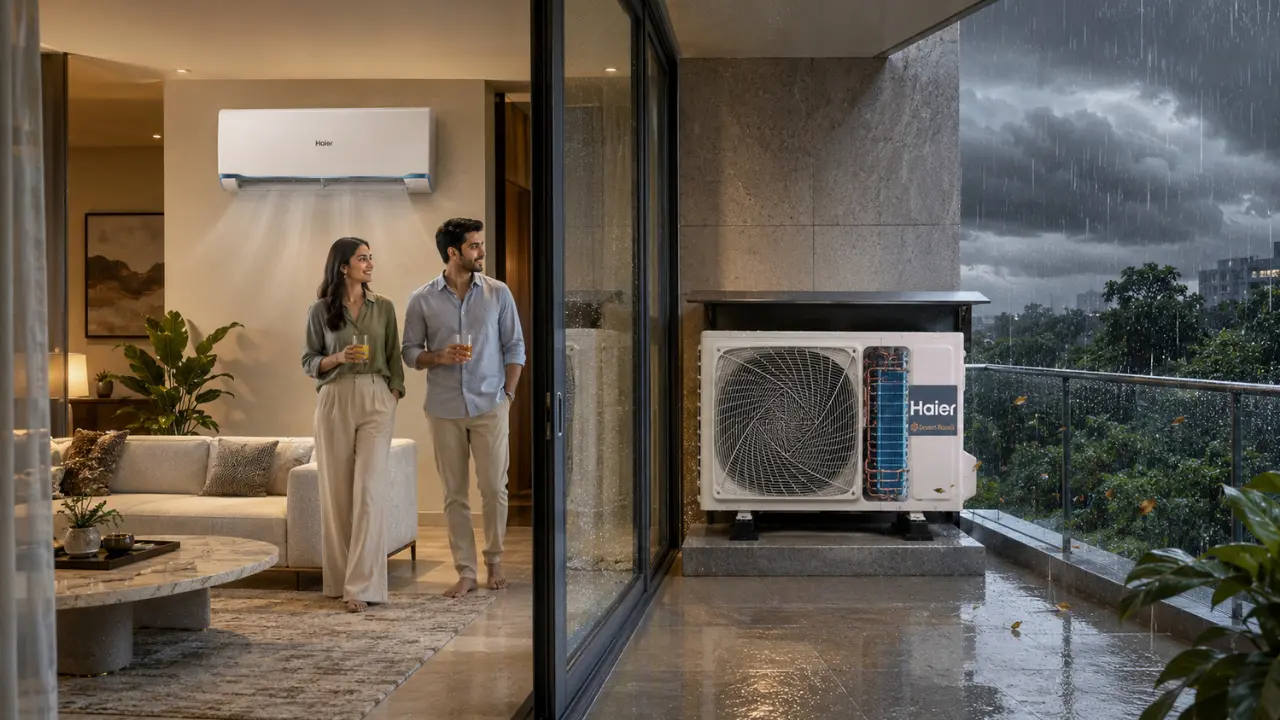

Most people judge an air conditioner from inside the room. How quickly did the temperature drop? Is the airflow reaching the sofa? Is the AC quiet enough at night?
Meanwhile, half the system is working outside.
An outdoor unit may spend months facing afternoon heat, airborne dust, humidity and rapidly changing weather. In India, that exposure can be particularly demanding because one AC may have to operate through very different seasonal conditions within a single year.
That changes how an AC should be evaluated. Cooling performance matters, certainly, but so does the engineering that supports it outdoors.
Your AC Experiences Summer Differently Than You Do
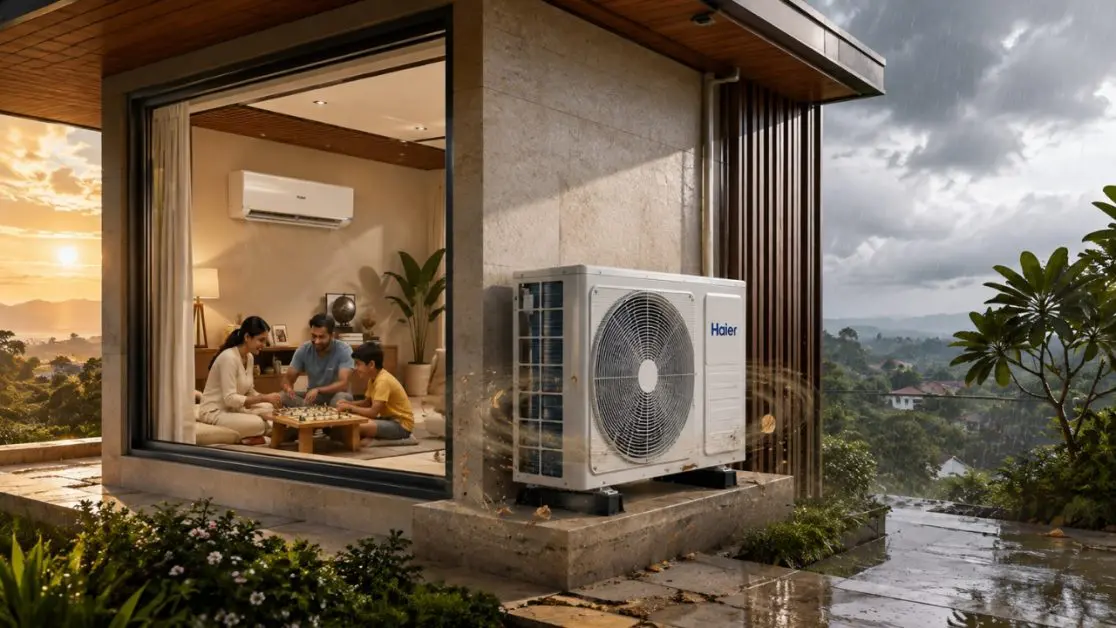
Imagine a scorching afternoon. Curtains are drawn, the fan is running, and everyone wants the room cooler immediately.
The outdoor unit has the opposite task. It has to help release heat while sitting in an already hot environment.
As ambient temperature climbs, operating conditions become tougher. This is why high-ambient cooling capability deserves attention when choosing an AC for regions that experience severe summers.
The Haier 1.5 Ton 5 Star Morning Mist Gravity Series Heavy Duty AI Smart AC, 5.13 kW (HSA19GHD-MAI5NB-I) is specified to cool at ambient temperatures of up to 60°C. Haier pairs this capability with a specially designed conformal coating and Hyper PCB intended to protect AC components from external factors.
That gives buyers a different way to read an AC specification sheet. Instead of looking only at what happens inside the room, look at what the machine is designed to handle outside it.
Think of Indian Weather as Four Different Tests
There isn’t really one universal “Indian climate”. An outdoor AC unit installed in a hot, dry location faces a different environment from one operating through a humid coastal season.
Broadly, weather can challenge the outdoor system in four ways.
Heat puts cooling capability under pressure
Peak summer is when households demand the most from their ACs. High ambient temperatures can create demanding operating conditions precisely when long hours of cooling are required.
Dust settles where you don’t notice it
The outdoor unit isn’t hidden from the environment. Dust and loose debris can reach its external surfaces and heat-exchange area.
The problem is easy to overlook because homeowners rarely inspect the outdoor unit as frequently as they notice the indoor AC.
Monsoon introduces moisture and humidity
After months of heat, many Indian cities move into extended periods of rain and humidity. Outdoor components consequently operate in a completely different environment.
Protection against environmental exposure therefore becomes more relevant than it might appear during a showroom demonstration.
Seasons keep changing
Perhaps the toughest part is repetition.
Hot. Dusty. Humid. Hot again.
An AC isn’t purchased for one afternoon. Its outdoor unit continues encountering changing conditions across seasons, which is why component protection and construction deserve consideration alongside headline cooling features.
The Condenser Needs Breathing Room
One surprisingly common mistake is treating the outdoor unit like something that should be boxed away.
It shouldn’t.
The outdoor section needs suitable airflow around it. Blocking the surrounding space with stored household items or improvised enclosures may interfere with the conditions required for heat exchange.
For homeowners, the practical checklist is refreshingly short:
- Keep unnecessary objects away from the outdoor unit.
- Avoid blocking its airflow.
- Watch for leaves and loose debris accumulating nearby.
- Don’t open or interfere with internal electrical components.
- Use professional servicing when inspection or technical attention is required.
Protection doesn’t mean suffocation. Proper placement and unobstructed airflow matter too.
A Cleaner Outdoor Unit Can Support Better Heat Exchange
Here’s something buyers rarely ask in a showroom:
What happens to the outdoor unit after the AC switches off?
Haier has approached this question through ODU Cyclone Clean in its Gravity Series.
Through intelligent programme control, the outdoor fan runs in reverse after shutdown to help remove debris from the condenser and heat-exchange fins. The function is designed to support efficient heat transfer and sustained energy savings.
That’s an interesting shift in AC design.
Traditionally, “self-clean” features tend to make people think about the indoor side of an air conditioner. ODU Cyclone Clean extends the maintenance conversation outdoors the area that is actually exposed to dust and environmental debris.
Materials Matter More After the First Summer
A beautiful indoor AC can make an immediate impression. Outdoor-unit construction tends to prove its relevance much later.
Haier equips the featured Gravity Series models with 100% grooved copper and Super Anti-Corrosion protection with indoor and outdoor Blue Fins. The product also lists a Hyper & Stronger PCB among its features.
These details matter because weather exposure isn’t a one-day event.
Consider a family using the same AC through several seasons. The unit isn’t merely being switched on and off; its outdoor section continues sitting in the environment even during periods of lighter usage.
So when comparing two ACs with apparently similar cooling specifications, it makes sense to examine what is protecting and supporting the system as well.
What Happens When the Weather Changes While the AC Is Running?
Modern cooling is becoming less about forcing one fixed operating pattern onto every situation.
The featured Gravity Series uses AI for Air powered by AI-ATMOX. Its AI for Comfort functionality analyses real-time weather and indoor conditions alongside usage habits, then selects an operating mode intended to provide suitable comfort.
There is also AI for Savings, which monitors energy consumption, provides alerts when usage increases and can shift operation to AI ECO mode. Haier states energy savings of up to 56% through this functionality.
That is particularly relevant in a country where AC conditions can change considerably between an April afternoon, a humid July evening and a comparatively pleasant night later in the year.
The machine isn’t dealing with the same environment every time it starts.
Heavy-Duty Cooling Is More Than Fast Cooling
Cooling speed gets attention because it is instantly noticeable.
Haier’s Gravity Series offers Supersonic Cooling in 10 seconds, using KTS and PKC technology, alongside a 20-metre long air throw. Those features address the immediate experience inside the room.
But there is another side to heavy-duty performance.
The HEXA Inverter uses advanced DC technology, while the Gravity Series is designed for stable operation at high ambient temperatures. Haier’s product material also highlights 90% cooling capacity at 48°C and stable operation at 60°C.
Put together, the proposition becomes broader than “cool the room quickly”.
It is about combining indoor comfort with engineering designed around demanding outdoor conditions.
A Better Way to Choose an AC for Your City
Before buying an AC, think about where its outdoor unit will actually spend the next several years.
Is your area intensely hot during summer? Does the neighbourhood become dusty? Is humidity a regular feature of the climate? Where can the outdoor unit be installed with appropriate airflow?
Then examine the AC accordingly.
For households looking for a system designed around these realities, Haier offers the 1.5 Ton 5 Star Morning Mist Gravity Series Heavy Duty AI Smart AC, 5.13 kW (HSA19GHD-MAI5NB-I) and the 1.5 Ton 5 Star Midnight Dream Gravity Series Heavy Duty AI Smart AC, 5.13 kW (HSA19GHD-PAI5NB-I).
Both bring together features including high-ambient cooling up to 60°C, HEXA Inverter technology, Hyper PCB, ODU Cyclone Clean, 100% grooved copper and anti-corrosion protection with indoor and outdoor Blue Fins. The Midnight Dream model also carries the same core Gravity AI Series positioning in a different finish.
That’s ultimately where outdoor-unit engineering earns its place in the buying decision.
You experience an AC indoors. But a considerable part of the work required to create that comfort happens on the other side of the wall.
Frequently Asked Questions
1. How does hot weather affect an outdoor AC unit?
High ambient temperatures make it harder for the outdoor unit to release heat. An AC designed for high-ambient operation can maintain cooling performance more effectively during extreme summer conditions.
2. Why is high-ambient cooling important in India?
Many parts of India experience very high summer temperatures. High-ambient cooling capability helps an AC operate reliably when outdoor temperatures become especially demanding.
3. Can dust affect an outdoor AC unit?
Yes. Dust and loose debris can accumulate around the condenser and heat-exchange fins, potentially affecting heat transfer and overall efficiency. Keeping the outdoor unit clean and unobstructed can help.
4. How does monsoon weather affect an AC outdoor unit?
Rain and high humidity expose outdoor components to moisture for extended periods. Protective construction and anti-corrosion features can help the unit withstand these environmental conditions.
5. Why should an outdoor AC unit have enough space around it?
The outdoor unit needs adequate airflow to release heat. Blocking it with objects, storage materials or an unsuitable enclosure can interfere with heat exchange and affect performance.
6. What is ODU Cyclone Clean?
ODU Cyclone Clean is a feature in Haier’s Gravity Series that reverses the outdoor fan after shutdown to help remove debris from the condenser and heat-exchange fins.