
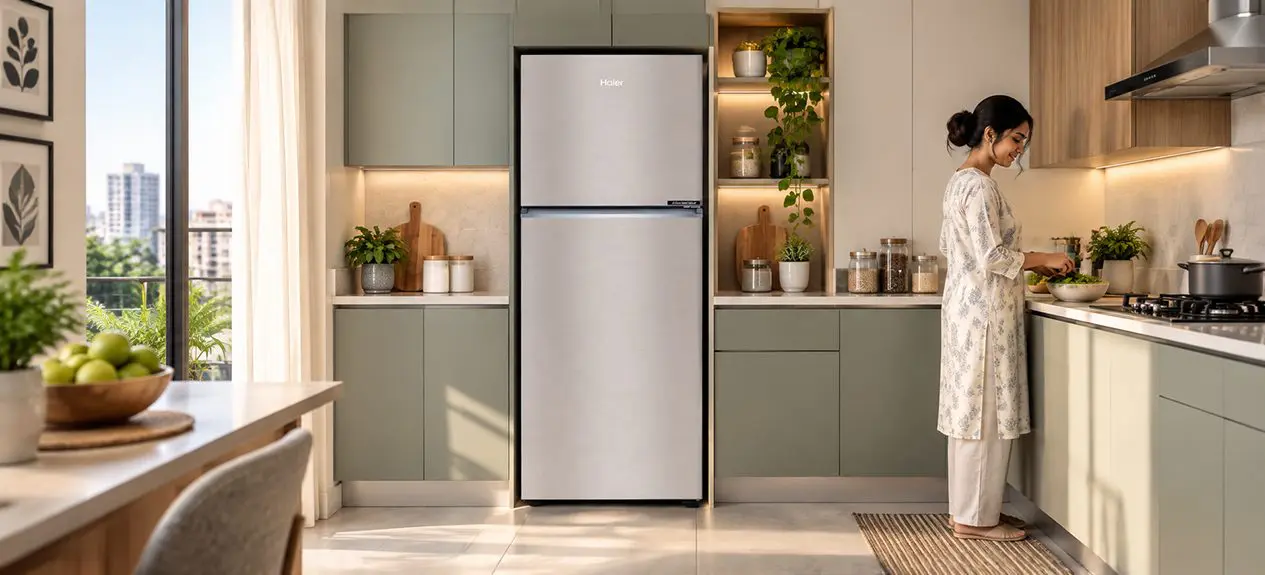

Every appliance choice is a considered choice for a small modular kitchen, especially when floor space, cabinetry and everyday movement have to work together. The fridge is one of the largest appliances in the room, so its placement can affect how open and functional the kitchen feels.
That’s why it’s important to look beyond capacity alone. Knowing the double-door fridge dimensions and how the fridge will sit in relation to the surrounding layout can help in choosing a model that will feel right for the space without disrupting the way the kitchen is used.
The first step is understanding what those size specs are really telling you about the fridge.
What Does the Size of a Double-Door Fridge Actually Tell You?
When you look at the double-door fridge size, there are two things to pay attention to: storage capacity and the refrigerator’s external measurements. Capacity is usually given in litres and tells you how much food the fridge can hold, while the width, height and depth tell you how much space the appliance will actually occupy in the kitchen.
This is why double door fridge size matters just as much as the litre rating, especially in a modular kitchen. Two refrigerators with similar capacities can still have different proportions depending on their design and internal layout, so checking the complete measurements gives you a much clearer idea of how well a model will fit into the available space.
How Much Space Does a Double-Door Refrigerator Usually Take Up?
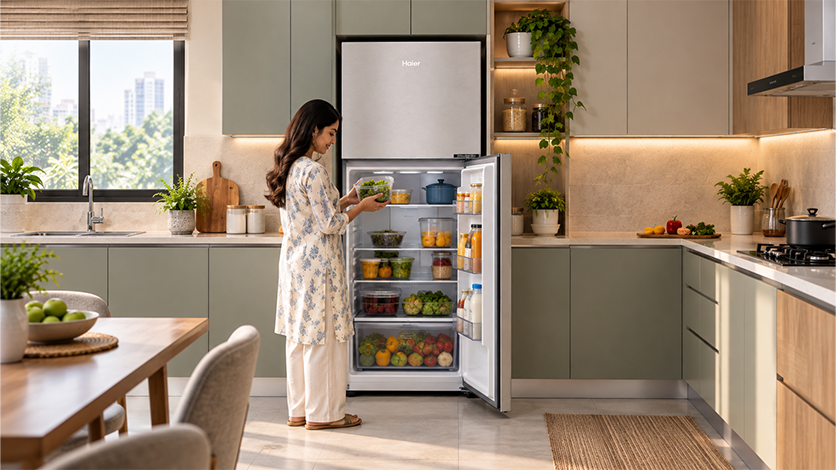
A good-sized refrigerator can impact the comfort of the space in a small kitchen when the doors are open and people are moving around it. Looking at the area around the appliance, not just the space underneath it, gives a better idea of how much room it will really need.
- Think about the working space in front of the fridge. You need enough room to stand comfortably while loading groceries, taking out containers or organising shelves.
- Corner placements can be more restrictive than they appear. A refrigerator positioned close to a side wall may fit into the allotted space but still feel awkward in daily use. Corners can limit how freely you approach the appliance or reach into the side of the compartment.
- Nearby heat-producing appliances can influence the best location. Placing a refrigerator immediately beside an oven, hob or another strong heat source can make the surrounding area warmer and may increase the cooling load. Where possible, the refrigerator should have a position that keeps it away from direct heat and strong sunlight.
- Allow for access when the appliance needs to be moved. Cleaning behind the refrigerator, reaching the electrical connection or arranging servicing is easier when the appliance is not permanently boxed into an inaccessible space.
Measuring Your Modular Kitchen Before Buying a Fridge
Measure the exact space where the refrigerator will sit, including width, height and depth available between cabinets and counters before settling on a refrigerator. For a compact layout, the right modular kitchen fridge size is based on the usable opening, not the total size of the kitchen.
This is also where “What is the difference between a deep fridge and a normal fridge?” becomes useful to think about. What matters in practice is how far the appliance extends from the wall or surrounding cabinetry. Comparing the listed depth with your counter line and walkway can give you a much clearer picture of the final fit.
Confused about what size refrigerator to invest in?
Read through: Fridge Size Guide: How to Pick One That Fits Your Kitchen Perfectly
How Do You Choose the Right Fridge Size for Your Household?
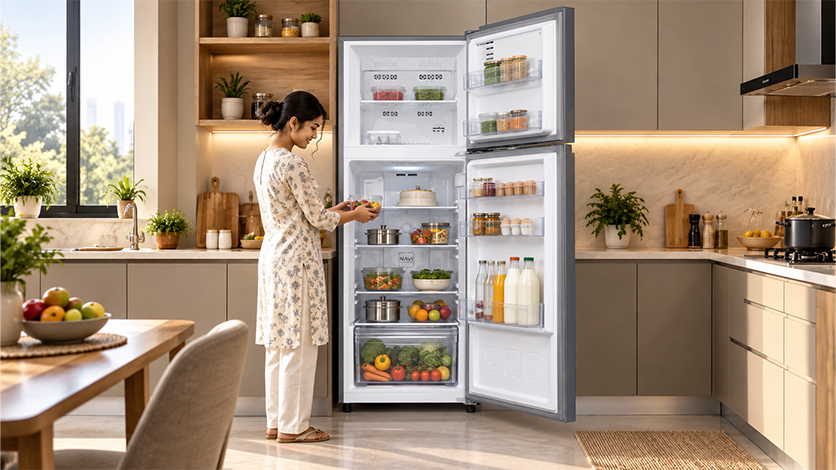
A fridge can feel spacious on paper and still become awkward once everyday containers, bottles and food boxes go inside. Looking at the kind of things your household actually stores can give you a much more useful idea of the capacity you need.
- Pay attention to the size of the containers you use most. Large kadais, casserole dishes, tiffin boxes or meal-prep containers can take up more usable shelf space than expected.
- Bottle and beverage storage can take up a surprising amount of space. Families that regularly keep milk bottles, juice cartons, water bottles or soft drinks may need more door and shelf space than households that store fewer beverages.
- Consider whether you need dedicated space for different food types. Some households prefer keeping fruits, vegetables, dairy, leftovers and snacks in clearly separated areas. If that sounds familiar, a slightly roomier refrigerator can make organisation easier without constantly rearranging shelves.
- Think about how your needs may change over the next few years. A fridge is usually bought for long-term use, so it can help to look beyond what works today. Changes in family size, work routines or cooking habits may gradually increase the amount of storage you need, making a little extra capacity useful over time.
How Haier’s Double-Door Refrigerators Fit Different Kitchen Spaces
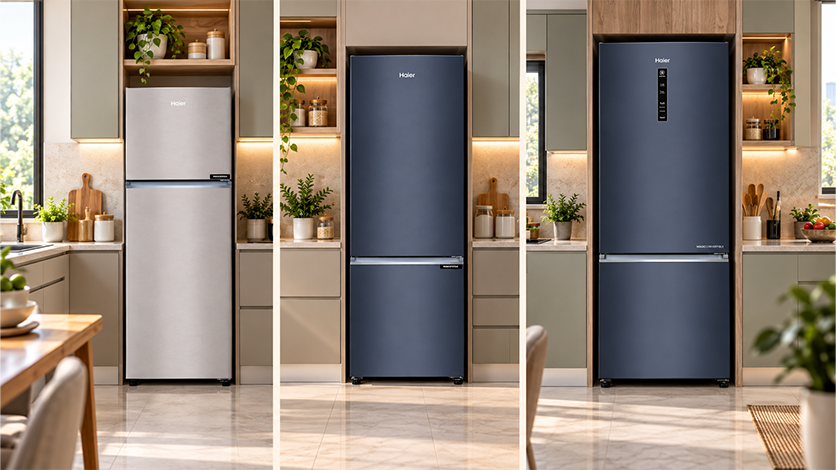
Kitchen layouts do not all leave the same amount of room for a refrigerator. Across our double-door range, we offer different capacities and top- or bottom-mounted configurations, so the choice can be based on both everyday storage needs and the actual width, depth and height available in the kitchen.
1> Our 240L top-mounted model keeps the footprint compact
For kitchens where width is limited, our 240L double-door models provide a relatively compact starting point. The HRF-2902 series measures 548 mm wide, 615 mm deep and 1560 mm high, while still providing separate refrigerator and freezer compartments.
The range also includes features such as 5-in-1 convertible modes on selected models, Turbo Icing and toughened glass shelves. This combination makes the 240L format particularly relevant when the available refrigerator space is modest, but a double-door layout is still preferred.
2> Our 265L bottom-mounted fridge uses a narrow body differently
Our Haier 2 Star 265L Flat Door Bottom Mount Refrigerator keeps the width at 548 mm and the depth at 615 mm, but increases the height to 1685 mm. That makes it an interesting option for layouts where vertical space is easier to accommodate than extra width.
Its bottom-mounted design places the refrigerator section higher up, while the freezer sits below. Haier’s catalogue also lists 8-in-1 convertible modes, a separate fruit box and a larger vegetable box for this 265L series, giving the additional height a practical storage role as well.
3> A 325L model needs a little more room around the cabinetry
When storage requirements increase, the physical footprint can increase with them. Our 325L 2-Star Double Door Bottom Mount Refrigerator has a 325L capacity and measures 623 mm wide, 665 mm deep and 1640 mm high. Compared with the 240L and 265L examples, the extra width and depth become important when the refrigerator has to sit between fixed cabinets or beside a countertop.
The model also brings in 14-in-1 convertible modes, a 2X bigger vegetable box and Triple Inverter & Dual Fan Technology. So the step up in size is not simply about adding litres; it also changes how the available storage can be organised and used.
4> The right Haier model depends on the space you can actually use
Our range shows why capacity should always be checked alongside the external fridge dimensions. A 240L top-mounted model and a 265L bottom-mounted model can share the same 548 mm width and 615 mm depth, while a 325L model moves up to 623 mm in width and 665 mm in depth.
For a small modular kitchen, these differences can matter as much as the litre rating itself. Checking the exact model dimensions against the cabinet opening, available depth, and door-opening space makes it easier to find a Haier double-door refrigerator that fits naturally into the kitchen rather than simply fitting on paper.
Conclusion
The best double-door fridge size at the end of the day is that which meets your storage requirements and your kitchen space. Capacity is important, but so are the actual width, depth and height of the refrigerator, plus the clearance needed for ventilation and easy movement of the door.
In advance, these measurements, for a small modular kitchen, can help you avoid an awkward fit and make day-to-day use much easier. Browse Haier’s selection of double door refrigerators and discover a model that fits your kitchen setup and your family’s storage needs.
FAQs
What is the size of a double-door fridge?
There is no standard measurement for the size of a double-door fridge, as this depends on its capacity, design and internal layout. Double-door refrigerators are generally narrower and shorter, but larger capacity units require greater width or depth. The safest bet is to check the exact width, depth and height of the model against the space available in your kitchen.
What are the dimensions of a 250-litre refrigerator?
The litre capacity of a refrigerator does not tell you the dimensions of the refrigerator. The size of a refrigerator in relation to height, width and depth will vary depending on whether it has a top freezer or bottom freezer, and the internal storage arrangement, with the volume around 250 litres. Always check the fridge dimensions listed by the manufacturer before planning the installation space.
What size fridge do I need for a family of 4?
For a family of four, a fridge of the 300-400 litre range can be a practical place to start. The right capacity also depends on how often the household shops, how much fresh food is stored and how well the freezer is used. If you’re a family that does grocery shopping for several days at a time, you might want to consider a slightly larger capacity for convenience.
How much clearance does a fridge need?
A refrigerator requires some open space around it to allow heat to escape properly and to operate without obstruction of the doors. The exact clearance varies between models, so installation instructions for the chosen refrigerator should always take priority. Leave enough space for the door to open completely and for shelves or vegetable drawers to come out easily.
How wide is a standard double-door fridge?
The width of a double-door refrigerator is not standardised. The width of a refrigerator varies depending on its capacity and design. Compact models can be about the mid-50 cm range in width, while larger refrigerators can be more than 60 cm. When choosing a modular kitchen fridge size, don’t just assume the standard width. Measure the actual space where you want to put the refrigerator.
What is a good fridge size for a small kitchen?
A double door fridge of around 240-270 litres is a good fit for many smaller kitchens, particularly for smaller households. But it should not be only a matter of capacity. Measure the physical width, depth and height of the refrigerator, and the space needed for ventilation and door movement.
How do I convert fridge litres to physical dimensions?
There is no direct formula to convert litres to fridge dimensions. Litres indicate internal storage capacity, while physical dimensions indicate the width, depth and height of the appliance measured externally. Two refrigerators of the same litre capacity can therefore have quite different external measurements.
The same applies even at much smaller capacities. How big is a 30 litre fridge? can only be answered by checking the dimensions of the particular model, since a 30-litre capacity does not translate into one fixed width, depth or height.