
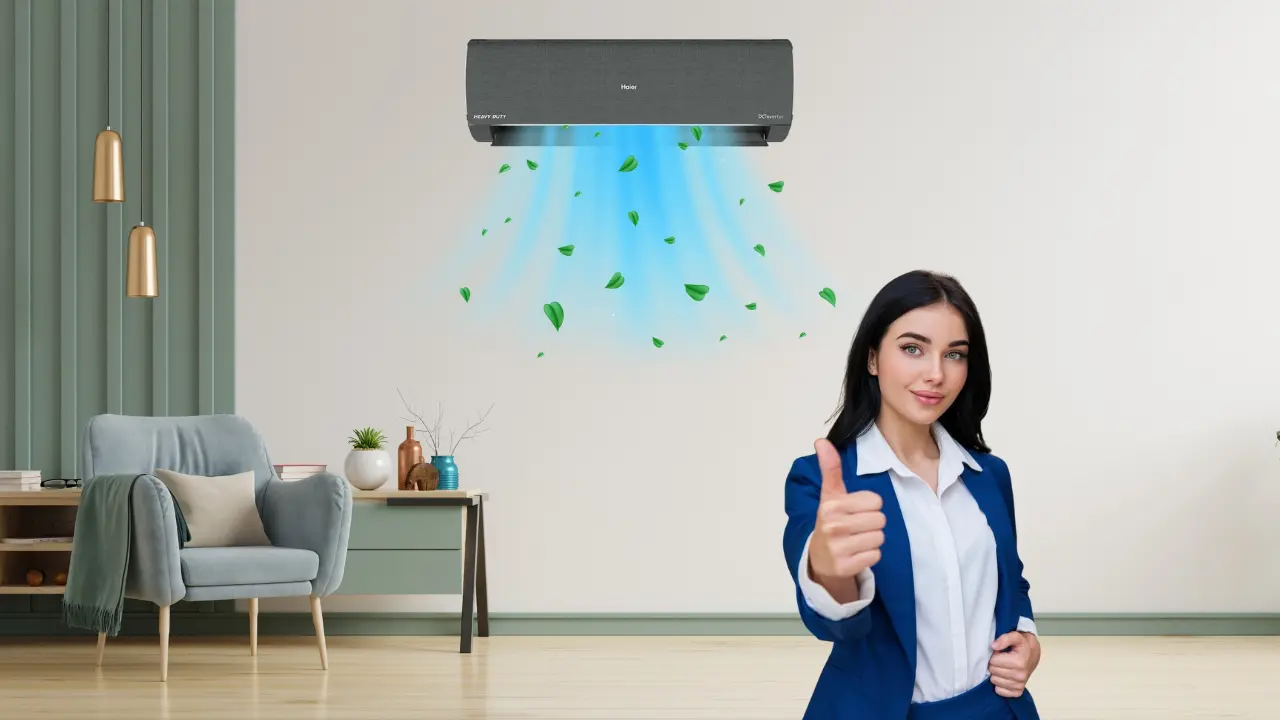

Cooling that reaches you, not just the room, means air conditioning that responds to people, presence, and patterns instead of blindly cooling empty space.
It is about directing comfort where it matters, when it matters, while quietly saving energy in the background. In Indian homes, this shift changes not just temperatures, but daily routines, bills, and how relaxed a space feels.
Why does cooling still feel hit or miss in most homes?
It usually starts the same way.
You switch on the AC.
The room starts getting colder.
You are still waiting.
Ten minutes later, the room feels cold, but you do not.
This gap is the problem most of us never name. Traditional air conditioning focuses on space, not people. It measures the room. It cools the room. It assumes comfort will follow.
In Indian homes, that assumption breaks quickly.
Rooms are not sealed boxes.
Ceiling fans are running.
Doors open for chai, kids, deliveries, pets.
People move constantly between the sofa, dining table, and bedroom.
Cooling the entire room evenly sounds logical. In real life, it wastes energy and delays comfort.
Comfort is not about temperature. It is about timing and direction
This is the first mental shift.
Comfort is not a number on a remote.
It is how fast cool air reaches your body.
It is how long that comfort stays stable.
It is how little you have to think about it.
Think about a movie theatre.
They do not freeze the entire hall first and hope you feel comfortable later. Airflow is directed. Temperature stabilises quickly. You forget about the AC within minutes.
Homes deserve the same intelligence.
The hidden cost of cooling empty space
Most ACs still operate on a simple logic.
- Measure room temperature
- Push cold air evenly
- Repeat until set point is reached
This works. But it is inefficient.
Consider a typical Indian evening.
- One person watching TV
- Another on a laptop at the dining table
- Kids moving in and out
- Kitchen heat bleeding into the living room
Cooling the entire room equally means cooling places no one occupies. That wasted effort shows up in two places.
- Slower comfort
- Higher electricity bills
This is not user error.
This is a system limitation.
Targeted cooling changes the equation
Now imagine a different approach.
Instead of cooling the room, the AC focuses on where you are.
The airflow adjusts direction.
Cooling reaches your sofa faster.
The rest of the room cools gradually, not aggressively.
This is the principle behind AI Target Cooling, a capability built into Haier’s AI Atmox platform. Using installation data and smart airflow mapping, the system directs cooling to occupied zones instead of treating every corner equally .
The implication is simple.
You feel comfortable sooner.
The AC works less.
Energy waste drops.
Comfort becomes precise, not loud.
Why faster comfort matters more than lower temperature
Most people respond to slow cooling by lowering the temperature.
From 24 to 22.
From 22 to 20.
This habit creates three problems.
- Overcooling later in the night
- Dry air and discomfort
- Power spikes during peak hours
Targeted cooling flips the behaviour.
When cool air reaches you faster, you stop chasing lower numbers. The body settles before the room fully cools.
This is how smarter systems reduce energy use without asking users to change habits.
Pre-cooling solves a problem we rarely articulate
The most uncomfortable moment with an AC is not while sleeping.
It is the first two minutes after you enter the room.
Sweaty. Tired. Impatient.
AI Pre-Cooling addresses this exact moment.
Using location awareness and learned routines, the system predicts arrival and begins cooling before you step inside. When you enter, the room is already settling into comfort .
No schedules to program.
No timers to remember.
No manual switching.
The value here is not novelty. It is a relief.
Why prediction matters in Indian homes
Indian days are not clock-perfect.
Traffic changes.
Meetings run late.
Kids arrive earlier than expected.
Rigid timers fail because life is fluid.
Prediction-based cooling adapts instead of enforcing rules. Over time, the system learns patterns and adjusts pre-cooling windows automatically.
This is what separates automation from intelligence.
Cooling that notices when no one is there
Another invisible problem.
ACs often keep running in empty rooms.
People step out for calls.
Kids fall asleep elsewhere.
Families leave for dinner.
AI Human Detection solves this quietly. Sensors detect absence and gradually reduce cooling intensity, eventually powering down if the room stays empty .
No sudden cut-offs.
No discomfort when you return.
Just steady efficiency.
The system does not scold you. It adapts around you.
Energy savings that do not feel like sacrifice
Traditional energy saving modes often feel restrictive.
Fan speed drops too much.
Cooling feels delayed.
Comfort takes a back seat.
AI Eco 2.0 works differently.
It constantly measures the gap between current temperature and desired comfort. Based on that gap, it adjusts power in real time across multiple levels rather than a single blunt mode .
The result is subtle.
- Stable comfort
- Lower power draw
- Fewer on-off cycles
Savings become a side effect, not the goal.
Electricity awareness changes behaviour without lectures
Most people do not change habits because they lack information.
They change when feedback is clear.
Electricity monitoring 2.0 within the Atmox Power Manager shows consumption patterns in simple graphs and daily summaries. Users see how long the AC ran, which modes were active, and what that translated into in cost terms .
This creates a quiet feedback loop.
- You notice spikes
- You adjust without instruction
- The system adapts further
Control returns without complexity.
Why cleaner ACs cool better
Maintenance is another invisible factor.
Dusty coils reduce efficiency.
Manual cleaning gets delayed.
Cooling performance drops gradually.
Atmox Auto Clean addresses this automatically. Indoor and outdoor units clean themselves using frost-based and reverse airflow processes, keeping heat exchange efficient over time .
Cleaner systems cool faster.
Faster cooling needs less power.
Less power means more consistent comfort.
Maintenance becomes preventative, not reactive.
The larger system at work
What looks like individual features is actually one connected system.
- Prediction handles arrival
- Targeting handles direction
- Detection handles absence
- Eco logic handles efficiency
- Monitoring handles awareness
- Auto clean handles longevity
Each piece solves a specific friction point.
Together, they change how cooling feels in daily life.
Why this matters for modern Indian households
Homes today are doing more.
Living rooms double as offices.
Bedrooms become study spaces.
Families spend longer indoors.
Cooling systems built for static usage struggle in dynamic homes.
Cooling that reaches people instead of walls adapts to these shifts naturally.
For solo professionals, it means coming home to instant relief.
For parents, it means stable comfort without constant adjustment.
For new homeowners, it means fewer regrets on bills.
The future of cooling is less visible, not louder
The best technology does not demand attention.
It does not announce itself.
It does not require learning curves.
It simply works.
The cooling that reaches you disappears into daily life. You stop adjusting remotes. You stop arguing about temperatures. You stop worrying about whether the AC is wasting power.
Comfort becomes the background.
The insight worth remembering
Rooms do not feel comfort.
People do.
Once cooling systems are designed around that truth, everything else falls into place.
Not colder rooms.
Better moments.
And that is the difference between cooling that fills a space and cooling that actually reaches you.
Frequently Asked Questions
Why do I keep waiting after turning on the AC?
Because cooling is measured by room temperature, not by how fast cool air reaches your body. That delay is what makes cooling feel hit or miss.
Is comfort really about temperature settings?
No. Comfort is about direction, timing, and stability. How fast the air reaches you matters more than how low the temperature is set.
Why don’t homes cool the same way?
Most home ACs are built around old assumptions: uniform cooling instead of directed comfort.
Why does cooling an entire room waste energy in Indian homes?
Because people rarely occupy the entire room. Cooling empty corners, unused dining areas, or closed balconies delays comfort and increases electricity bills.
What does “cooling that reaches you” actually mean?
It means directing airflow toward where you are sitting or resting, instead of cooling the entire room evenly.