


The monsoon doesn’t leave when the calendar says so.
Anyone who has lived through October in India knows this. The skies hold on a little longer. Clothes on the balcony take an extra day to dry. Rooms smell a little damp. And the air that should have been crisp by now still feels sticky.
It’s in this lingering season that most homes realise: cooling is only half the job. The real challenge is humidity.
Why the air still feels heavy after the rains

Here’s a truth most people don’t talk about: the monsoon doesn’t end at once.
Even after the big showers fade, the air remains loaded with moisture. And that’s what makes your living room feel clammy at 11 pm when all you wanted was a cool breeze before bed.
Humidity isn’t just uncomfortable. It’s systemic.
- It slows down evaporation, so sweat sticks longer on the skin.
- It makes rooms smell musty, as dampness settles into curtains and cushions.
- It even pushes your AC to work harder, because cooling alone doesn’t solve moisture.
That’s the hidden system: temperature is only half the comfort equation, humidity is the other half.
The overlooked hero in modern ACs
When most people buy an AC, they compare tonnage, star ratings, and price tags. But comfort is rarely about numbers alone.
The one feature that decides how you feel when monsoon overstays? Dehumidification.
Think of it as your AC’s second personality. Not just cooling the air, but pulling out the extra moisture so your home feels breathable again. It’s the quiet fix that saves a sticky evening from becoming unbearable.
A concrete scenario we all recognise

Picture this.
It’s the first week of October. You’ve invited friends over for chai and pakoras. The rain outside has finally stopped, but the living room feels like a damp cave.
The fan only circulates the same sticky air. The AC cools the room but doesn’t fix the heaviness.
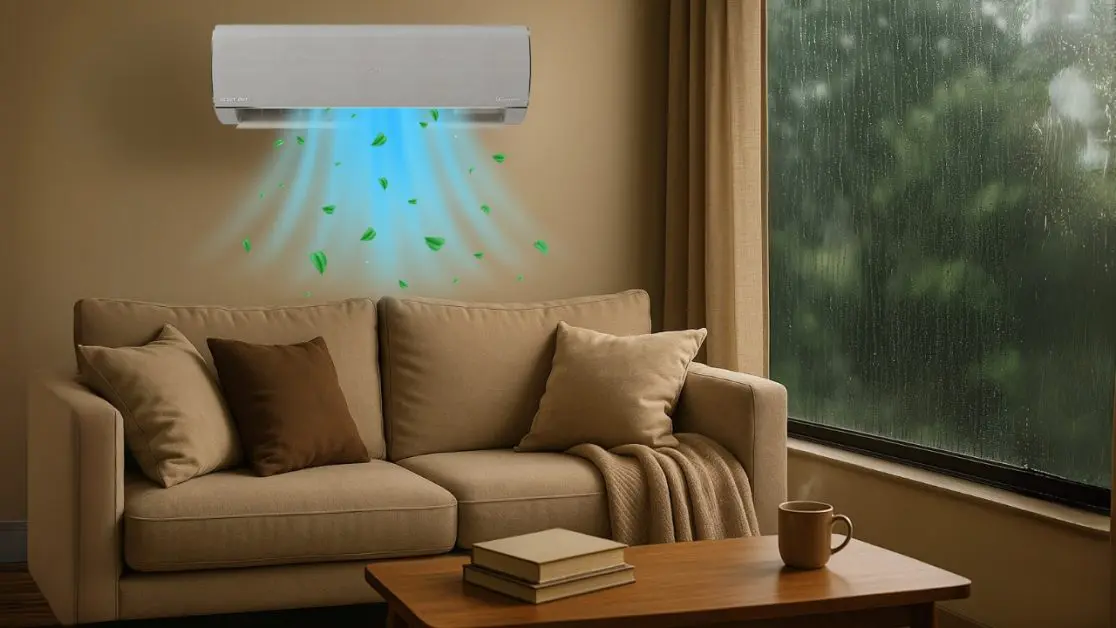
Now imagine switching to dehumidification mode. Within minutes, the space feels lighter. The cushions lose that clammy touch. The conversation flows easier.
That’s the difference between a machine that only cools and one that understands how Indians actually live through seasons.
Where Haier fits into this system
Haier’s Gravity AI Series AC was designed with this exact reality in mind.
It’s not just about a 5-star energy rating or a 1.6-ton capacity though those matter for bills and coverage. It’s about intelligence. The AC senses what’s happening in the room and adjusts automatically. Cooling when it should. Dehumidifying when it must.
For Indian homes, that’s not a luxury. That’s survival through months when the monsoon overstays its welcome.
Why this matters to different households
One option is the working professional living solo in Gurgaon. For them, the AC doubles as both a comfort system and an energy line item. Dehumidification means the machine doesn’t have to overcool just to make the air feel fresh, saving money while keeping evenings comfortable.
The second option is the young couple in Bangalore, setting up their first apartment. For them, it’s about lifestyle. Hosting friends, watching movies at night, sleeping without tossing in sticky sheets. The Gravity Series makes those transitions smoother.
The third option is the family in Kolkata. Parents, grandparents, kids, the house is always full. Here, it’s about health. Less dampness means fewer respiratory triggers, fewer musty odours, and less risk of mold around bookshelves and beds.
Different lives. Same invisible need.
The economics of comfort
There’s also a financial system at play.
- Run a regular AC longer to battle stickiness, and your bill goes up.
- Switch constantly between modes, and the compressor works harder, cutting lifespan.
- Ignore humidity, and you end up spending on room fresheners, cleaning services, and even medical bills when dampness causes coughs or allergies.
Dehumidification isn’t just about air. It’s about efficiency, longevity, and hidden savings.
Technology that feels human
What makes Haier’s Gravity Series stand out is not the technical jargon but the way it quietly blends into life.
- AI Smart Sensors: Adjust cooling and humidity based on room conditions, so you don’t have to fiddle with remotes.
- 5-Star Energy Rating: Keeps bills predictable even when the AC doubles up as a dehumidifier.
- All-Weather Performance: Whether its peak summer or monsoon’s tail end, the unit adapts seamlessly.
It’s like having a system that listens to the room the way a host listens to their guests anticipating needs before they’re spoken.
Hidden systems behind seasonal living
Step back and notice the pattern.
- In summer, the problem is heat.
- In monsoon, it’s humid.
- In winter, it’s dry.
Every season brings not just a temperature shift but a systemic air shift. And appliances that win in Indian homes are the ones that understand these invisible systems.
The Gravity Series AC is essentially a response to this truth. Not one-dimensional, but multi-seasonal. Not a machine that waits for you to intervene, but one that manages comfort as if it knows what’s coming.
The aphorism worth remembering

Cool air is temporary. Balanced air is comfortable.
That’s the principle hidden inside the one AC feature that matters most when the monsoon lingers.
So what does this mean for us?
For Indian households, the implication is clear. The next time you think of comfort, don’t just ask “how many tons?” or “how many stars?”. Ask: Does this AC handle humidity when the rain refuses to leave?
Because seasons in India don’t respect tidy endings. And neither should your appliances.
Haier has simply built a system that accepts this messy truth and turns it into comfort that feels designed for us.
Final reflection
Every year, the monsoon lingers. Every year, homes fight the same battle.
But not every year do we stop to see the system behind it: comfort isn’t just cooling, it’s balance.
That’s what the Gravity Series dehumidification mode does. It doesn’t just promise numbers. It delivers breathability.
And once you’ve experienced that difference, you’ll never look at an AC as just a cooling machine again.