


AI climate control adapts to changing weather by reading your environment in real time, learning your habits, and automatically adjusting cooling power, airflow, and energy usage.
Instead of fixed settings, it uses data, sensors, and machine learning to maintain comfort while reducing electricity waste across seasons.
That is the short answer.
The longer one lives inside your home.
Why does Indian weather make manual cooling obsolete?
Step outside in May in Delhi.
Then step outside in July in Mumbai.
Then in October in Bengaluru.
Same country. Completely different air.
India records temperatures from near 0°C in the north to over 45°C in summer heatwaves. Humidity swings from dry desert air to 90 percent coastal moisture.
According to the India Meteorological Department, urban heat island effects push city temperatures 2 to 4 degrees higher than surrounding areas.
Yet most of us still use air conditioners like it is 2005.
Remote. Temperature. Fan speed. Repeat.
Here is the problem.
The weather no longer changes slowly. It shifts by the hour.
The morning sun heats the living room. Afternoon clouds cool it. Evening cooking adds warmth. Night humidity climbs.
Manual cooling cannot keep up.
Static settings fail in dynamic environments.
That is where AI climate control begins to matter.
What Exactly Does AI Climate Control Do?
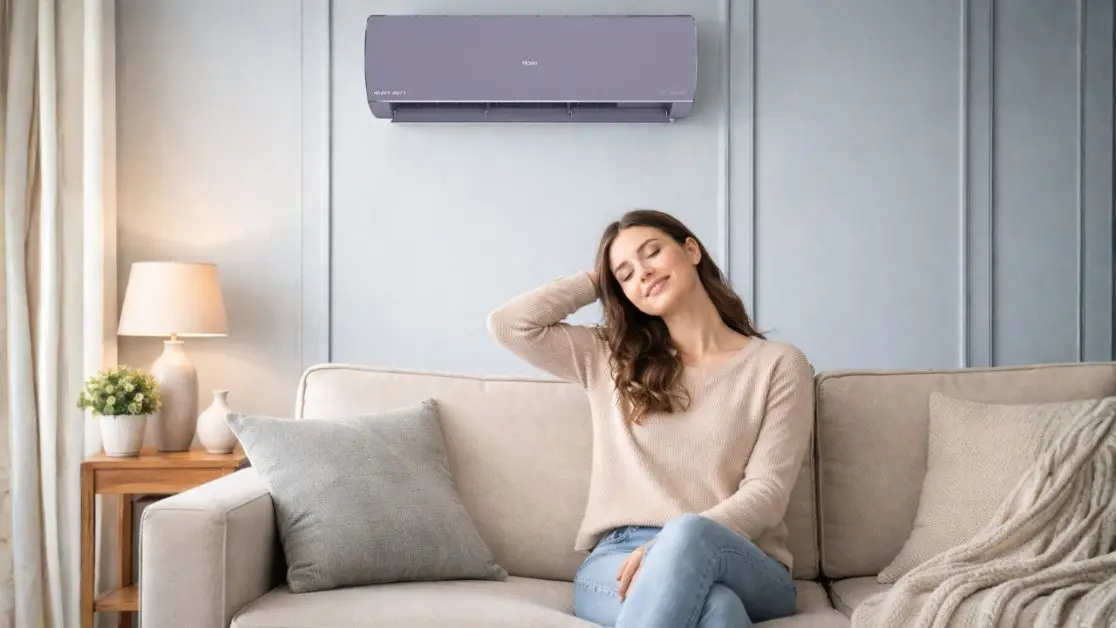
At its core, AI climate control replaces guesswork with continuous monitoring.
Technology like Haier’s AI Atmox powered AI Climate Control combine environmental sensors, user behavior data, and geo intelligence to adjust performance automatically .
But let us break this down simply.
AI climate control does three essential things:
1. Reads the room
- Detects temperature gap
- Monitors humidity
- Senses occupancy
2. Learn your habits
- Tracks preferred settings
- Learns usage timings
- Builds a consumption model
3. Adapts performance in real time
- Adjusts compressor speed
- Shifts between energy modes
- Focuses cooling where needed
The result is no louder cooling.
It is a smarter way of cooling.
AI Climate Control Across Seasons
Summer: Heat Without Overcooling
In peak summer, room-set temperature gaps often exceed 3°C. AI Eco 2.0 modes automatically adjust to higher capacity levels for faster pull-down cooling, then step down once stability is achieved .
Why this matters:
- Faster comfort
- Reduced compressor strain
- Lower long-term power draw
Overcooling wastes electricity. Under-cooling frustrates people.
AI sits in between.
Monsoon: Humidity Becomes the Enemy
In cities like Kolkata or Chennai, humidity makes 26°C feel sticky.
AI climate control systems analyse environmental data and optimise airflow and cooling balance automatically .
This reduces that damp, heavy air feeling.
Comfort is not about numbers. It is about sensation.
Winter and Transitional Weather
In early winter evenings, temperatures drop sharply. Traditional ACs continue aggressive cooling until manually adjusted.
AI climate control senses narrowing temperature gaps and shifts to lower Eco levels automatically .
This protects:
- Electricity bills
- Sleep quality
- Long-term machine health
Energy saved in small adjustments compounds over months.
AI Pre-Cooling: The System Thinks Ahead

Picture this.
You leave the office at 6:30 PM. Traffic moves slowly. Your phone crosses a 100-meter geofence near home.
The AC switches on before you arrive.
This is AI Pre-Cooling .
No timer. No call home. No guesswork.
Benefits of AI Pre-Cooling
- Instant comfort on arrival
- Reduced peak compressor stress
- No need to run AC continuously
According to Bureau of Energy Efficiency studies, optimal temperature management can reduce residential cooling costs by 10 to 15 percent annually.
Pre-cooling works because it replaces reactive cooling with predictive cooling.
The best systems do not wait. They anticipate.
AI Target Cooling: Precision Over Excess
Traditional ACs cool the entire room evenly.
But not all spaces are used equally.
You sit on the sofa.
Your child studies at the table.
The rest of the room is empty.
AI Target Cooling uses installation data and cloud intelligence to focus airflow directly where needed .
Why Target Cooling Matters
| Traditional Cooling | AI Target Cooling |
| Higher energy draw | Reduced energy waste |
| Slower perceived comfort | Faster comfort delivery |
Faster airflow to occupied areas means:
- Lower overall runtime
- Improved efficiency
- Better thermal comfort
Precision beats power.
AI Human Detection: When Rooms Empty, Energy Should Too
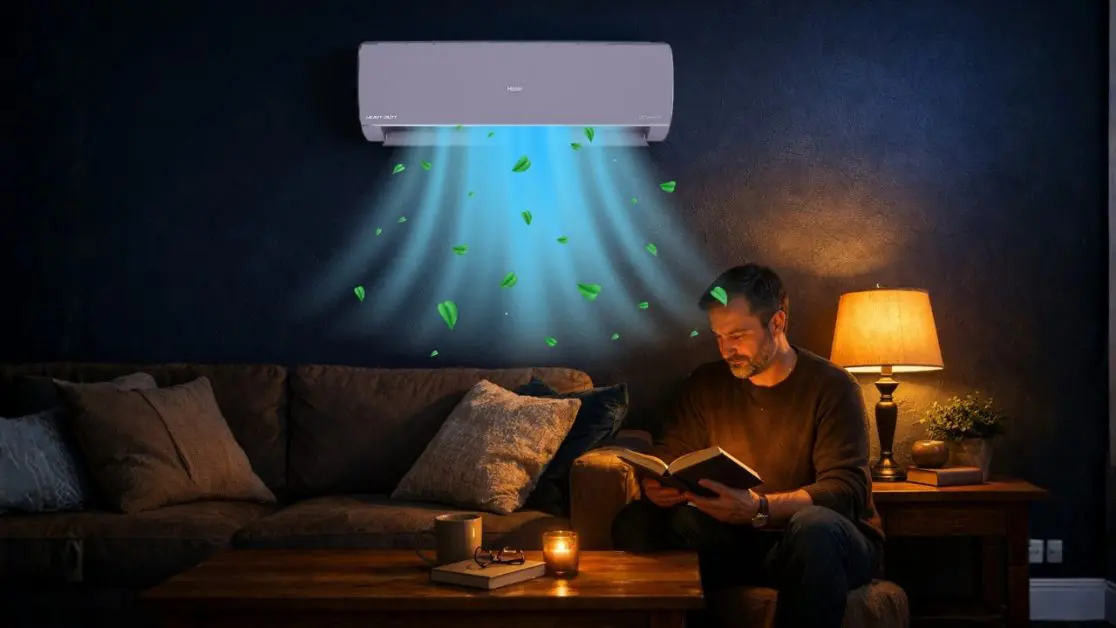
How often does an AC run in an empty room?
Research by Lawrence Berkeley National Laboratory shows idle HVAC usage contributes significantly to residential waste.
AI Human Detection addresses this directly .
After 15 minutes of inactivity, the system shifts to energy-saving mode. After 30 minutes, it powers down.
No reminders required.
This is not about saving one day’s bill.
It is about creating a pattern.
Small daily savings multiplied over 300 days make a visible impact.
Electricity monitoring 2.0: Awareness Changes Behaviour
Most people do not know how much their AC consumes daily.
AI-powered Electricity monitoring 2.0 changes that .
It offers:
- Graphical usage views
- Calendar tracking
- Cost display in currency
- Custom energy targets
When usage becomes visible, discipline improves.
Why Monitoring Works
- Visibility drives accountability
- Targets encourage optimisation
- Real-time cost display alters decisions
Studies in energy psychology show households reduce consumption by 5 to 12 percent when real-time feedback is available.
What gets measured gets managed.
Auto Clean: Weather Is Not Just Temperature
Indian weather carries dust, pollen, and pollution.
Dirty coils reduce cooling efficiency by up to 15 percent, according to HVAC industry estimates.
AI IDU Frost Self Clean and ODU Cyclone Clean systems reverse airflow and initiate automatic wet cleaning after 240 operational hours .
Cleaner coils mean:
- Faster cooling
- Lower electricity bills
- Better air quality
- Reduced maintenance costs
Climate control includes maintenance intelligence.
Three Ways to Think About AI Climate Control
When evaluating smart AC systems, consider three approaches:
One option is manual optimisation
You adjust settings daily.
You track bills independently.
You rely on memory.
Cost: Time and attention.
The second option is scheduled automation
You use timers.
You set Eco modes manually.
You guess arrival times.
Cost: Inaccuracy during unpredictable days.
The third option is AI climate control
The system reads weather patterns.
Learn your habits.
Adapts continuously.
Cost: Initial investment.
Benefit: Compounding savings and comfort.
Over five years, electricity savings alone can offset premium features.
Comfort compounds. So does efficiency.
AI Climate Control and the Future of Indian Homes
Indian households are becoming data-aware.
Smart TVs adjust brightness based on ambient light. Refrigerators optimize cooling cycles. Washing machines auto-detect load weight.
Climate control is following the same path.
The question is not whether the weather changes.
It is whether your cooling system evolves with it.
The Bigger Pattern Behind AI Adaptation
Here is the hidden system.
Weather variability increases.
Electricity tariffs fluctuate.
Urban living compresses time.
In uncertain environments, adaptive systems outperform rigid ones.
This is true for organizations.
And it is true for homes.
AI climate control is not about technology.
It is about resilience.
What This Means for Everyday Life
It means fewer arguments over thermostat settings.
Better sleep during unpredictable nights.
Lower shock when the electricity bill arrives.
Less cognitive load after long workdays.
In a country where cooling demand accounts for nearly 40 percent of peak electricity load in summers, intelligent climate management is no longer a luxury. It is infrastructure thinking.
The future belongs to systems that adjust before you notice the need.
When an AC learns, adapts, and cools without constant instruction, something subtle changes.
The home feels calmer.
The environment feels responsive.
And comfort stops being a manual task.
That is what AI climate control quietly delivers.
No noise.
Not complexity.
Just balance.
Frequently Asked Questions
Why do I keep changing my AC temperature every few hours?
Because your environment changes faster than your settings. Morning sun, afternoon humidity, cooking heat, and nighttime moisture all shift indoor comfort levels. Manual settings are static but your home isn’t. AI climate control continuously monitors temperature gaps, humidity, and occupancy, then adjusts automatically so you don’t have to.
I’m exhausted after work. Do I really need to manage my AC settings daily?
Not if your system learns your habits. AI models build a usage pattern when you arrive, what temperature you prefer, how long you run cooling and adapt automatically. It removes the mental load of remembering timers and Eco modes.
Is AI climate control just a convenience, or does it actually save money?
It saves money through small daily optimisations:
Faster pull-down cooling reduces compressor strain
Auto Eco shifts prevent overcooling
Human detection avoids empty-room waste
Electricity monitoring changes behavior
Savings compound over months.
Why does 26°C feel sticky during the monsoon even though it should be comfortable?
Because comfort is about humidity, not just temperature. In coastal cities, high moisture makes air feel heavier. AI climate systems analyze both temperature and humidity and balance airflow accordingly reducing that damp sensation.
I haven’t cleaned my AC in months. Is that affecting cooling?
Yes. Dirty coils can reduce efficiency by up to 15%. AI Auto Clean systems reverse airflow and initiate self-clean cycles after fixed operational hours, improving cooling speed and reducing energy waste.
My AC smells dusty sometimes. Can AI prevent that?
Yes, indirectly. Systems with automated cleaning cycles reduce dust buildup and coil moisture both of which cause odor and microbial growth.
Why does my room feel hot again after I switch off fast cooling?
Because traditional fast modes overcool quickly, then stop abruptly. AI systems increase compressor capacity only when needed and taper down gradually to maintain stability reducing rebound heat.