
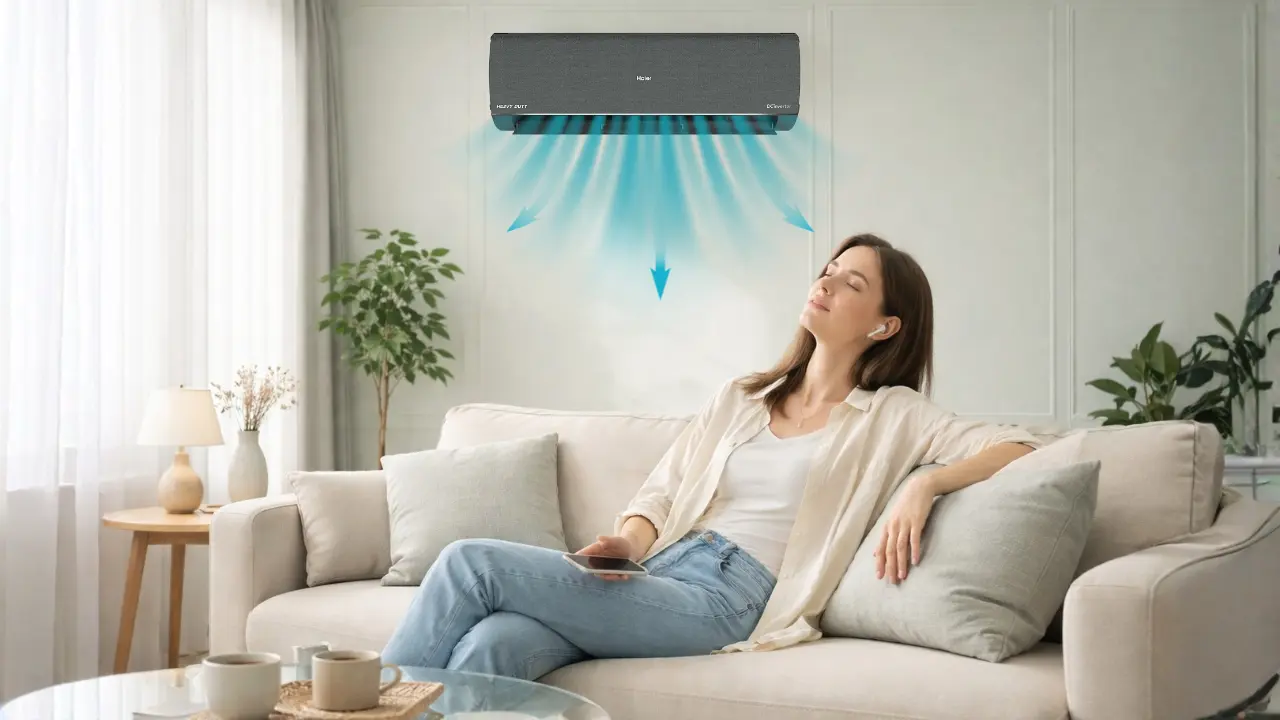

AI Climate Control is ideal for Indian summers because it learns your habits, adapts to real-time weather, and optimises cooling automatically to balance comfort and electricity savings. Instead of fixed settings, it uses data, sensors, and predictive logic to cool only when and where needed. That shift changes everything.
Indian summers are not polite.
They arrive early. They stretch long. And they demand decisions every single day.
Do we lower the temperature further?
Do we switch to Eco mode?
Do we turn it off and tolerate the heat?
Behind every small AC adjustment sits a larger system. Comfort. Electricity bills. Family routines. Sleep quality. Work productivity.
AI Climate Control changes how that system behaves.
Not by cooling harder.
By cooling smarter.
Indian Summers Are a Temperature Problem, Not a Systems Problem
In May, Delhi can cross 45°C. In Chennai, humidity stays above 70 percent. In Mumbai, nights refuse to cool down. According to IMD data, India has recorded increasing heatwave days over the past decade.
The traditional solution is simple.
Set the AC to 18°C.
Hope for relief.
But here is what actually happens:
- The AC overcools the room.
- Electricity consumption spikes.
- Someone feels too cold at night.
- The remote becomes a negotiation tool.
Cooling is not just about lowering temperature. It is about stability.
And stability in Indian summers is hard.
That is why AI Climate Control matters.
What AI Climate Control Actually Does Differently
On paper, AI Climate Control sounds like a buzzword.
In reality, it is a layered system.
Based on the AI Atmox platform for Haier’s air conditioners , the system combines environmental sensing, machine learning, and real-time optimisation.
Here is what that means in practice.
One: It Learns
AI tracks usage patterns.
- When you switch on the AC.
- Which temperature you prefer at night.
- How long the cooling runs.
- How outside temperature affects indoor comfort.
Over time, it builds a personalized consumption model.
Comfort becomes predictive.
Not reactive.
Two: It Adapts
AI analyses:
- Current temperature
- Geo conditions
- Humidity patterns
- Human activity inside the room
Instead of waiting for you to adjust settings, it auto-optimises performance.
No manual fine-tuning.
Three: It prevents over cooling and under cooling
Overcooling wastes power.
AI Eco 2.0 in Haier systems automatically shifts modes based on the temperature gap.
- If the gap exceeds 3°C, it switches to L1 Eco mode.
- If the gap is 1–3°C, it moves to L2.
- If the gap is 1°C or less, it shifts to L3.
That dynamic control prevents unnecessary energy use.
Cooling becomes precise.
Precision saves money.
AI Pre-Cooling: Because Summers Begin Before You Enter the Room
Picture this.
It is 6:30 PM. You are 100 metres from home.
The day has drained you.
The lift ride feels endless.
Now imagine walking into a room that is already cool.
AI Pre-Cooling uses geofencing technology. When you enter a preset 100 metre radius, the AC anticipates your arrival and begins cooling automatically.
No timers.
No manual setup.
Just anticipation.
Comfort that respects your time.
In Indian cities where commute fatigue is real, this is not luxury. It is a relief.
AI Target Cooling: Why Cool the Entire Room When You Are on the Sofa

Traditional ACs cool everything equally.
Walls. Ceilings. Empty corners.
AI Target Cooling changes that.
Using cloud data and installation positioning, the system directs airflow to the area where cooling is needed most.
Let us simplify the logic.
One option is to cool the entire room aggressively.
The second option is to focus on cooling where people actually sit or sleep.
The second option is economically efficient and requires less power.
Targeted comfort feels sharper.
And sharper comfort uses less energy.
AI Human Detection: Cooling That Knows When to Pause
In Indian homes, doors open often.
Children run out.
Parents step away.
Sometimes the room is empty for hours.
AI Human Detection senses occupancy within a 12 metre range and automatically adjusts power use.
- Auto L3 mode activates after 15 minutes of inactivity.
- The system powers off after 30 minutes without movement.
No reminders needed.
No guilt about forgotten switches.
The system protects you from your own forgetfulness.
That is what intelligent automation should do.
Electricity monitoring 2.0: Because Awareness Changes Behaviour
https://youtu.be/KHLMAGd0KA0?si=yG6ifW8yKkSjtrVP 5
Most people do not track AC electricity usage daily.
They wait for the bill.
Then react.
AI Electricity monitoring 2.0 shifts this behaviour.
It provides:
- Graphical usage views
- Calendar tracking
- Mode duration comparison
- Real-time cost display in currency
- Customisable energy targets
When power consumption becomes visible, decisions improve.
Energy data turns from surprise to strategy.
According to BEE estimates, air conditioners account for nearly 40 percent of residential electricity usage during peak summer months in urban India.
Even a 10 percent optimization can create meaningful savings.
Small percentages compound.
Auto Clean Systems: Why Clean Coils Matter in Dusty Indian Cities
Cooling efficiency drops when coils accumulate dust.
Most outdoor units sit exposed to pollution, construction debris, and dust storms.
Haier’s AI IDU Frost Self Clean automatically washes the indoor unit every 240 hours of operation.
The AI ODU Cyclone Clean reverses airflow 15 seconds after shutdown to remove condenser dust.
Cleaner coils mean:
- Faster cooling
- Lower compressor strain
- Reduced electricity consumption
Maintenance becomes automated.
And automated maintenance extends product life.
Comparing Traditional AC vs AI Climate Control
| Feature | Traditional AC | AI Climate Control |
| Temperature Adjustment | Manual | Automatic, dynamic |
| Energy Mode | Fixed | Gap-based L1, L2, L3 shifts |
| Room Entry Cooling | Timer-based | Geo-fenced pre-cooling |
| Occupancy Awareness | None | Human detection auto adjust |
| Electricity monitoring 2.0 | Monthly bill only | Real-time tracking |
| Cleaning | Manual service | AI self-clean systems |
The difference is not incremental.
It is architectural.
Why This Matters for Modern Indian Homes

Indian households today are layered.
Dual-income couples working from home.
Parents managing hybrid schooling.
Solo professionals in compact apartments.
Grandparents sensitive to temperature shifts.
One fixed cooling setting cannot satisfy all.
AI Climate Control works because it personalises without asking for constant attention.
It learns silently.
Adjusts quietly.
Optimises continuously.
The best technology disappears into the background.
Comfort Is Emotional. Efficiency Is Financial. AI Connects Both.
A restless summer night affects productivity.
An inflated electricity bill affects monthly budgets.
An overheated living room changes family moods.
AI Climate Control connects these invisible threads.
It protects sleep.
It reduces energy waste.
It anticipates needs.
And it does so without demanding technical expertise.
That balance is rare.
The Bigger Pattern: Indian Summers Are Becoming Smarter
Heatwaves are intensifying.
Electricity tariffs fluctuate.
Urban lifestyles accelerate.
Manual systems struggle under complexity.
Intelligent systems thrive.
The question is no longer whether an AC can cool.
The question is whether it can think.
AI Climate Control answers that.
Not loudly.
But consistently.
So What Should You Look For This Summer
When evaluating an air conditioner for Indian summers, think in systems.
Ask:
- Does it learn from daily patterns?
- Does it adjust power dynamically?
- Can it monitor electricity in real time?
- Does it anticipate arrival?
- Does it clean itself to maintain efficiency?
If the answer is yes across these layers, you are not buying cooling.
You are buying predictability.
And predictability reduces stress.
A Final Thought
The remote control was designed for constant adjustment.
AI Climate Control is designed for fewer decisions.
That shift matters.
Because in Indian summers, heat is not the only thing rising.
So are expectations.
When comfort adapts without asking, homes feel calmer.
When electricity bills behave, budgets feel stable.
When technology learns, people rest.
And in a country where summers test patience every year, that quiet intelligence feels exactly right.
Frequently Asked Questions
Why do I keep adjusting my AC temperature at night during Indian summers?
Because traditional ACs operate on fixed settings. As outdoor temperature drops or humidity shifts at night, the room becomes too cold or too warm. AI Climate Control continuously recalibrates cooling to maintain stability instead of extremes.
I’m tired of fighting over the remote at home. Can AI really reduce this?
Yes. AI systems learn usage patterns, preferred night temperature, cooling duration, and usage timing and automatically optimize settings. Fewer manual changes mean fewer “remote negotiations.”
I live in a dusty city. Does AC coil dust really affect cooling?
Yes. Dust accumulation reduces cooling efficiency and increases compressor strain, leading to higher electricity usage.
Do AI ACs really clean themselves or is that marketing?
Systems like Haier’s AI IDU Frost Self Clean wash the indoor unit every 240 hours of use, while AI ODU Cyclone Clean reverses airflow after shutdown to remove condenser dust. Cleaner coils mean faster cooling and lower power consumption.
If I forget to turn off my AC, will AI handle it?
Yes. AI Human Detection senses inactivity and automatically shifts to low-power mode after 15 minutes and powers off after 30 minutes without movement.
Why does setting my AC to 18°C cool fast but spike my electricity bill?
Because the system overworks to reach an extreme temperature, often overshooting comfort needs. AI avoids extreme drops and instead manages the temperature gap dynamically.
Is cooling the entire room necessary if I’m only sitting on the sofa?
Not always. AI Target Cooling focuses airflow where people are present, reducing wasted cooling in unused areas.
Does AI Pre-Cooling actually help after a long commute?
Yes. With geo-fencing, the AC begins cooling when you enter a preset radius (e.g., 100 metres), so the room is comfortable upon arrival.