
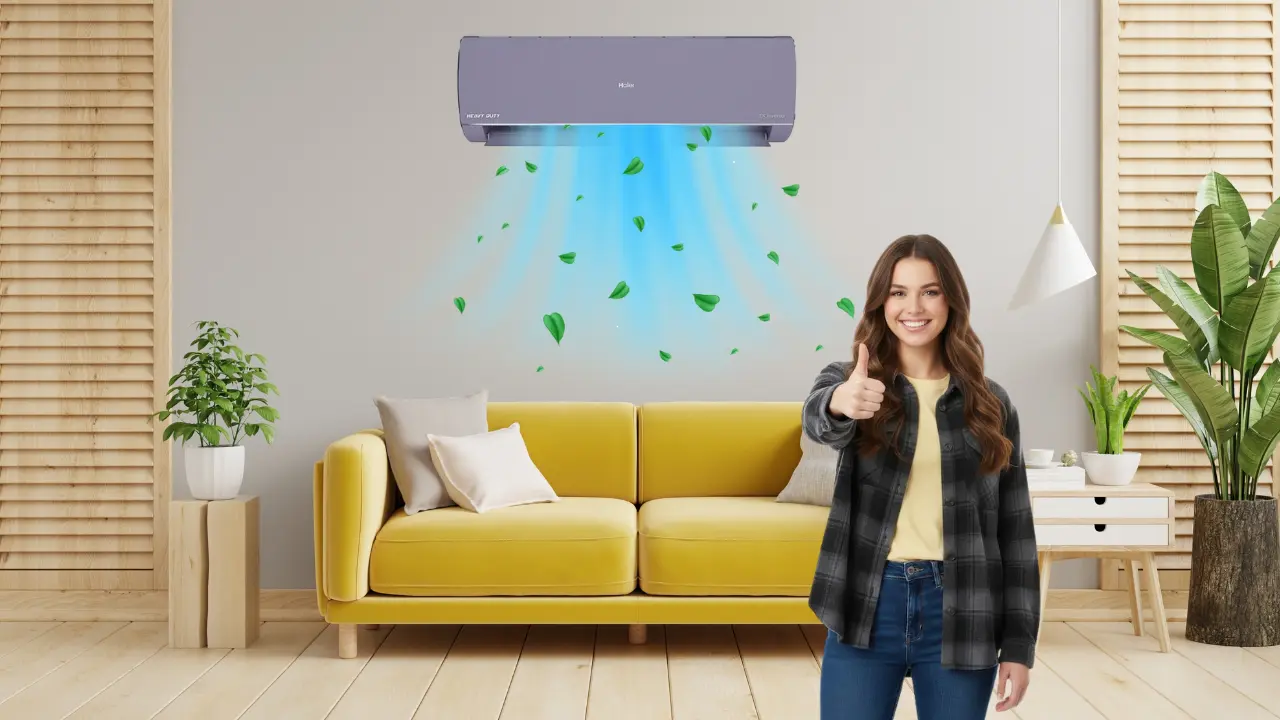

AI climate control maintains perfect room temperature by continuously sensing the environment, learning user habits, and adjusting cooling in real time without manual intervention.
Instead of reacting after discomfort sets in, it predicts, adapts, and fine-tunes airflow and power usage so the room feels consistently comfortable, energy-efficient, and effortless to live in.
The small moment that reveals a big problem
You come home after a long day.
Outside, the heat is still clinging to your clothes. Inside, the room feels stuffy for the first few minutes, then suddenly too cold.
You adjust the remote. Again.
This tiny ritual plays out in millions of Indian homes every summer.
And it reveals something important.
Traditional air conditioning is reactive.
Human comfort is not.
Why “set temperature” never really worked
Most of us were taught a simple rule.
Pick a number. Stick to it.
22°C.
24°C.
Sometimes 26°C, if the electricity bill is watching.
But rooms are not static boxes.
They change constantly.
- Sunlight shifts through the day
- Humidity spikes during monsoon evenings
- More people enter the room
- Cooking heat drifts in from the kitchen
- Fans, lights, laptops add invisible warmth
A fixed temperature cannot respond to a living space.
That gap is where discomfort lives.
Comfort is not a number. It is a moving target.
AI climate control starts with this insight.
Instead of asking you to guess the perfect setting, the system studies the space itself.
What AI climate control actually does differently
AI-powered climate systems treat cooling as a system, not a switch.
They combine multiple inputs at once.
According to Haier’s AI Atmox platform, the system continuously analyses environmental data, room conditions, and usage patterns to adjust cooling dynamically rather than relying on manual settings .
Here is how that plays out inside a real home.
1. It reads the room before you feel the change
Sensors track:
- Current room temperature
- Humidity levels
- Time of day
- Seasonal patterns
- Occupancy
Instead of waiting for the room to become uncomfortable, AI anticipates what is about to happen.
Hot afternoon sun hitting west-facing windows.
Humidity rising before evening rain.
A room filling up with people during dinner time.
The system adjusts early.
Good comfort feels invisible because it arrives before you notice the problem.
Learning replaces constant adjusting
The most exhausting part of cooling is not the heat.
It is the thinking.
Should I lower the temperature?
Switch to Eco?
Turn it off while stepping out?
Did I forget to change the mode again?
AI removes that mental load.
2. It learns how you live, not just how the room behaves
Over time, AI climate control builds a usage memory.
It observes:
- When the AC is usually turned on
- How long it runs
- Preferred comfort levels during sleep, work, and leisure
- Power consumption patterns
Haier’s Atmox Neuro system uses machine learning to track usage duration, mode selection, and power data to generate a personalized comfort and energy plan automatically .
No profiles to fill.
No complicated setup.
Just quiet learning.
Comfort that adapts to your rhythm, not the other way around
Pre-cooling changes the arrival experience
There is a moment every working professional knows.
You unlock the door.
The room is still warm.
You wait.
AI climate control removes that wait.
3. Pre-cooling starts before you step inside
AI-powered pre-cooling uses location-based prediction to sense when you are nearing home and begins cooling in advance.
According to the AI Atmox system, when a user enters a predefined geofence, the AC anticipates occupancy and starts pre-cooling automatically, without manual scheduling .
The result is simple.
You enter a room that already feels right.
Comfort should greet you, not make you wait.
Targeted cooling stops wasting energy
Traditional ACs cool entire rooms, even when only one corner is in use.
That made sense once.
It no longer does.
4. Cooling where you are, not where you are not
AI target cooling uses installation data and room layout information to direct airflow precisely.
Instead of blanketing the whole room, it focuses on:
- The sofa where you are sitting
- The bed during sleep hours
- The work desk during the day
Haier’s AI target cooling delivers air exactly where needed, improving comfort while reducing unnecessary power usage .
This changes the equation.
- Faster cooling
- Lower energy waste
- More consistent comfort
Efficiency is not about less comfort. It is about smarter delivery.
Energy saving without comfort compromise
Indian households care deeply about electricity bills.
But no one wants savings that come with discomfort.
AI bridges that trade-off.
5. Eco modes that think, not restrict
AI Eco 2.0 does not simply reduce power.
They adapt output based on real-time temperature gaps.
As outlined in Haier’s AI Eco 2.0 system:
- Larger temperature gaps trigger higher efficiency modes
- Smaller gaps reduce output gradually
- Comfort remains stable while power draw decreases dynamically
This removes the old dilemma.
Comfort or savings?
With AI, it becomes both.
Human detection closes the biggest waste gap
The most common energy loss happens quietly.
An empty room.
An AC is still running.
6. Cooling pauses when life pauses
AI human detection senses movement and occupancy.
When no activity is detected:
- The system shifts to lower power modes
- Eventually powers down if absence continues
According to Haier’s Atmox Power Manager, this predictive energy conservation prevents unnecessary usage while maintaining readiness when occupants return .
You do not have to remember.
The system remembers you.
Why this matters for modern Indian homes
Homes today do more than before.
They host:
- Work calls
- Study sessions
- Afternoon naps
- Late-night movies
- Weekend gatherings
Each moment demands a different comfort profile.
AI climate control makes one system serve many lives.
Three types of households. One quiet solution
1. Working professionals living solo
Consistent comfort without constant adjustment.
2. Families with children and elders
Stable temperatures without sharp fluctuations.
3. New couples setting up homes
Smarter energy habits from day one.
Good technology disappears into daily life. That is its real success.
The bigger pattern behind AI climate control
This is not just about cooling.
It is about how systems evolve.
Manual control worked when life was simpler.
Predictive systems emerge when complexity grows.
AI climate control reflects a broader shift.
From command to collaboration.
From reaction to anticipation.
From adjustment to alignment.
The future of comfort is not colder. It is smarter.
Perfect temperature is no longer something you chase.
It is something the home quietly maintains for you.
And when that happens, comfort stops being a task.
It becomes the background of a well-lived life.
Frequently Asked Questions
Is AI climate control just about luxury?
No. It’s about aligning technology with how people actually live busy, dynamic, and distracted.
What does AI climate control say about the future of home technology?
Systems are moving from command-based to predictive, collaborative, and invisible.
Is AI climate control useful for families with kids and elders?
Yes. It avoids sharp temperature swings, maintaining stable comfort throughout the day
How does AI climate control know when to adjust before I feel uncomfortable?
Sensors track temperature, humidity, time of day, occupancy, and seasonal patterns continuously.
Does AI climate control really learn my habits automatically?
Yes. Systems like Haier’s AI platforms observe when you turn the AC on, how long you use it, and which modes you prefer without manual setup.
How does AI cooling feel smoother than normal AC cooling?
AI fine-tunes power and airflow gradually, maintaining stability instead of abrupt changes.