

AI helps you use energy responsibly by shifting control from constant human decisions to quiet, adaptive systems that learn how your home actually lives.
Instead of fixed settings and guesswork, intelligent appliances sense usage patterns, adjust in real time, and reduce waste without asking for attention. The result is comfort that feels natural and energy savings that happen in the background.
The energy problem no one talks about
Most energy waste does not come from negligence.
It comes from friction.
The AC runs longer than needed because no one remembers to turn it off.
The fridge works harder during festive weeks without adjusting its rhythm.
The TV stays on bright mode long after sunlight fades.
Not because people do not care.
Because life gets busy.
Energy consumption in Indian homes is rarely deliberate. It is reactive.
That is the real gap AI steps into.
Not as a control panel.
As a system that observes, learns, and responds.
Why manual energy saving never scales
Indian households already know the rules.
Set the AC at 24 degrees.
Use Eco mode.
Switch off when you leave the room.
The problem is not knowledge.
The problem is consistency.
Three common approaches people try
1. Constant control
Adjusting settings manually throughout the day.
Works in theory. Fails in real life.
2. Fixed schedules
Timers and routines.
Break the moment life deviates.
3. Ignoring it altogether
Comfort first. Bills later.
None of these scale across seasons, people, or changing routines.
Energy efficiency fails when it depends on perfect behaviour.
Systems win when they adapt to imperfect humans.
What responsible energy use actually looks like
Responsible energy use is not about using less.
It is about using only what is needed.
That requires three capabilities.
- Awareness of the environment
- Awareness of human presence
- The ability to adjust instantly
This is where AI changes the equation.
Not by adding features.
By removing effort.
How AI learns the rhythm of your home
Every home has patterns.
Morning rush.
Empty afternoons.
Crowded evenings.
Quiet nights.
AI systems observe these rhythms over time and build a living model of how energy is actually used.
What the system pays attention to
- Room temperature changes across the day
- How long appliances run at different times
- Occupancy patterns
- Seasonal shifts in behaviour
This is not automation.
It is an adaptation.
Instead of asking you to adjust to the machine, the machine adjusts to you.
Cooling only where and when it matters
One of the biggest energy leaks in homes is overcooling.
Entire rooms get cooled when only one corner is occupied.
Air keeps circulating long after people leave.
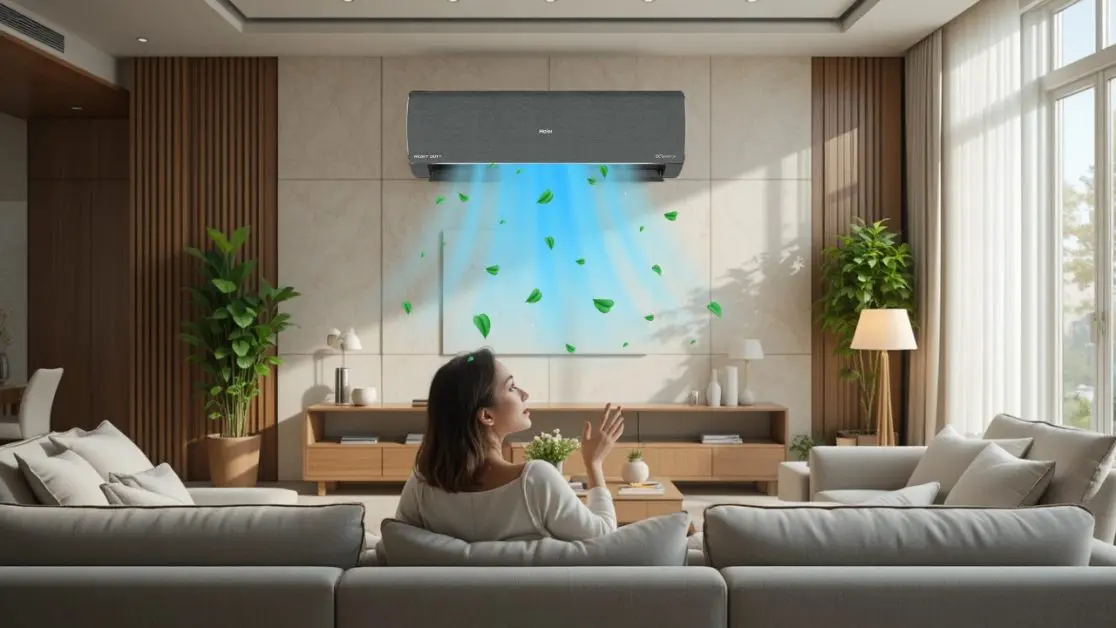
AI-based climate systems solve this by narrowing the focus.
Targeted cooling works because
- Cooling reaches the person, not the room
- The system avoids unnecessary air circulation
- Comfort arrives faster with less energy
This is efficiency without sacrifice.
Less power.
Same comfort.
Pre-emptive comfort beats reactive cooling
Most AC usage starts late.
You come home.
The room is warm.
The system works at full power to catch up.
AI flips this model.
By understanding location cues and routine timing, intelligent systems can prepare the space before you arrive.
Not colder than needed.
Just ready.
This avoids power spikes and reduces prolonged high-load usage.
Comfort feels instant.
Consumption stays controlled.
When presence becomes the switch

Empty rooms waste energy silently.
Lights.
Cooling.
Air circulation.
AI changes this by turning presence into a signal.
What human detection enables
- Energy-saving modes when rooms are empty
- Gradual power reduction instead of abrupt shutoffs
- Automatic optimisation without reminders
The system notices when people leave.
No guilt.
No second-guessing.
Just fewer wasted units.
Seeing energy changes behaviour
Awareness changes habits faster than advice.
When consumption becomes visible, choices become intentional.
Modern AI systems now translate electricity usage into understandable formats.
What visibility unlocks
- Daily and monthly consumption views
- Cost displayed in currency, not units
- Patterns between comfort and cost
When people see impact, they adjust naturally.
Not because they are told to.
Because it makes sense.
AI Eco 2.0 modes are not shortcuts
AI Eco 2.0 used to mean compromise.
Less cooling.
Uneven comfort.
AI changes this.
By measuring the gap between current temperature and target comfort, intelligent systems adjust output dynamically.
The logic behind adaptive AI Eco 2.0
- Larger temperature gaps get stronger cooling
- Smaller gaps shift to lower energy states
- The system balances efficiency with comfort continuously
This is not a fixed mode.
It is a living response.
Why this matters more in Indian homes
India is not a single climate.
Summer heatwaves.
Humid monsoons.
Mild winters.
Energy usage swings dramatically across months.
AI systems that adjust based on real-time conditions perform better than static efficiency ratings.
They respond to weather, not averages.
They adapt to homes, not lab conditions.
The hidden benefit most people miss
Energy efficiency is not just about bills.
It is about reducing decision fatigue.
Every setting you do not adjust.
Every reminder you do not need.
Every manual correction that disappears.
That mental space adds up.
Good technology gives time back.
Where Haier fits into this shift
Haier’s AI-powered climate systems, including its AI-Atmox platform, are built around this idea of adaptive responsibility.
Not controlling users.
Supporting them.
Features like AI Climate Control, AI Eco 2.0 modes, electricity monitoring 2.0, human detection, and self-optimising performance work together as one system rather than isolated tools.
The goal is not to showcase intelligence.
It is to let intelligence stay invisible.
The underlying capabilities and system design referenced here are drawn from Haier’s AI-Atmox framework, which focuses on automated temperature optimisation, occupancy sensing, and energy monitoring across select air conditioner models
Responsible energy use is a system choice
People do not fail at saving energy.
Systems fail when they expect perfection.
AI succeeds when it accepts reality.
Homes are dynamic.
People are inconsistent.
Comfort matters.
The future of responsible energy use does not look like restraint.
It looks like an alignment.
Technology that understands how we live, and quietly adjusts so we do not have to.
That is not just smart.
That is respectful.
And once you experience it, it becomes hard to imagine living any other way.
Frequently Asked Questions
Why does saving energy feel so exhausting even when I know what to do?
Because energy saving usually depends on constant micro-decisions adjusting temperatures, switching modes, remembering timers. Life does not run on perfect routines, so the mental load builds up. AI removes this fatigue by handling those adjustments quietly in the background.
I care about my electricity bill, but I forget settings all the time. Is that normal?
Completely. Most energy waste comes from friction, not negligence. AI systems are designed specifically to work with imperfect human behaviour, not against it.
Why don’t fixed schedules and timers work well in real homes?
Because real homes are dynamic. Guests arrive, routines shift, seasons change. Fixed schedules break the moment life deviates. AI adapts in real time instead of assuming your day looks the same every day.
Is energy waste really about habits, or just bad systems?
Mostly systems. When energy efficiency depends on perfect behaviour, it fails. Systems that observe, learn, and adjust succeed even when humans are inconsistent.
Why does my AC blast at full power when I get home?
Because traditional systems react late. The room heats up, then the AC works aggressively to catch up. AI anticipates your arrival based on patterns and prepares the space gently avoiding power spikes.
Does faster cooling always mean higher electricity use?
Not necessarily. Targeted and pre-emptive cooling can feel faster while using less energy, because the system cools only what matters when it matters.
What does “AI learning my home” really mean?
It means observing patterns of morning rush, empty afternoons, crowded evenings, seasonal shifts and building a living model of how energy is actually used, not how it’s supposed to be used.