

AI monitoring helps Indian households move from guessing to knowing. It tracks how appliances are used, learns daily patterns, and quietly adjusts performance to reduce waste. The result is simple. More comfort, fewer surprises on electricity bills, and decisions driven by insight instead of habit.
The moment awareness begins
It usually starts with a bill.
Not an outrageous one. Just high enough to make you pause.
You scroll. Units consumed. Peak hours. A number that feels oddly disconnected from how you remember living that month.
No extra guests. No parties. No obvious excess.
Yet the number climbed.
This is where most households sit today. Aware that energy costs matter, but unclear where the drain actually happens.
Awareness without visibility creates anxiety.
Visibility creates control.
That is the quiet shift AI monitoring introduces into Indian homes.
Why “being careful” is no longer enough
For years, energy saving meant discipline.
Switching things off.
Setting timers.
Lowering temperatures manually.
Reminding parents. Reminding kids. Reminding yourself.
The system relied on memory. And memory is fragile.
Especially in homes where routines overlap. Work from home in the mornings. School afternoons. Late dinners. Weekend naps. Guests who forget switches.
AI monitoring exists because modern homes are complex systems, not checklists.
According to India’s Bureau of Energy Efficiency, air conditioning alone can account for up to 40 percent of household electricity usage during peak summer months. The challenge is not usage. It is unmanaged.
What AI monitoring actually watches
AI monitoring does not just look at units consumed.
It observes patterns.
- When rooms are occupied
- How long cooling runs at different temperatures
- How outside weather affects indoor demand
- When power usage spikes without adding comfort
Systems like Haier’s AI Atmox track electricity usage at a granular level, translating invisible consumption into understandable signals through features like Electricity Monitoring 2.0 and the Atmox Power Manager .
Awareness moves from vague to specific.
Not “we should save power,” but “this room overcools after midnight.”
That distinction changes behaviour.
From data to decisions

Data alone does nothing.
What matters is interpretation.
AI monitoring turns raw usage into choices households can actually act on.
One option is to keep everything manual.
This gives control, but demands constant attention.
The second option is partial automation.
Timers. Preset schedules. Still rigid.
The third option is adaptive systems.
AI learns, predicts, and adjusts without reminders.
Most Indian homes are quietly moving toward the third option. Not because it is futuristic, but because it respects how people actually live.
Awareness shows up in small moments
The real value of AI monitoring is not dashboards.
It is a moment.
You leave a room, and cooling reduces automatically.
You return home, and comfort is already set.
You check usage in rupees, not just units.
You notice fewer spikes without trying harder.
AI-powered Electricity Monitoring 2.0 allows users to view consumption in calendar and graphical formats, see normal versus eco usage, and even display cost in currency terms. These details matter because money is easier to relate to than kilowatt hours .
Awareness becomes intuitive.
Why savings follow awareness
Savings are not achieved by sacrifice. They come from precision.
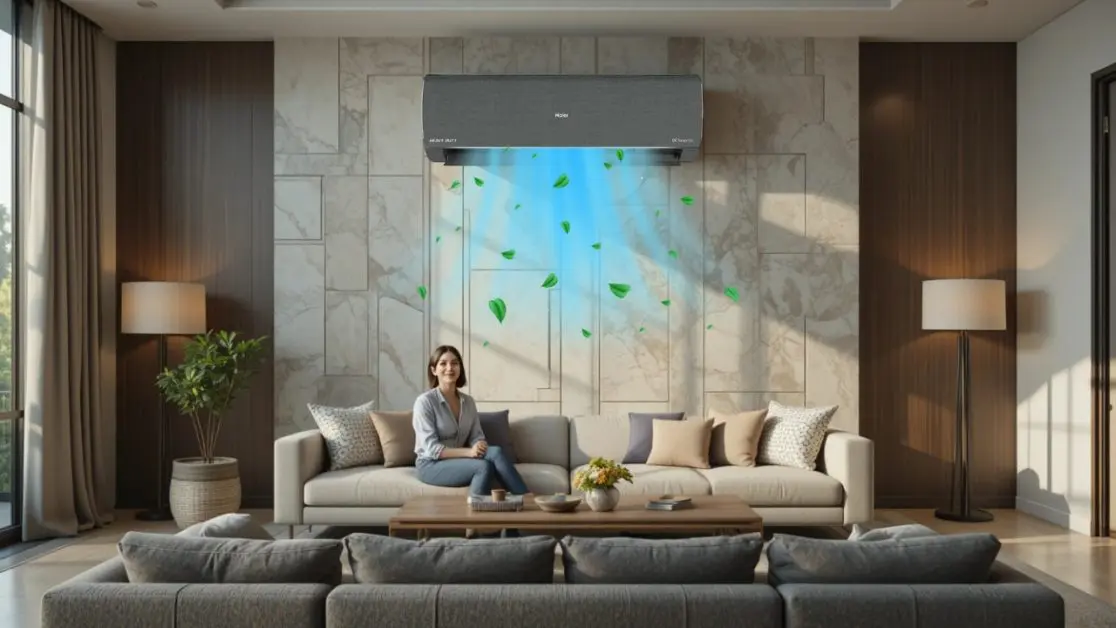
AI Eco 2.0 works by adjusting output based on real-time temperature gaps. When the room is far from the set temperature, cooling is stronger.
As the gap narrows, the system shifts into lighter modes automatically. This prevents overcooling and unnecessary power draw.
The system saves energy without asking for restraint.
This is a crucial psychological shift. When savings do not feel like deprivation, they stick.
The role of human detection
One of the biggest sources of energy waste is empty rooms.
Lights stay on. Cooling keeps running. No one benefits.
AI Human Detection solves a problem people stopped noticing. Sensors detect occupancy and automatically reduce or shut down cooling when no movement is sensed.
Some systems reduce output within minutes and power down entirely after extended inactivity.
No scolding. No reminders. Just logic.
In dense urban homes where rooms serve multiple purposes, this single feature can prevent hours of silent waste every week .
Monitoring turns habits into systems
The biggest misconception about smart homes is that they demand attention.
In reality, the best systems demand less.
AI monitoring replaces habit-based saving with system-based saving.
Habits fail under stress.
Systems scale under pressure.
This is why families with children, professionals living alone, and multi-generational households benefit differently but equally from the same underlying intelligence.
The system adapts to people, not the other way around.
Why Indian households are ready for this shift
Three forces are converging.
- Rising electricity costs across states
- Increased appliance usage due to work from home
- A cultural shift toward tracking and transparency
People already monitor steps, sleep, and spending. Energy is simply the next invisible system becoming visible.
According to the International Energy Agency, smart energy management can reduce residential energy consumption by 10 to 20 percent without reducing comfort. That range is significant over a year.
Savings are not just financial
Lower bills matter.
But so does peace of mind.
AI monitoring reduces decision fatigue.
It removes guilt from comfort.
It replaces constant tweaking with trust.
The system learns. Adjusts. Improves.
Over time, households stop checking dashboards often. That is the real success signal.
The quiet future of living
AI monitoring does not announce itself.
It does not change daily rituals.
It does not demand learning curves.
It does not make homes feel technical.
It simply aligns energy use with real life.
From awareness to savings is not a dramatic leap. It is a series of small, intelligent decisions made automatically, consistently, and without effort.
The future of energy efficiency is not about doing more.
It is about thinking less, and living better.
Frequently Asked Questions
My electricity bill isn’t shocking, but it’s higher than expected. Why does this keep happening?
This usually happens because modern homes consume power in small, invisible ways. Cooling that runs a bit longer, rooms used irregularly, overlapping routines, and peak-hour usage quietly add up. Without visibility, the bill feels disconnected from daily life even when nothing “extra” happens.
I try to be careful with electricity. Why doesn’t that seem to reflect in my bill?
Because discipline alone depends on memory. And memory fails in real homes with guests, kids, work-from-home schedules, and late nights. Being careful works in theory, AI monitoring works in practice by observing patterns instead of relying on reminders.
Why does not knowing where electricity is used feel stressful?
Awareness without visibility creates anxiety. You know costs matter, but you don’t know what to fix. AI monitoring replaces guessing with clarity showing when, where, and why power is consumed.
How is AI monitoring different from just checking units on my bill?
Bills show totals. AI monitoring shows patterns of room-level behavior, time-based spikes, overcooling, and comfort gaps. This turns energy saving from a vague intention into specific, solvable actions.
Does AI monitoring just track how many units I consume?
No. It watches how energy is used:
Room occupancy
Cooling duration at different temperatures
Weather impact on demand
Power spikes that don’t add comfort
Systems like Haier’s AI Atmox translate this data into insights through features like Electricity Monitoring 2.0 and adaptive power management.
Do energy savings always mean sacrificing comfort?
Not with AI-based systems. Features like AI Eco 2.0 adjust cooling strength based on real-time temperature gaps stronger when needed, lighter as comfort is reached. This prevents overcooling without you feeling it.
Is human detection actually useful in Indian homes?
Yes, especially in dense urban homes where rooms serve multiple purposes. One feature can quietly prevent hours of weekly waste without changing behavior.