


AI-powered air conditioners are the future of smart home cooling because they learn how you live, adapt to Indian weather in real time, and deliver comfort with lower power bills and less effort.
Instead of reacting to button presses, these systems anticipate needs, manage energy intelligently, and quietly fit into everyday life.
That shift changes everything.
Not just how rooms feel.
But how homes behave.
The problem no one talks about with conventional ACs.
It is 11:30 pm in May.
The AC is running.
The blanket is half on, half off.
Someone gets up to lower the temperature. Again.
This is not a cooling problem.
This is a decision fatigue problem.
Traditional air conditioners expect humans to constantly adjust them.
Temperature. Fan speed. Mode. Timers.
Over a long summer, those micro decisions add up. So does wasted electricity.
AI-powered air conditioners flip that relationship.
They learn instead of waiting.
What makes an air conditioner truly AI-powered

An AI-powered air conditioner does not just connect to WiFi.
It observes patterns.
It understands context.
It improves without being asked.
Modern AI cooling systems use a combination of sensors, machine learning, and usage history to make decisions automatically. According to Haier’s AI Atmox platform , these systems continuously analyse room temperature, outdoor conditions, occupancy, and past behaviour to optimise performance in real time.
That leads to three fundamental shifts.
Shift one: From fixed settings to adaptive comfort
Why one temperature never works for everyone
Indian homes are not uniform.
A sun-facing bedroom heats up faster.
The living room fills with people in the evening.
The kitchen spikes in temperature during cooking.
Yet conventional ACs treat all situations the same.
AI-powered cooling adapts instead.
- It adjusts cooling intensity based on room conditions
- It recognises seasonal patterns like dry heat, humidity, or monsoon weather
- It avoids overcooling when the target temperature is nearly reached
Haier’s AI Climate Control system, for example, automatically analyses environmental data and usage habits to maintain comfort without manual input, as outlined in the AI Atmox overview
The insight: Comfort is not a number. It is a moving target.
AI understands that. Fixed remotes do not.
Shift two: Cooling that starts before you arrive
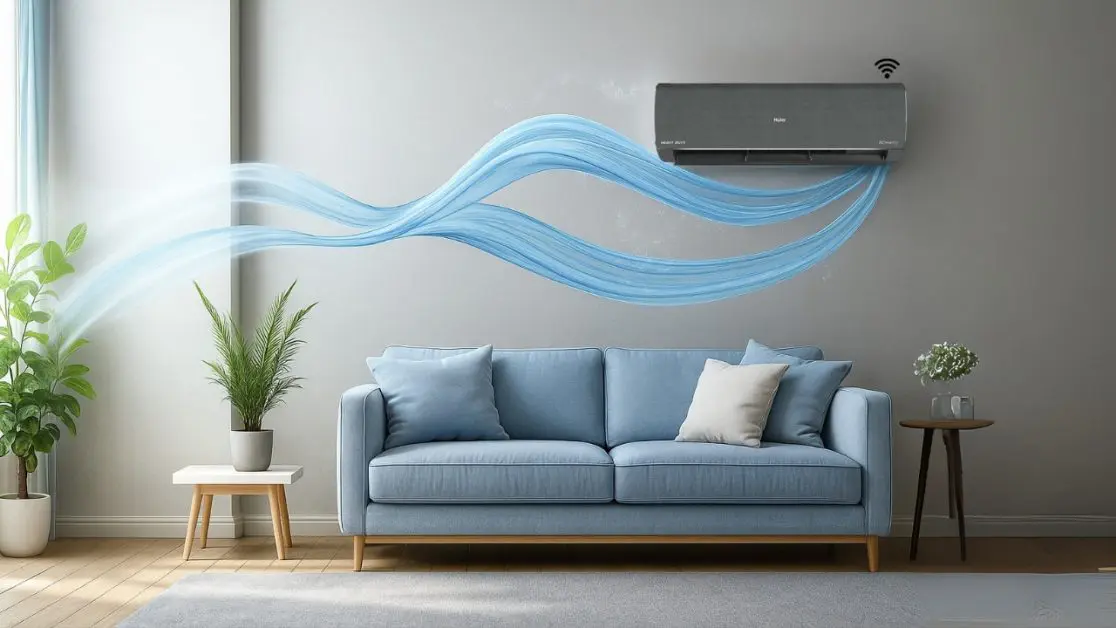
Why timing matters more than power
There is a familiar moment after a long commute.
You open the door.
Warm air greets you.
The AC switches on too late.
AI-powered pre-cooling changes this sequence.
Using location awareness and behavioural patterns, the system predicts when you are about to reach home and starts cooling in advance.
Haier’s system activates when the user enters a preset geo range, delivering comfort the moment you arrive without manual scheduling.
This is not about speed.
It is about anticipation.
One option is manual timers that you forget to reset.
The second option is remote app control you rarely open.
The third option is AI that prepares the space automatically.
Only one of these scales effortlessly.
Shift three: Cooling the person, not the room
Why targeted cooling saves more than electricity
Most ACs cool empty space.
AI-powered systems focus on where comfort is actually needed.
Target cooling uses installation data and room layout information to direct airflow toward occupied zones instead of blanketing the entire room.
The benefits are practical.
- Faster comfort delivery
- Reduced compressor load
- Lower electricity consumption
The principle is simple: Precision beats power.
Energy efficiency that works without discipline
Why good intentions are not enough
Everyone wants to save electricity.
Few people want to constantly monitor usage.
AI-powered air conditioners bridge that gap.
Through intelligent power management, AI Eco 2.0 modes, and electricity monitoring, these systems automatically balance comfort and consumption. The AI Eco 2.0 and Power Manager features show real-time tracking, cost visibility, and automatic adjustments based on temperature gaps and occupancy.
Instead of asking users to change habits, the system adapts around them.
- Auto switching to lower power modes
- Visual energy tracking in simple graphs
- Currency-based cost awareness instead of technical units
Insight worth remembering: The best energy-saving system is the one you never have to remember to use.
When the AC knows when no one is home
Human detection as a quiet superpower
Empty rooms do not need cooling.
AI-powered human detection uses sensors to identify occupancy and automatically reduce or stop cooling when the room is empty. Haier’s system can progressively lower power usage and switch off entirely after sustained inactivity, without compromising comfort when people return.
This solves a common Indian household issue.
Someone forgets to switch off the AC.
The bill reflects it later.
AI handles it silently, without reminders or guilt.
Less maintenance, fewer surprises
Why self-cleaning matters more than people think
Dust is not just a cleanliness issue.
It is an efficiency issue.
AI-powered self-cleaning systems maintain both indoor and outdoor units automatically. frost-based indoor cleaning and cyclone outdoor cleaning that remove dust buildup and preserve heat exchange efficiency over time.
The result is consistent performance across seasons.
- Faster cooling
- Lower power draw
- Longer component life
This is maintenance as prevention, not repair.
How this fits into the future Indian home
Smart homes are not about gadgets talking to each other.
They are about friction disappearing.
AI-powered air conditioners fit naturally into this future because they respect how people actually live.
- Parents juggling routines
- Professionals returning late
- Couples managing shared spaces
- Solo residents balancing comfort and cost
Haier’s AI-powered air conditioners, built on platforms like AI-AtmoX, reflect this philosophy by focusing on comfort, savings, and simplicity rather than feature overload.
The bigger implication
This is not just about cooling.
It is about systems that adapt instead of demanding attention.
AI-powered air conditioners represent a broader shift in home technology. From appliances that wait for instructions to systems that quietly make good decisions on our behalf.
The future of cooling is not colder air.
There are fewer decisions.
And in a world already full of choices, that may be the smartest upgrade of all.
Frequently Asked Questions
Why doesn’t one temperature work across my whole house?
Different rooms heat differently due to sunlight, occupancy, and usage. Fixed AC settings ignore this reality.
How does an AI-powered AC adapt to Indian weather?
It continuously analyses humidity, heat, seasonal changes, and past usage to fine-tune cooling in real time.
What is pre-cooling in AI air conditioners?
It’s when the AC starts cooling before you arrive home, based on your routine or location patterns.
How does an AI AC save power without me doing anything?
It automatically balances comfort and consumption using intelligent power management modes.
What is AI-powered self-cleaning in air conditioners?
Automated cleaning cycles that remove dust from indoor and outdoor units to maintain efficiency.
Why do AI-powered air conditioners fit naturally into this future?
Because cooling is daily, emotional, and repetitive, perfect for automation.