
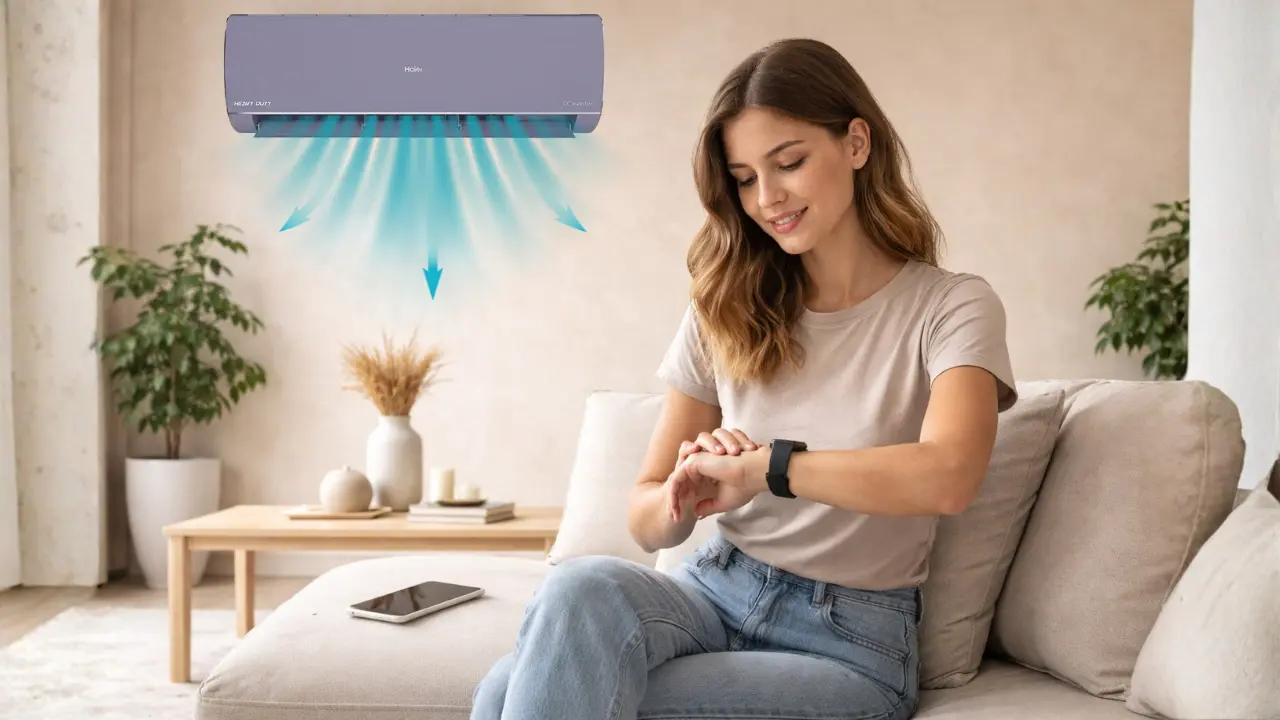

AI pre-cooling means your AC knows you’re on the way home and cools the room before you arrive.
AI pre-cooling uses location data and learning models to predict your arrival, start cooling automatically within a preset geofence, and deliver instant comfort the moment you step in. No timers. No reminders. Just a room that feels ready.
That is the short answer.
The longer story is about how mornings and evenings in Indian homes actually work.
And why timing, not temperature, is the real problem.
The 8:42 AM problem nobody talks about.
It is 8:42 AM in a Mumbai apartment.
The pressure cooker whistles. A school bag zipper breaks. The office cab says “arriving in 3 minutes.” Someone runs back inside because they forgot their laptop.
At that moment, nobody thought about the AC.
But everyone thinks about comfort.
Because mornings in India are compressed. According to industry time-use surveys, urban professionals spend less than 30 focused minutes at home before leaving on workdays. Every minute feels shorter than it is.
Here is the hidden system:
- Time shrinks
- Decisions pile up
- Energy drains early
When homes demand extra manual steps, stress multiplies.
Switch on AC.
Wait.
Adjust temperature.
Leave.
It sounds small. It compounds.
Friction is rarely loud. It is just repetitive.
This is where AI pre-cooling changes the pattern.
What AI Pre Cooling Actually Does
AI pre-cooling, as part of Haier’s AI Atmox platform, predicts your arrival using a 100 metre geofence and automatically starts cooling before you step inside.
No timer setting required.
No daily reset.
The system learns patterns, tracks habits, and adapts.
How the System Works
From the AI Atmox:
- The AC predicts user behaviour through a smart model
- When the user enters a preset geofence of 100 metres, cooling begins automatically
- No manual setup or timing is needed
This matters because India has over 30 crore smartphone users in urban clusters. Location data is already part of everyday apps. AI pre-cooling simply uses it for comfort.
Technology should remove steps, not add them.
Busy Mornings Demand Systems, Not Effort
Let us look at three options for handling morning cooling.
One option is manual control
Switch on the AC when you wake up.
- Cost: Extra electricity if forgotten
- Risk: Overcooling empty rooms
- Effort: Daily manual input
The second option is timer-based cooling
Set a timer at 7:30 AM.
- Cost: Works only for predictable schedules
- Risk: Fails when meetings shift
- Effort: Constant resetting
The third option is AI pre cooling
The AC senses your return pattern and starts cooling automatically.
- Cost: Energy used only when needed
- Risk: Minimal, system adapts
- Effort: Zero after setup
The third option is not futuristic. It is efficient.
It treats time like a resource.
In mid-level organisations, leaders build systems so teams do not reinvent processes daily. Homes deserve the same logic.
Comfort scales when decisions shrink.
Tired Evenings Are a Different Problem
Evenings are not rushed. They are drained.
You come back after traffic. Or back-to-back calls. Or a long day of managing people, projects, and problems.
The room feels warm. The body feels heavier.
Research from the Bureau of Energy Efficiency shows that AC usage in India peaks between 6 PM and 11 PM. That is not a coincidence. That is recovery time.
If cooling starts only after arrival, recovery gets delayed.
AI pre-cooling solves that invisible lag.
When you enter the building compound and cross the geofence, the AC begins working. By the time the door unlocks, the temperature feels balanced.
No waiting.
No manual adjustment.
Just continuity.
Recovery should not depend on reaction time.
AI Climate Control Is the Larger System
AI pre-cooling is one piece of a broader intelligence model.
According to Haier’s AI Atmox platform, the system:
- Learns user habits in real time
- Tracks mode usage and duration
- Collects environmental and temperature data
- Auto-generates an optimized energy plan
This is not just about cooling early.
It is about preventing overcooling.
AI climate control analyzes room temperature gaps and adjusts performance dynamically. It maintains comfort without waste.
Why This Matters in Indian Homes
Indian weather shifts fast.
- April heat spikes
- Monsoon humidity rises
- October evenings fluctuate
Static presets fail.
Adaptive systems succeed.
The AI Climate Control approach ensures the AC learns, adapts, and cools accordingly.
The future of comfort is predictive, not reactive.
Energy Anxiety Is Real
Electricity costs in metro cities average ₹7 to ₹10 per unit.
ACs contribute nearly 40 percent of summer household electricity consumption, according to industry data from the International Energy Agency.
So the question becomes simple.
Does AI pre-cooling increase bills?
The short answer is no, because it works alongside AI Eco 2.0 and Electricity monitoring 2.0 features.
From the AI Atmox system:
- AI Eco 2.0 adjusts cooling levels based on temperature gaps
- Electricity monitoring 2.0 tracks consumption graphically
- AI Human Detection cuts power when no activity is sensed
Cost vs Benefit Snapshot
| Feature | Immediate Comfort | Energy Impact | Manual Effort |
| Manual On | Delayed | High | Daily |
| Timer | Semi-Predictable | Medium | Repeated |
| AI Pre Cooling | Instant | Optimized | One-time setup |
It is economically efficient and requires no daily thinking.
That combination changes behaviour.
The Psychological Shift
Here is something I have noticed.
When systems anticipate needs, people feel calmer.
Hospitals use predictive monitoring to prevent crises. Airports use predictive scheduling to reduce congestion. Smart homes use predictive cooling to reduce stress.
The principle is universal.
Anticipation reduces anxiety.
When the AC prepares the room before you arrive, it signals readiness.
That signal matters more than temperature.
AI Pre Cooling and the Future of Work
Hybrid work models have changed occupancy patterns.
People step out mid-day. Return unpredictably. Travel for short meetings.
Rigid cooling systems cannot keep up.
AI pre-cooling adapts.
It fits the flexible rhythm of modern Indian professionals. Whether it is a solo working parent, a Gen Z founder, or a couple setting up a first apartment, predictability feels powerful.
And powerful homes shape focused work.
In organisations, impact comes from designing processes that run quietly in the background. At home, AI does the same.
The best systems are invisible.
What This Means for Modern Indian Homes
AI pre-cooling is not about showing off intelligence.
It is about removing small frictions.
Here is what changes practically:
- Morning rush feels smoother
- Evening fatigue recovers faster
- Electricity usage stays optimized
- Manual adjustments disappear
And when combined with AI Target Cooling, which directs air exactly where needed , the experience sharpens further.
Instead of cooling the entire room blindly, the AC focuses cooling where you are sitting. Efficiency rises. Waste drops.
Precision is comfort.
A System That Learns, Adapts, Cools
Haier’s AI Atmox platform describes itself with three words: Learns. Adapts. Cool.
Those words matter.
Learning means tracking patterns.
Adapting means adjusting dynamically.
Cooling means delivering comfort without drama.
It is a philosophy, not just a feature list.
And in a country where summers grow hotter every year and daily schedules grow tighter, philosophy matters.
The Bigger Insight
We often think smart homes are about screens and voice commands.
They are not.
They are about energy management.
Decision reduction.
Emotional recovery.
AI pre-cooling for busy mornings and tired evenings is a small example of a larger shift.
Homes are becoming proactive.
Not reactive.
And when comfort anticipates you instead of waiting for instruction, life feels sorted.
Not because the air is cooler.
Because the system is smarter.
That is the difference.
And once you live with anticipation instead of adjustment, going back feels like extra work.
In the end, comfort is not about temperature.
It is about timing.
Frequently Asked Questions
Why do my mornings feel more stressful than they should, even when I wake up on time?
Because small manual decisions (like switching on the AC, adjusting temperature, remembering timers) stack up during already compressed mornings.
Do I really need another smart feature, or will it just add more setup stress?
AI pre-cooling is designed as a one-time setup system. After that, it works automatically using your location pattern with no daily interaction needed.
Why does waiting for the AC to cool down irritate me more in the evening than in the morning?
Evenings are recovery time. When comfort is delayed, fatigue feels heavier.
Is AI pre-cooling actually useful for unpredictable schedules like mine?
Yes. It uses geofencing and habit learning rather than fixed timers, so it adapts to irregular arrival times.
Why does my house feel like it reacts to me instead of anticipating me?
Traditional systems are reactive (manual or timer-based). AI pre-cooling is predictive.
If my routine changes during monsoon or summer heat waves, will AI pre-cooling still work properly?
Yes. It adapts using temperature data and usage patterns rather than static presets.
What if multiple family members come home at different times?
Smart systems linked to multiple users’ devices can trigger cooling based on whoever enters the geofence.