
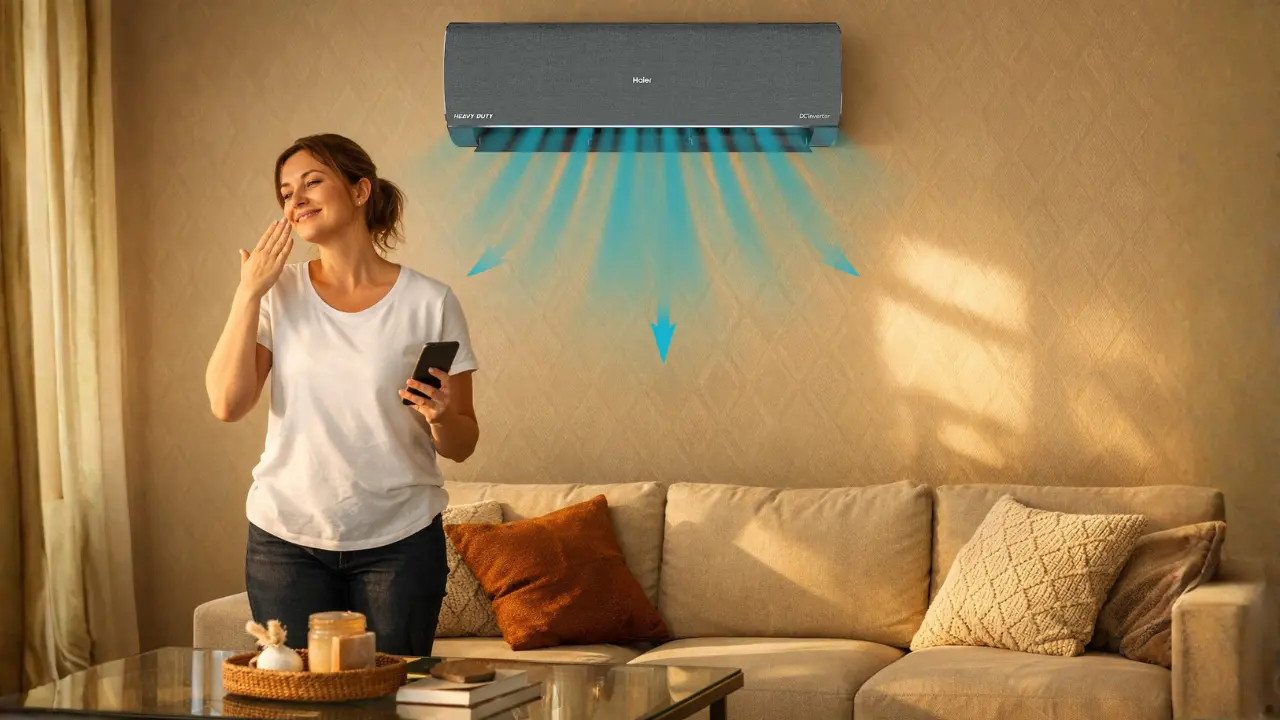

AI Pre Cooling predicts when you are about to arrive home and starts cooling in advance, based on your habits and location.
AI Pre Cooling studies your daily routines, tracks patterns like arrival times and usage modes, and uses geofencing to begin cooling automatically when you enter a preset zone, often within 100 metres. By the time you open the door, comfort is already waiting.
That is the short answer.
The deeper story is about something else.
Anticipation.
Why coming home to a hot room feels worse than it should?
You know this moment.
It is May in Ahmedabad. Or June in Delhi. The lift is slow. The corridor is still. You unlock the door and step into air that feels heavy.
The AC remote becomes urgent.
Traditional cooling works like a switch. You press a button. The machine reacts. Cooling begins. You wait.
In most Indian cities, summer temperatures cross 40°C regularly. According to the India Meteorological Department, heatwave days have increased in frequency over the last decade. That means your home absorbs heat all day.
So when you enter, the room is not neutral. It is already loaded with stored warmth.
Waiting five to eight minutes feels longer than it is.
The problem is not speed.
It is timing.
AI Pre Cooling Shifts Cooling from Reactive to Predictive
Traditional AC logic is simple.
- You enter
- You switch on
- Cooling starts
AI Pre Cooling rewrites that sequence.
- The system studies your usage habits
- It understands your usual arrival time
- It detects when you enter a geofenced zone
- It starts pre cooling automatically
This is not guesswork. It is pattern recognition powered by machine learning.
The system observes three core data points:
| Data Input | What It Tracks | Why It Matters |
| Location data | Entry into 100 metre geofence | Predicts occupancy |
| Usage history | Preferred mode and temperature | Personalizes comfort |
| Environmental data | Outdoor temperature and season | Adjusts cooling intensity |
This is what predictive comfort looks like.
Not louder machines.
Smarter timing.
The Hidden System Behind AI Pre Cooling
It Learns Before It Acts
The first week after installation, the AC watches quietly.
What time do you usually return from work?
Do you prefer 24°C or 26°C?
Do you use Eco mode or Normal mode?
Over days, the system builds a personalized consumption model.
It notices patterns.
Patterns become predictions.
Predictions become pre-cooling.
There is no manual timer.
No complicated scheduling.
The intelligence sits in the background.
Why This Matters in Real Indian Homes
Indian households are not predictable laboratories.
They are layered.
One person returns at 6 pm. Another at 9 pm. Children come back at 3 pm. Weekends shift everything.
AI Pre Cooling adapts.
One option is to rely on manual timers.
The second option is to switch on the AC remotely every day.
The third option is to let the system learn and act on your behalf.
The first option requires discipline.
The second requires constant attention.
The third requires trust.
Trust reduces friction.
Friction drains energy.
AI Pre Cooling and Energy Efficiency Are Not Opposites
There is a common assumption.
If the AC starts before you arrive, it wastes power.
That logic misses a key point.
Cooling a heat soaked room quickly consumes more electricity than gradually conditioning it.
According to the Bureau of Energy Efficiency, air conditioning accounts for nearly 40 percent of household electricity consumption in peak summer months. Sudden high load cooling spikes energy use.
AI Pre Cooling avoids this spike.
It starts earlier but runs smarter.
It uses environmental analysis and adaptive performance to optimize output.
The system balances three variables:
- Temperature difference between indoor and outdoor
- Duration before occupancy
- User energy preferences
Comfort without excess.
Savings without discomfort.
That balance defines intelligent cooling.
How AI Pre Cooling Connects to Atmox Neuro
AI Pre Cooling is part of a larger system.
In Haier’s AI Atmox platform, Atmox Neuro combines human perception and environmental data to automatically adjust cooling.
This means:
- It learns habits
- It tracks mode usage and duration
- It builds an optimized energy plan
- It dynamically controls performance
In simple terms, the AC does not just cool.
I think.
The moment you enter your building complex, the system anticipates occupancy through geofencing.
By the time you reach your door, the temperature already feels right.
No scramble.
No waiting.
Just continuity.
Three Real Life Scenarios Where AI Pre Cooling Changes Everything
1. The Working Professional
You leave the office at 6 pm most weekdays. The system learns this rhythm.
At 6:40 pm, when you enter the 100 metre radius, cooling begins automatically.
You walk into a balanced room, not a furnace.
Energy used is controlled. Comfort feels instant.
2. The Family with School Going Kids
Children return home mid afternoon.
Instead of keeping the AC on all day, the system activates only when arrival is detected.
This reduces idle consumption.
Smart timing protects the electricity bill.
3. The Weekend Pattern Shift
Weekends are different.
You may leave later. Return unpredictably.
The system adjusts based on observed behaviour across weeks.
Machine learning is not rigid.
It evolves.
That adaptability mirrors how real families function.
AI Pre Cooling as a Decision Framework
This is not just about an AC feature.
It reflects a broader shift in how homes operate.
There are three ways to manage comfort:
- Manual control
- Scheduled automation
- Predictive intelligence
Manual control gives flexibility but demands effort.
Scheduled automation gives structure but lacks context.
Predictive intelligence blends both.
It uses patterns instead of assumptions.
The same principle applies to work decisions, family routines, and energy use.
Systems that anticipate reducing stress.
Systems that react increase friction.
What AI Pre Cooling Teaches Us About Smart Living
A bookstore arranges popular titles at the entrance because it predicts demand.
A streaming app suggests shows based on your history.
A modern AC pre-cool because it understands your rhythm.
The pattern is universal.
Anticipation creates ease.
Ease creates loyalty.
When technology learns quietly and acts without drama, it becomes invisible infrastructure.
That is the real upgrade.
Not speed.
Not power.
But timing.
The Broader Implication for Indian Homes
Indian homes are changing.
Remote work blends with office days.
Parents juggle hybrid schedules.
Electricity tariffs fluctuate.
Heatwaves intensify.
Predictive cooling aligns with this reality.
It reduces cognitive load.
It optimizes consumption.
It protects comfort during extreme summers.
AI Pre Cooling is not about luxury.
It is about alignment between machine intelligence and human routine.
The Insight Worth Remembering
Cooling is not about temperature.
It is about transition.
The moment between outside chaos and inside calm.
AI Pre Cooling shortens that transition.
It reads patterns, enters the 100 metre geofence, starts cooling automatically, and delivers comfort without manual input.
That shift from reaction to anticipation defines the next generation of smart homes.
The future of comfort is not louder machines.
It is quieter intelligence.
And once you experience a room that feels ready before you arrive, going back to waiting feels unnecessary.
That is when technology stops feeling like a feature.
And starts feeling like foresight.
Frequently Asked Questions
Is AI Pre Cooling actually useful for my daily routine, or is it just another smart feature I won’t use?
If you follow fairly consistent arrival times or travel patterns, AI Pre Cooling reduces the need to manually switch on the AC or set timers. It quietly learns your habits and removes the daily decision of “Should I turn it on now?”
I’m already tired after work. Can AI Pre Cooling really make coming home feel different?
Yes. Instead of entering a heat-soaked room and waiting 5–8 minutes for relief, the system anticipates your arrival and conditions the room in advance, shortening that uncomfortable transition.
Should I use manual timers, remote control, or predictive cooling? What’s realistically easier for me?
Manual timers require discipline. Remote control requires daily attention. Predictive cooling uses machine learning and geofencing to act automatically, reducing mental load over time.
I don’t have a fixed schedule. Will this still work for my unpredictable routine?
AI Pre Cooling adapts over time by studying arrival patterns across weekdays and weekends. It evolves rather than relying on rigid schedules.
My family members return home at different times. How does AI Pre Cooling handle multiple schedules?
The system uses geofencing and learned behavior patterns to detect occupancy triggers. It adapts to layered household rhythms instead of assuming one fixed arrival time.
I live in a city like Ahmedabad or Delhi where temperatures cross 40°C. Will it handle extreme heat effectively?
Yes. By analyzing outdoor temperature and indoor heat load, it adjusts cooling intensity gradually rather than blasting at maximum load once you arrive.
What happens if I unexpectedly stay out late? Will it waste electricity?
The system relies on geofence entry (typically within 100 metres). If you don’t enter that zone, pre-cooling doesn’t trigger.
Is my location data safe when geofencing is used?
Geofencing typically operates within the brand’s app ecosystem, using encrypted location triggers to predict occupancy without continuous surveillance.