
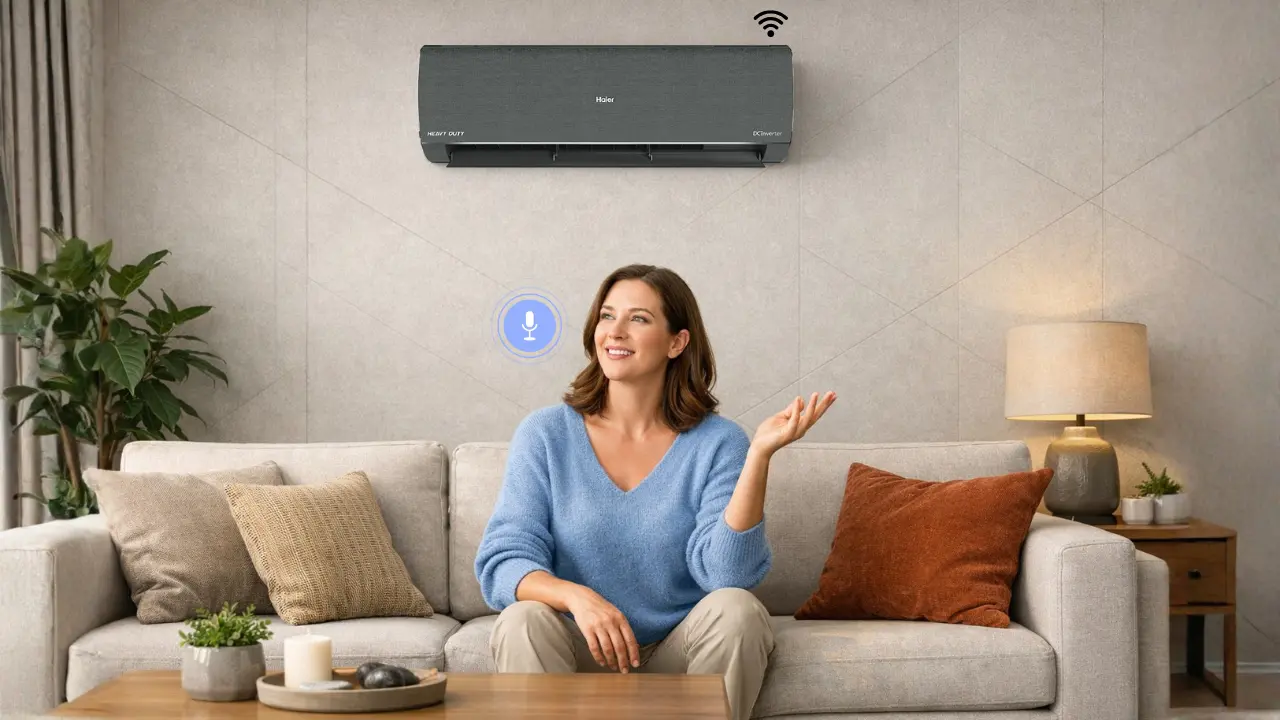

What Are Hands-Free Climate Adjustments and Why Do They Matter?
Hands-free climate adjustments mean your air conditioner senses, predicts, and adapts without you touching a remote.
It learns your habits, detects room occupancy, pre-cools before you arrive, and manages electricity smartly. The result is simple: consistent comfort, lower bills, and fewer small decisions draining your day.
That is the short answer.
The longer story lives inside real Indian homes.
The Evening Rush No One Talks About
It is 7:15 pm in Bengaluru.
Traffic was heavier than usual. The lift takes forever. Groceries feel heavier than they should.
You open the door and the house feels warm. Stale. Waiting.
In most homes, this is where the ritual begins. Remote search. Temperature guess. Fan speed adjustment. Swing angle change. Repeat.
Climate control becomes a manual chore.
And here is the hidden truth: every manual adjustment is friction.
Friction is what makes good technology feel tiring.
Modern Homes Are Not Static. So Why Are AC Settings?
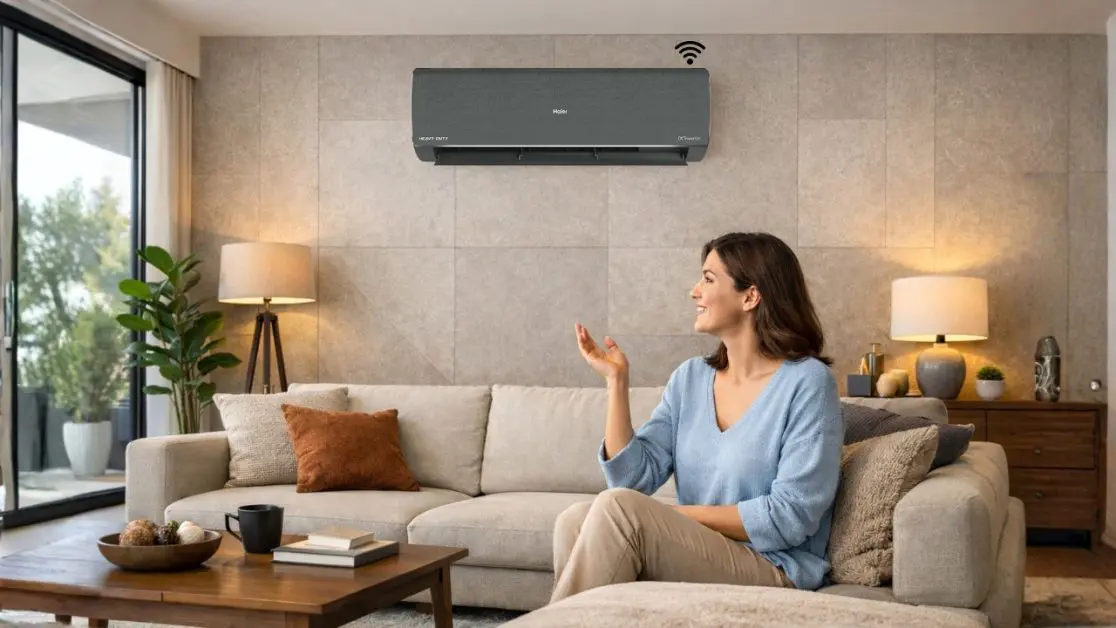
Indian homes are dynamic ecotechnology.
- One person is working from the dining table.
- A child is watching YouTube on the sofa.
- Someone steps out for 20 minutes.
- The balcony door opens.
- The kitchen heats up.
The temperature shifts. Occupancy changes. Humidity varies by season.
Yet traditional ACs cool the entire room the same way, regardless of what is happening inside it.
That mismatch wastes energy.
According to the Bureau of Energy Efficiency, air conditioners account for nearly 40percent* of household electricity use in peak summers. When technology runs longer than needed, costs compound quietly.
Hands-free climate adjustments exist to fix that gap.
How Hands-Free Climate Adjustments Actually Work
This is not about louder cooling.
It is about smarter cooling.
Let us break it down into technology that matters.
1. AI Climate Control That Learns, Adapts, Cools
Some newer technology, like Haier’s AI Atmox platform , use machine learning to analyse temperature patterns, user habits, and environment data.
The system:
- Tracks usage duration and preferred modes
- Monitors temperature differences
- Adjusts compressor performance dynamically
- Prevents overcooling
It builds a personalized consumption model.
The benefit is practical.
Instead of cooling aggressively every evening, the AC adapts to seasonal shifts, occupancy patterns, and real-time room data.
Comfort becomes responsive, not reactive.
And here is the insight:
The best climate technology disappears into the background.
2. AI Pre-Cooling That Knows You Are On Your Way
Imagine your AC turning on before you reach home.
Not because of a timer.
But because it detects you entering a 100 metre geofence radius and predicts your arrival .
This is AI Pre-Cooling.
No manual scheduling. No guessing.
It is like a theatre dimming lights before a movie begins. The transition feels natural.
The cost-benefit is clear:
| Feature | Manual Timer | AI Pre-Cooling |
| Setup effort | High | Zero |
| Accuracy | Often mistimed | Predictive |
| Energy use | Fixed schedule | Smart timing |
| Comfort on arrival | Uncertain | Immediate |
One option is manual scheduling.
The second option is reactive cooling after arrival.
The third option is predictive pre-cooling.
Predictive technology wins because they remove decision fatigue.
And decision fatigue is real.
3. Target Cooling That Focuses Where You Sit
Why cool the entire room when you are sitting in one spot?
AI Target Cooling uses installation data and cloud logic to direct airflow toward specific seating areas .
This shifts cooling from broad to precise.
Instead of lowering the temperature to feel relief, the AC channels airflow directly to the sofa, desk, or bed.
That changes two things:
- Faster perceived comfort
- Reduced energy waste
It is economically efficient and requires less compressor strain.
Precision beats power.
4. AI Human Detection That Cuts Unnecessary Power
We all forget.
You step out to answer a call. Then dinner happens. Then the AC keeps running.
AI Human Detection monitors room activity and automatically switches to energy-saving mode when the room is empty .
Some technology:
- Shift to L3 energy mode within 15 minutes of no activity
- Power off automatically after 30 minutes
No reminders needed.
This is where hands-free climate adjustments move from luxury to logic.
Because empty rooms should not burn electricity.
5. Electricity monitoring 2.0 That Makes Costs Visible
Energy waste often hides in invisibility.
When electricity usage appears in graphical and calendar formats, behaviour changes.
Modern technology provide:
- Daily and monthly consumption charts
- Normal vs AI Eco 2.0 runtime tracking
- Cost display in currency
- Custom energy-saving targets
When you see usage in rupees instead of kilowatt hours, the insight becomes personal.
Transparency drives discipline.
Three Ways Homes Approach Climate Control
Let us zoom out.
Most households fall into one of three technologies.
Option 1: Manual Control
- Remote dependent
- Frequent temperature adjustments
- Higher electricity bills
- Inconsistent comfort
This is reactive living.
Option 2: Basic Smart Scheduling
- Timers set manually
- Some automation
- Limited occupancy sensing
This reduces effort slightly but still depends on memory.
Option 3: Hands-Free Climate Adjustments
- Predictive AI models
- Human detection sensors
- Pre-cooling intelligence
- Real-time electricity tracking
This removes friction.
And friction is what drains modern households.
Why This Matters for Working Professionals and Young Families

If you work from home, thermal comfort affects productivity.
Studies from the International Energy Agency show that optimized temperature control can improve workplace comfort and energy efficiency simultaneously.
Too cold leads to distraction. Too warm reduces focus.
Climate is not just about comfort.
It influences mood, sleep quality, and concentration.
For parents, consistent temperature helps children sleep better. For solo professionals, automated control reduces mental clutter.
Small technology creates large outcomes.
The Hidden Pattern Behind Smart Homes
Every smart home breakthrough follows the same principle:
- Remove repetitive decisions
- Anticipate behaviour
- Optimize energy quietly
Refrigerators track freshness. Washing machines detect load size. Televisions auto-adjust brightness.
Climate technology is evolving the same way.
The shift is from control to intelligence.
And intelligence feels calmer.
What To Look For in Hands-Free Climate technology
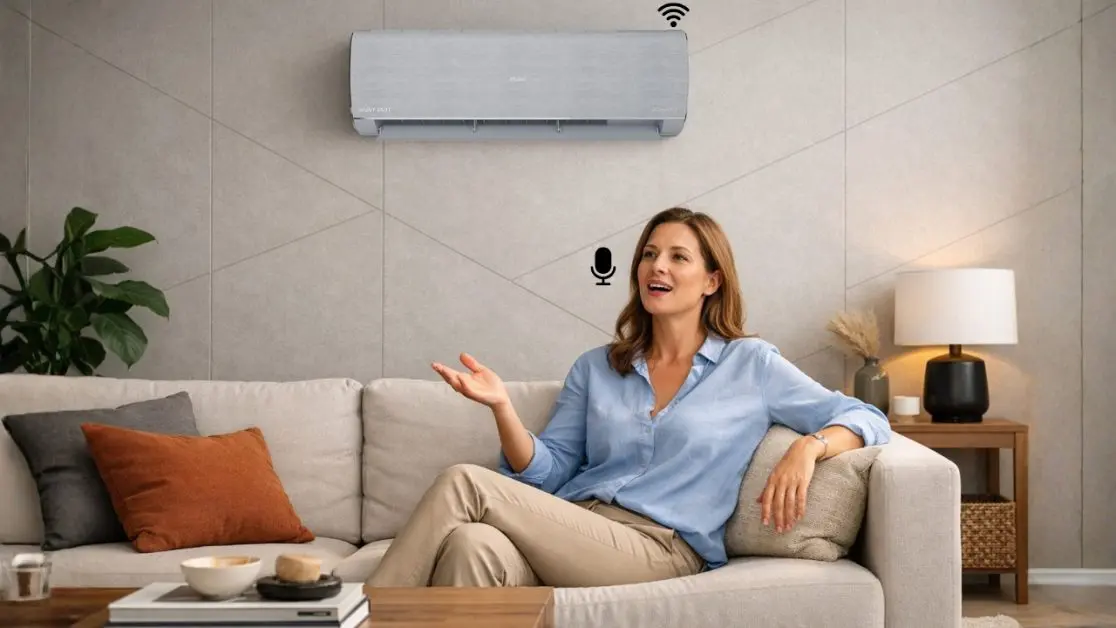
If you are evaluating a new AC for your home, consider this checklist:
- Does it learn usage patterns?
- Does it support predictive pre-cooling?
- Does it detect human activity?
- Does it offer Electricity monitoring 2.0?
- Does it adjust capacity dynamically through Eco modes?
If the answer is yes to most of these, you are moving toward hands-free climate adjustments.
Haier’s AI Atmox platform brings together AI Climate Control, AI Pre-Cooling, AI Target Cooling, AI Eco 2.0, Human Detection, and Electricity monitoring 2.0 in one ecosystem.
But the larger point is not the brand.
It is system design.
Smart climate control is not about cold air.
It is about cognitive ease.
The Future of Climate in Indian Homes
India’s climate patterns are becoming more extreme.
High ambient temperatures in cities like Delhi and Hyderabad push ACs to work harder. Long summers extend operating hours.
As energy costs rise, automation becomes less optional and more strategic.
Hands-free climate adjustments reduce waste without sacrificing comfort.
They are practical.
They are efficient.
They are quietly transformative.
The Memorable Insight
Comfort should not demand constant attention.
The best technology thinks ahead so you do not have to.
When the climate adjusts itself, evenings feel lighter. Workdays feel smoother. Bills feel manageable.
And the home feels like it understands you.
That is what hands-free climate adjustments really mean.
Not technology.
Relief.
Frequently Asked Questions
Why do I keep adjusting my AC temperature every evening?
Most traditional air conditioners cool at a fixed intensity regardless of room activity. When room conditions change like cooking heat, more people entering the room, or outdoor temperature drops, you manually compensate by changing settings.
Hands-free climate systems remove this friction by learning usage patterns and adjusting compressor performance automatically.
I’m tired of constantly using the AC remote. Is there a way my AC can just manage the temperature itself?
Yes. Newer AI-driven climate systems monitor temperature trends, occupancy, and user preferences. Over time they build a personalized cooling profile and automatically adjust cooling levels, fan speed, and energy mode without requiring manual input.
I come home exhausted after work. Why does the house always feel warm when I enter?
Traditional AC setups require you to turn the unit on after you arrive. Smart systems with AI pre-cooling detect when you’re approaching home (through geofencing via your phone) and start cooling the room shortly before you arrive, so the house feels comfortable the moment you walk in.
How do hands-free climate systems reduce everyday mental load?
They remove repetitive decisions such as:
Adjusting temperature
Changing fan speeds
Turning the AC on/off
Monitoring electricity usage
Instead, the system anticipates behavior and automates these actions in the background.
I often leave the AC running when I step out. Can smart ACs detect that the room is empty?
Many modern units include human detection sensors. If the room remains empty for a defined period (for example, 15 minutes), the AC automatically switches to a lower energy mode or powers off completely.
I work from home. Can smarter temperature control actually help productivity?
Yes. Consistent thermal comfort helps reduce fatigue and distraction. When the room temperature stays stable rather than fluctuating between too warm and too cold, it becomes easier to focus during long work sessions.