
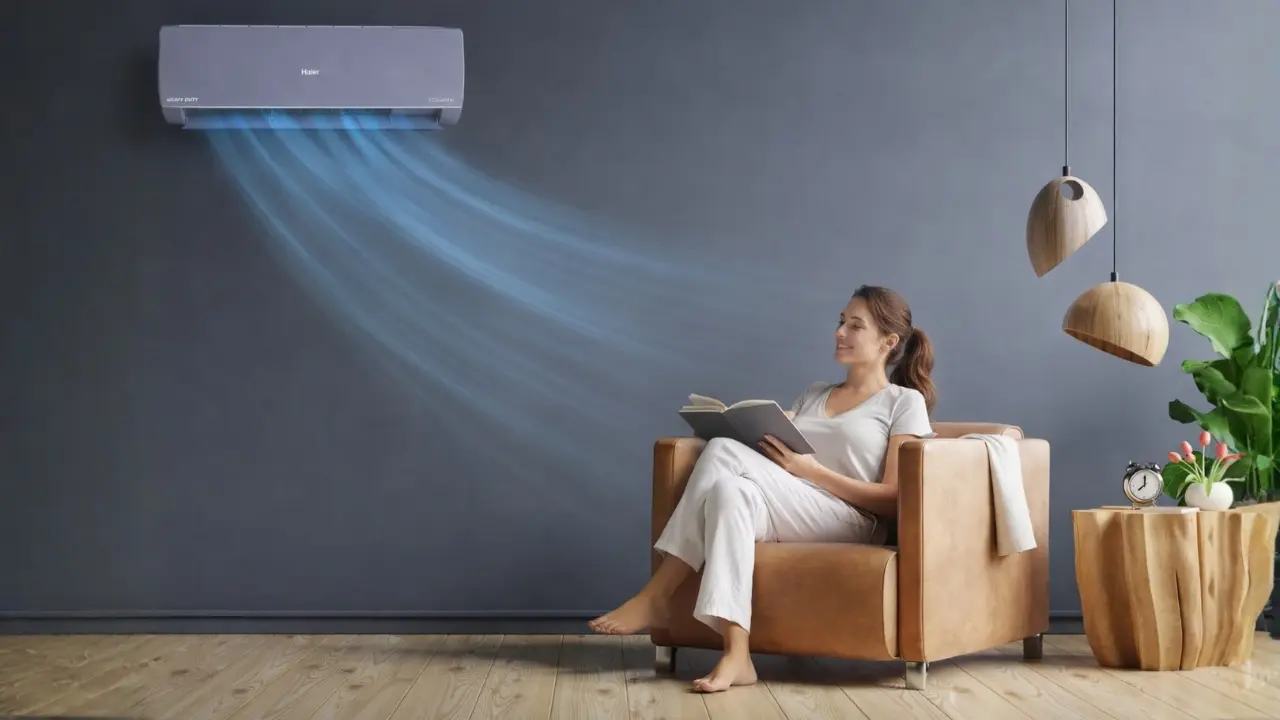

AI Target Cooling is a smart air conditioning feature that uses artificial intelligence to cool the exact area where people are present instead of chilling the entire room.
By understanding room layout, AC installation position, and usage patterns, it delivers faster comfort with lower energy use, making cooling feel more personal, efficient, and intentional rather than wasteful or generic.
Why does cooling an entire room no longer make sense?
Think about a regular evening at home.
You come back from work.
You drop your bag.
You sit on the sofa with your phone.
The AC switches on and starts cooling every corner of the room, including the empty dining area, the closed balcony door, and the unused corner near the window.
This is how air conditioning has worked for decades.
Not because it is smart.
Because it is simple.
Traditional ACs assume one thing.
That comfort means cooling everything, everywhere, all at once.
Modern homes do not work that way anymore.
Indian living rooms have zones.
Sofas. Study tables. Beds. Work corners.
Most of the time, people occupy just one of them.
Cooling the whole room for one person is not comfortable.
It is inefficiency disguised as habit.
What exactly is AI Target Cooling?
AI Target Cooling changes a single assumption.
It stops asking, “How cold should the room be?”
And starts asking, “Where is comfort actually needed right now?”
Using AI cloud intelligence, installation position data, and room layout inputs, the AC learns where cool air should be directed for maximum effect. Instead of spreading air evenly across the entire space, it focuses airflow toward the occupied zone.
The idea is simple.
- Cool where you are
- Not where you are not
- And do it faster, with less energy
This approach is highlighted in Haier’s AI Atmox ecosystem, where AI Target Cooling works alongside climate intelligence to create sharper, more focused comfort rather than blanket cooling .
The hidden system most people never notice
Air conditioning is not just about temperature.
It is about time to comfort.
Here is the invisible equation at play.
- Traditional cooling spreads air thinly across a room
- Target cooling concentrates airflow where it matters
- Concentration reduces time
- Reduced time reduces power consumption
This is why AI Target Cooling feels quicker even at moderate temperature settings.
You do not wait for the room to cool down.
Comfort arrives where you are sitting.
That difference changes how people use ACs daily.
How AI Target Cooling actually works inside the system
There is no magic button.
The intelligence comes from layering multiple inputs together.
The first input is installation awareness
The AC understands where it is mounted on the wall, its height, and its airflow reach. This matters because air behaves differently depending on angle and distance.
The second input is room layout
Users define basic room layout and seating zones through the companion app. Sofa location. Bed position. Study area. This creates a spatial map of comfort zones.
The third input is usage behavior
Over time, the AI learns patterns.
- Where cooling is most often needed
- How long the AC runs
- When focused cooling delivers faster satisfaction
The fourth input is real-time optimization
Based on these layers, airflow direction and intensity adjust dynamically so cool air reaches the intended zone first, not last .
This is not manual control.
It is delegated decision-making.
Why AI Target Cooling feels different in daily life
The change is subtle.
But it compounds.
Here is how it shows up at home.
Scenario one: The solo professional
You sit at your work desk in the evening.
The AC focuses airflow toward your chair.
The rest of the room stays neutral.
You feel comfortable faster.
The AC works less.
Scenario two: Family TV time
Everyone gathers on the sofa.
Cooling targets the seating area instead of the entire living room.
Comfort feels even.
Cold air does not blast unused corners.
Scenario three: Night-time bedroom use
You lie on the bed.
Airflow focuses on the sleeping zone, not the wardrobe or door.
Sleep stays undisturbed.
Overcooling reduces.
These moments do not feel technical.
They feel considerate.
The energy conversation most AC brands avoid
Energy saving is often framed as sacrifice.
Lower cooling.
Higher temperatures.
Less comfort.
AI Target Cooling flips that framing.
By focusing cooling only where needed, it reduces energy waste without asking users to compromise comfort. The system uses less power because it does less unnecessary work.
In Haier’s AI Atmox models, this targeted approach works alongside AI Eco 2.0 and power management systems to balance comfort and electricity consumption dynamically rather than statically .
The result is not discipline.
It is alignment.
How AI Target Cooling compares to traditional cooling
| Aspect | Traditional AC Cooling | AI Target Cooling |
| Cooling method | Uniform room cooling | Focused zone cooling |
| Time to comfort | Slower | Faster |
| Energy usage | Higher due to full-room cooling | Lower due to selective airflow |
| User effort | Manual adjustments | Minimal input |
| Comfort consistency | Uneven | More precise |
This comparison explains why AI-driven systems feel calmer.
They remove unnecessary decisions.
Why this matters in Indian homes specifically
Indian homes are layered with context.
- Mixed-use rooms
- Seasonal humidity
- High occupancy shifts
- Rising electricity costs
Blanket cooling ignores these realities.
AI Target Cooling responds to them.
During humid monsoons, focused airflow avoids excessive chilling.
During peak summers, faster comfort reduces runtime.
During shared family hours, cooling aligns with where people gather.
This is not luxury behavior.
It is adaptive behavior.
The psychology of targeted comfort
Comfort is not just physical.
It is psychological.
When cooling responds to your presence, it creates a feeling of being noticed.
Not watched.
But I understood.
This mirrors how good services work everywhere else.
- Streaming platforms recommend content instead of forcing search
- Navigation apps reroute instead of asking for directions
- Smart cooling adjusts instead of waiting for commands
AI Target Cooling belongs to this shift.
From control to trust.
When AI Target Cooling makes the biggest difference
Not every home needs it equally.
It matters most when:
- Rooms are large or open-plan
Focused cooling avoids wasting energy on unused zones. - Occupancy changes frequently
Solo use. Family use. Guests. Different zones matter at different times. - Electricity awareness is high
Faster comfort reduces runtime and cumulative cost. - Users value quiet efficiency
Less aggressive cooling cycles mean steadier operation.
This is why the feature feels invisible when it works well.
It removes friction instead of announcing itself.
The bigger idea behind AI Target Cooling
This is not about colder air.
It is about intentional systems.
Systems that ask fewer questions.
Systems that assume responsibility.
Systems that adapt quietly in the background.
Haier’s AI Atmox philosophy reflects this shift, where cooling intelligence blends into everyday life rather than demanding attention through constant settings and modes .
The best technology does not impress.
It is reassuring.
What AI Target Cooling signals about the future of home appliances
The future is not smarter buttons.
There are fewer buttons.
AI Target Cooling shows where appliances are heading.
- From uniform output to contextual response
- From maximum power to precise power
- From manual tuning to automatic alignment
Homes will not feel colder or hotter.
They will feel more aware.
That awareness is what modern households quietly crave.
The insight worth remembering
Cooling the entire room was never the goal.
Feeling comfortable was.
AI Target Cooling simply removes the waste between intention and experience.
And once you notice that difference,
everything else starts to feel outdated.
Frequently Asked Questions
What exactly is AI Target Cooling in an air conditioner?
AI Target Cooling is a feature that directs cool air only to the area where people are present, instead of cooling the entire room evenly. It focuses comfort where it’s actually needed.
How is AI Target Cooling different from normal AC cooling?
Traditional ACs cool the whole room equally. AI Target Cooling asks a smarter question: “Where is comfort needed right now?” and directs airflow there first.
My living room has multiple zones. Does AI Target Cooling help with that?
Yes. Indian homes often have mixed-use rooms. AI Target Cooling adapts to sofas, study corners, or beds instead of treating the room as one uniform space.
Why does targeted cooling feel faster even at normal temperatures?
Because concentrated airflow reaches you directly. You don’t wait for the entire room to cool before feeling comfortable.
How does AI Target Cooling reduce waiting time?
By focusing airflow where you’re sitting, comfort arrives almost immediately, even before the rest of the room cools.
Does AI Target Cooling actually save electricity?
Yes. By avoiding unnecessary cooling of unused areas, the AC consumes less power while delivering the same or better comfort.