


AI upscaling enhances lower-resolution videos and images using artificial intelligence so they appear sharper and more detailed on modern large screens.
It analyses each frame and intelligently refines it for higher-resolution displays like 4K panels.
That is the technical explanation.
The emotional one is simpler.
It helps yesterday’s memories look comfortable on today’s screens.
Why does old content feel outdated on new TVs?
You buy a new large-screen TV.
You play an old cricket highlight from 2011. Or a wedding video saved on a hard drive. Or a classic Bollywood film.
The picture looks softer than expected.
Not broken.
Just stretched.
The Resolution Gap
Technology has moved fast:
- Standard Definition once meant 480p.
- HD introduced 720p and 1080p.
- 4K now means 3840 x 2160 pixels.
- Larger 164 cm (65), 189cm (75), and 254cm(100) screens are becoming common in Indian homes.
Content, however, evolves slower than hardware.
Much of what families watch daily is still HD or compressed streaming quality.
When displayed on a larger panel, low-resolution content spreads across more pixels. That is when blur becomes visible.
A bigger screen magnifies detail.
And it magnifies limitations.
AI upscaling exists to manage that transition.
What AI Upscaling Actually Does

AI upscaling does not simply enlarge an image.
It analyses patterns inside each frame and predicts how missing detail might appear at a higher resolution.
Think of it as guided enhancement.
A Simple Breakdown
| Stage | What Happens | Why It Matters |
| Source detection | TV identifies input resolution | Determines processing needs |
| Pattern analysis | AI studies edges, textures, faces | Recognises common visual structures |
| Detail prediction | Pixels are refined and added | Improves perceived sharpness |
| Noise management | Grain and blur are adjusted | Creates cleaner output |
Instead of stretching pixels blindly, the system uses trained algorithms to refine them.
It does not recreate original data.
It improves perceived clarity.
Why AI Upscaling Matters in Indian Living Rooms
Indian homes mix content types constantly.
You stream an OTT series in 4K.
You watch a regional film in HD.
You replay family videos shot on older cameras.
You follow cricket highlights streamed in variable quality.
Not every file is at a premium resolution.
Yet the screen is.
Three Everyday Situations
1. Sports Viewing
Cricket telecasts vary by network and bandwidth. AI upscaling can refine field textures and player outlines for large displays.
2. Family Archives
Older wedding videos or birthday recordings often have visible grain. Upscaling attempts to improve sharpness and balance.
3. Classic Cinema
Many beloved films exist only in HD masters. AI processing helps present them more comfortably on larger 4K panels.
The improvement is not transformation.
It is refined.
And refinement changes experience.
Where AI Upscaling Meets Display Technology
Upscaling does not work alone.
It operates inside a broader picture processing system that includes brightness control, colour handling, and contrast management.
For instance, models such as:
- Haier 164 cm (65) QD Mini LED AI Smart Google TV M92 Series
- Haier 189 cm (75) QD Mini LED Smart AI Google TV M92 Series
- Haier 254 cm (100) QD Mini LED AI Smart Google TV M96 Series
These televisions integrate AI-based picture optimisation alongside Quantum Dot and Mini LED technologies.
The processing engine evaluates content frame by frame and applies picture adjustments dynamically.
Upscaling becomes one layer inside a larger display architecture.
Not a standalone feature.
Is AI Upscaling Perfect?
No enhancement system can fully recreate detail that was never captured.
Extremely low-resolution files still show limits.
Over-compressed streaming cannot become native cinema quality.
However, the goal is not perfection.
It is consistent.
Large screens reveal flaws clearly.
AI upscaling works to soften that contrast between old content and new panels.
It helps older content feel proportionate on modern displays.
Should AI Upscaling Influence Buying Decisions?

The answer depends on viewing habits.
If you only watch native 4K streaming, the impact may be limited.
If your content library includes:
- HD sports broadcasts
- Archived family videos
- Classic films
- YouTube content
- Regional programming
Then upscaling becomes relevant.
Three Viewing Approaches
Basic Display Processing
- Suitable for smaller screens
- Standard scaling only
- Minimal image refinement
Mid-Level AI Processing
- Moderate edge refinement
- Better motion handling
- Improved HD presentation
Advanced AI Processing in Large Panels
- Frame-by-frame analysis
- Dynamic brightness mapping
- Enhanced clarity on 164 cm (65) and above displays
The difference is subtle on small screens.
It becomes noticeable as screen size increases.
The Bigger System at Work
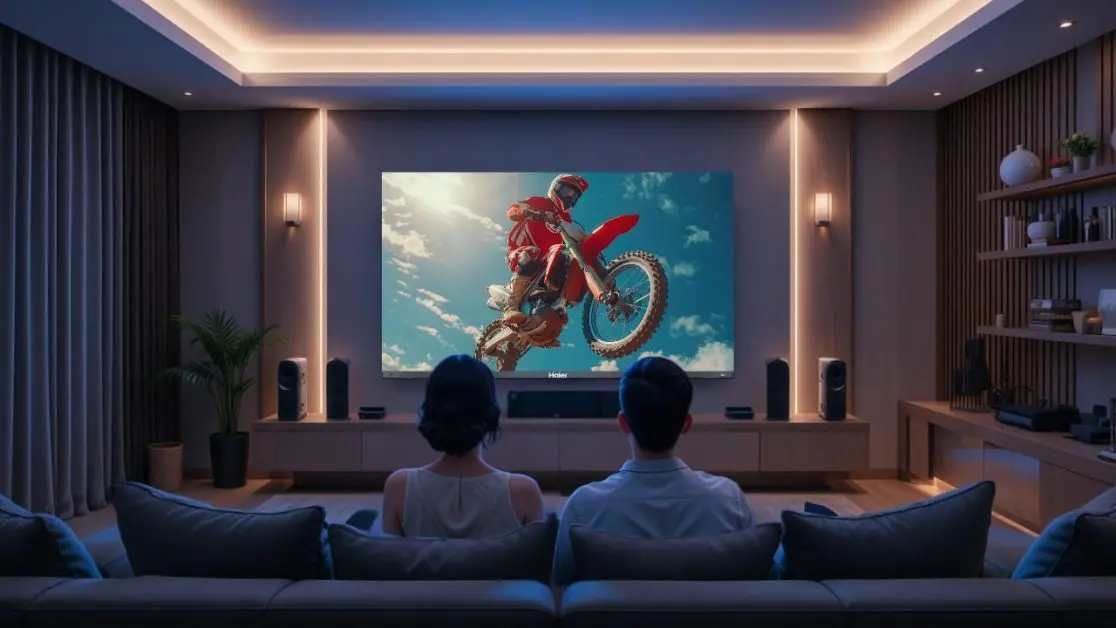
Television technology evolves faster than content libraries.
Screen resolution increases.
Backlighting improves.
Colour accuracy expands.
But millions of videos remain in older formats.
AI upscaling addresses that mismatch.
It ensures older content sits comfortably within newer hardware environments.
This matters in Indian homes where one screen often serves multiple generations.
Grandparents watch classic cinema.
Parents follow news and sports.
Children stream animated series.
Young professionals game or binge OTT content.
A shared screen demands adaptability.
A Simple Analogy
Think of an old printed photograph.
You place it under better lighting.
You clean dust from the surface.
You adjust contrast gently.
You do not redraw the picture.
You improve how it appears.
AI upscaling works in a similar way.
It enhances presentation.
It does not rewrite history.
What This Means for Modern Homes
Large-screen televisions are becoming central to Indian living rooms.
They host festival gatherings.
Weekend movie nights.
Live cricket screenings.
Family video playback sessions.
Not every piece of content arrives in perfect resolution.
AI upscaling attempts to maintain visual comfort across varied sources.
It becomes part of a broader picture processing framework.
The goal is not spectacle.
It is a smooth continuity.
Technology should not only serve new releases.
It should also support the content people already cherish.
Because in most homes, the value of a screen lies not just in what is new.
But in how it carries forward what already matters.
Frequently Asked Questions
Why do my old videos look blurry on my new 4K TV?
Old videos were recorded at lower resolutions like 480p or 720p. When displayed on a large 4K screen, the TV has to stretch those pixels across many more pixels, making softness or blur more noticeable.
I bought a 165cm (65) TV but my old cricket highlights look worse than before. Is something wrong with my TV?
Usually nothing is wrong. Larger screens magnify imperfections in older HD or SD broadcasts. The bigger the screen, the easier it is to notice compression artifacts and lower resolution.
Why did my old wedding videos look fine on my laptop but blurry on my living room TV?
Smaller screens hide imperfections because the pixels are packed closer together. On a large television, the same video is spread out across a much larger display.
If content is HD, shouldn’t it still look good on a 4K TV?
It can still look good, but HD has only about one-quarter of the pixels of 4K. When expanded to fill a 4K screen, the TV must estimate additional detail.
Why does a bigger TV sometimes make old movies look worse instead of better?
Larger screens reveal detail more clearly including limitations in older recordings, compression, and lower resolution formats.
Do I really need AI upscaling if I mostly watch Netflix or OTT platforms?
If you mainly watch native 4K content, AI upscaling has a smaller role. But if you watch HD shows, YouTube videos, sports broadcasts, or older movies, it becomes more useful.
I watch a lot of YouTube and regional channels. Would AI upscaling help me?
Yes. Many YouTube videos and TV broadcasts stream in compressed HD or lower resolutions. AI upscaling can refine edges and reduce visual noise on larger displays.
Is AI upscaling important when buying a large TV like 165cm (65) or 189cm (75)?
It becomes more relevant as screen size increases. Large displays make lower-resolution content imperfections more visible.
If I only watch modern 4K movies, is AI upscaling wasted?
Not entirely. Even streaming platforms often deliver dynamic resolutions depending on bandwidth. Upscaling helps maintain consistent picture clarity.
Should AI picture processing be a deciding factor when choosing a TV?
It should be considered alongside brightness, contrast technology, and color accuracy. Upscaling is one part of the overall picture processing system.