

Balanced & Natural Sound by KEF Means You Hear What Was Meant to Be Heard
Balanced and natural sound by KEF means your TV does not exaggerate bass, drown voices, or distort details. It reproduces dialogue, music, and effects in harmony, just as creators intended.
In models like the Haier M80F Mini LED series, the M92 Series QD Mini LED TVs, and the flagship M96 Series 254cm (100) QD Mini LED, Sound by KEF integrates precision speaker engineering with immersive formats like Dolby Atmos for a fuller and more realistic listening experience.
The goal is not to make a louder sound.
The goal is true sound.
Now let us slow that down.
Because most homes do not struggle with volume.
They struggle with clarity.
Why Most Living Rooms Sound Louder, Not Better
Picture a typical Saturday night.
Cricket on the screen.
Pressure cooker in the kitchen.
Ceiling fan spinning at full speed.
Someone scrolling reels on their phone.
The TV volume reaches 35.
And still someone asks, “What did he say?”
This is not about decibels.
It is about balance.
Research from Dolby and other audio labs consistently shows that dialogue clarity ranks among the top complaints in home entertainment systems. Indian living rooms make this challenge even more complex.
Open kitchens.
Marble flooring.
High ceilings.
Minimal carpeting.
These surfaces reflect sound. Voices scatter. Details disappear.
Loud sound fills a room.
Balanced sound fills a moment.
That is where KEF’s tuning philosophy matters.
What Does Balanced & Natural Sound Actually Mean?
Balanced sound is not accidental. It is engineered.
A properly tuned system creates harmony between three critical audio layers:
1. Bass
Deep bass supports action scenes and music without overpowering voices.
2. Midrange
This is where human voices live. Clear midrange ensures dialogue remains understandable.
3. Treble
Treble carries detail. Footsteps. Claps. Ambient sounds. Background music.
When these layers cooperate, the result feels natural.
The Structure Behind Sound by KEF Tuned
Many televisions rely on simple stereo speakers.
But Haier’s Mini LED lineup approaches sound more intentionally.
Models like the Haier M80F Mini LED series and the M92 Series QD Mini LED TVs, including the 164cm (65) H65M92FUX and 189cm (75) H75M92FUX, feature a 2.1 channel speaker system with a dedicated subwoofer and 50W audio output.
That structure matters.
Two speakers create stereo separation.
One dedicated woofer handles low frequency bass.
Clear roles. Clear sound.
Systems work best when responsibilities are defined.
Audio systems are no different.
Layered with Dolby Atmos, these TVs expand sound beyond simple left and right channels, adding spatial depth that enhances immersion.
How Sound by KEF Changes Everyday Watching
Cricket Nights Feel Closer to the Stadium
When the bat connects with the ball, you hear the crack.
When the crowd erupts, it surrounds you.
When the commentator speaks, the voice cuts through the atmosphere.
This is the difference between flat audio and tuned audio.
Dolby Atmos adds vertical space to the soundstage. Instead of sound coming only from the screen, it spreads around the room.
Watching becomes participation.
Movie Dialogues Stay Clear Even During Action
Action scenes expose weak audio systems.
Explosions become louder. Dialogue disappears.
Balanced tuning prevents that imbalance.
KEF’s acoustic expertise focuses on preserving clarity while maintaining depth, ensuring that voices remain intelligible even during complex sound sequences.
Clarity is respect for the story.
The Step Up: M96 Series 254cm (100) with Sound by KEF
If the M80F and M92 series feel cinematic, the M96 Series 254cm (100) QD Mini LED pushes the experience closer to a home theatre.
Its audio system introduces a 6.2.2 channel configuration with 90W output and Total Sonic sound enhancement.
That architecture includes:
• Horizontal surround channels
• Dedicated bass channels
• Height channels for spatial sound
Sound no longer feels like a flat layer.
It becomes dimensional.
Think of it like a well cooked biryani.
Rice alone is plain.
Masala alone is sharp.
Together they create depth.
That is balanced audio.
Audio Comparison Across Key Models
| Model | Audio Configuration | Audio Output | Immersive Format |
| M80F 165cm (65) | 2.1 Channel with Woofer | 50W | Dolby Atmos |
| M80F 189cm (75) | 2.1 Channel with Woofer | 50W | Dolby Atmos |
| M80F 215cm (85) | 2.1 Channel with Woofer | 50W | Dolby Atmos |
| M92 164cm (65) | 2.1 Channel with Subwoofer | 50W | Dolby Atmos |
| M92 189cm (75) | 2.1 Channel with Subwoofer | 50W | Dolby Atmos |
| M96 254cm (100) | 6.2.2 Channel | 90W | Dolby Atmos + Total Sonic |
Sources: Product specification pages for H65M92FUX and H75M92FUX.
Why Natural Sound Matters in Modern Indian Homes
Open Layouts Demand Smarter Audio
Modern apartments combine living rooms, kitchens, and dining areas into one continuous space.
This creates beautiful interiors.
It also complicates sound.
Hard surfaces reflect sound waves.
Balanced speakers compensate through accurate sound dispersion.
This ensures:
• Voices stay centred
• Music remains smooth
• Bass supports without overwhelming
Good design becomes invisible when it works.
Family Viewing Needs Clarity Across Generations
In many Indian homes:
Parents prefer moderate volume.
Kids want an energetic sound.
Elders need clear dialogue.
Balanced audio reduces the need to constantly increase volume.
Clear sound at lower levels is more comfortable for long viewing sessions.
Natural tuning supports comfort.
Sound as a System, Not a Feature
The M92 and M96 series introduce powerful visual technologies such as:
• AI Ultra Sense Processor
• Dolby Vision IQ
• 144Hz refresh rate for smooth motion
But here is the real insight.
When picture quality improves without audio keeping pace, immersion breaks.
Sound must evolve alongside visuals.
Balanced & Natural Sound Tuned by KEF ensures that audio performance grows with the screen experience.
Systems fail when one component outruns the other.
Three Ways Homes Typically Handle TV Audio
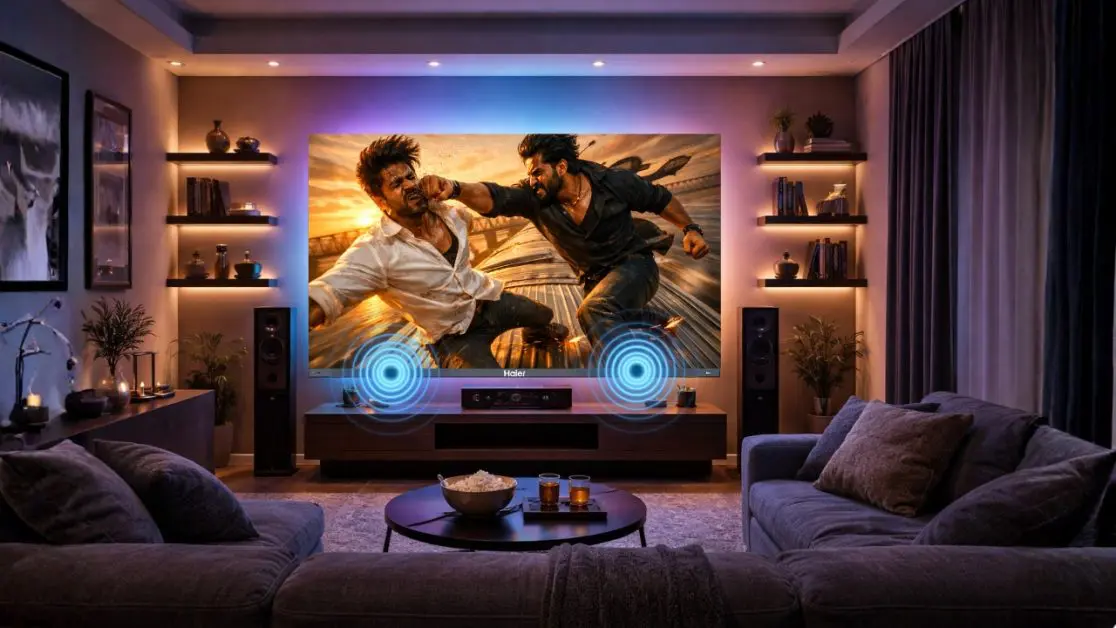
Most households follow one of three paths.
1. Use Default TV Speakers
Low cost
Limited depth
Often thin dialogue
2. Add an External Soundbar
Stronger bass
Extra wiring
Additional space required
3. Choose a TV Tuned for Balanced Audio
Integrated clarity
Optimised speaker placement
Cleaner aesthetics
The third option simplifies the experience.
Less clutter.
More coherence.
The Hidden System Behind Better Evenings
Think about how evenings unfold.
OTT series after dinner.
IPL weekends with friends.
Music playlists during house parties.
Gaming marathons.
Sound shapes memory.
If audio distorts, the moment feels incomplete.
If dialogue remains clear and bass supports the scene, the experience feels whole.
Balanced & Natural Sound Tuned by KEF is not about louder living rooms.
It is about truer rooms.
Rooms where sound and picture cooperate.
Rooms where technology disappears into the experience.
So What Does This Mean for You?
When choosing a TV, the obvious questions appear first.
How big is the screen?
How bright is the panel?
But another question matters just as much.
How honest is the sound?
Models like the Haier M80F Mini LED series, the M92 Series QD Mini LED TVs, and the flagship M96 Series 254cm (100) QD Mini LED show how Sound by KEF, Dolby Atmos, and structured speaker design combine into a cohesive system.
Technology works best when features align.
Balanced sound aligns intention with experience.
And when sound feels natural, the room feels complete.
That is the quiet advantage.
Not flashy.
Not exaggerated.
Just right.
Frequently Asked Questions
My TV is already getting loud enough. Why should I care about “balanced sound”?
Volume and sound quality are different things. Many TVs can get loud, but the audio often becomes unbalanced, where bass overwhelms dialogue or background noise masks voices. Balanced sound ensures bass, midrange (voices), and treble (details) work together so you can hear every element clearly without increasing volume.
I often raise the volume just to hear dialogue. Is that normal?
Yes, it’s one of the most common complaints in home entertainment. Standard TV speakers often mix voices with background effects in the same frequency range. Systems tuned for balanced sound emphasize the midrange frequencies where human voices exist, improving dialogue clarity even at lower volumes.
My living room has marble floors and open space. Why does the sound sometimes feel messy?
Hard surfaces like marble, tiles, and glass reflect sound waves, which can cause echo and muddiness. Balanced speaker tuning helps compensate by directing sound more precisely and maintaining clarity across different frequencies.
I watch TV while the kitchen fan and appliances are running. Will better audio help?
Yes. Tuned audio systems focus on clear midrange frequencies, which helps voices remain understandable even when background noise exists in the room.
My family complains the TV is too loud even though I’m just trying to hear dialogue. What’s happening?
This happens when audio systems lack balance. To hear speech, viewers increase the volume, which also increases background music and effects. Balanced tuning allows dialogue to stay clear without raising overall volume.
Why do action movies make dialogue disappear on my TV?
Action scenes often contain a wide dynamic range, meaning loud explosions and quiet dialogue occur in the same sequence. Poorly balanced speakers cannot separate these elements well. Tuned systems maintain clarity so dialogue remains intelligible even during intense scenes.
I play games on my TV. Does balanced sound make a difference?
Yes. Games rely on audio cues like footsteps, environmental sounds, and directional effects. Balanced sound ensures these details remain audible without being masked by music or explosions.
My TV supports Dolby Atmos. Does tuning still matter?
Absolutely. Dolby Atmos expands sound spatially, but the quality of the speakers and tuning determines how clearly those sound objects are reproduced. Balanced tuning ensures Atmos effects feel precise and natural rather than chaotic.
Why do some TVs include a dedicated subwoofer in a 2.1 audio system?
A dedicated subwoofer handles low-frequency bass, allowing the main speakers to focus on midrange and treble. This separation improves clarity and prevents bass from overwhelming voices.