

AI-based cooling in modern air conditioners reduces energy use, improves comfort, and removes manual effort by learning your habits and adjusting automatically.
It delivers cooling before you need it, where you need it, and only as much as needed.
That is the short answer.
The real story is more human.
Because cooling was never just about temperature.
It was always about timing, comfort, and control.
And for the first time, air conditioners are starting to understand that.
Why does traditional cooling always feel one step behind?
Picture a familiar Indian summer evening.
You step into your home after a long commute.
The room feels heavy. Still. Warm.
The instinct is automatic.
Switch on the AC.
Wait.
Five minutes. Sometimes more.
This is how cooling has worked for decades.
Reactive. Manual. Delayed.
And here is the uncomfortable truth.
Comfort that arrives late never feels complete.
This is the problem AI-based cooling is trying to solve.
What changes when cooling starts thinking for you
AI-based air conditioners shift one fundamental technology.
From reaction to prediction.
Instead of waiting for you to press a button, the technology:
- Observes your patterns
- Learns your routines
- Adapts to your environment
- Optimises performance in real time
Technologies like Haier’s AI Atmox platform take this further by combining environmental data, user behaviour, and energy tracking into one technology that constantly refines cooling decisions .
The result is simple.
The AC stops being a machine. It starts behaving like a technology.
Benefit 1: Comfort that arrives before you do
Why waiting disappears
The biggest visible change is timing.
AI-powered pre-cooling technology predicts when you are about to arrive and starts cooling in advance. For example, some technology triggers pre-cooling when you enter a defined geofence, often around 100 metres from home .
So when you walk in, the room is already comfortable.
No delay. No adjustment.
What this changes in real life
- After work, your room feels ready
- During afternoons, bedrooms stay usable
- Before sleep, the environment stabilises earlier
This is not faster cooling.
This is earlier cooling.
And that difference changes how comfort feels.
Benefit 2: Cooling that follows you, not the room
Why uniform cooling is inefficient
Traditional ACs treat every corner equally.
But homes are not used equally.
- The sofa is used. The corners are not
- The bed matters. The wardrobe does not
- The study area needs focus. The hallway does not
AI target cooling changes this.
It directs airflow precisely to where people are, instead of cooling empty space .
The hidden advantage
- Faster cooling where you sit or sleep
- Less energy wasted on unused areas
- More consistent comfort
Comfort is not about square feet. It is about where you are.
Benefit 3: Energy savings that happen automatically
Why most energy waste is invisible
In Indian homes, ACs often:
- Run in empty rooms
- Stay on longer than needed
- Cool beyond necessary levels
These small inefficiencies add up.
AI-based cooling fixes this quietly.
How AI reduces electricity consumption
- Detects occupancy and reduces cooling when no one is present
- Adjusts compressor levels dynamically
- Switches between energy modes based on temperature difference
For example, AI Eco 2.0 modes can shift between different power levels depending on how far the room temperature is from the set temperature, ensuring efficiency without manual intervention .
What this means financially
| Behaviour Change | Impact |
| Auto energy adjustment | Lower monthly bills |
| Occupancy detection | No wasted cooling |
| Smart mode switching | Consistent efficiency |
Savings are not created in big moments. They are built in small corrections.
Benefit 4: Personalised cooling that adapts to your life
Why fixed settings fail
Most people use the same temperature setting every day.
But life changes daily.
- Weather shifts
- Room usage changes
- Sleep patterns vary
- Work schedules fluctuate
AI-based cooling tracks these patterns.
It learns:
- When you use the AC
- How long you use it
- What temperatures you prefer
Over time, it builds a personalized model and adjusts automatically .
The real shift
You stop adjusting the AC. The AC adjusts to you.
Benefit 5: Real-time electricity awareness and control
Why people overspend without noticing
Most households do not track AC usage.
Electricity bills arrive.
People react after the fact.
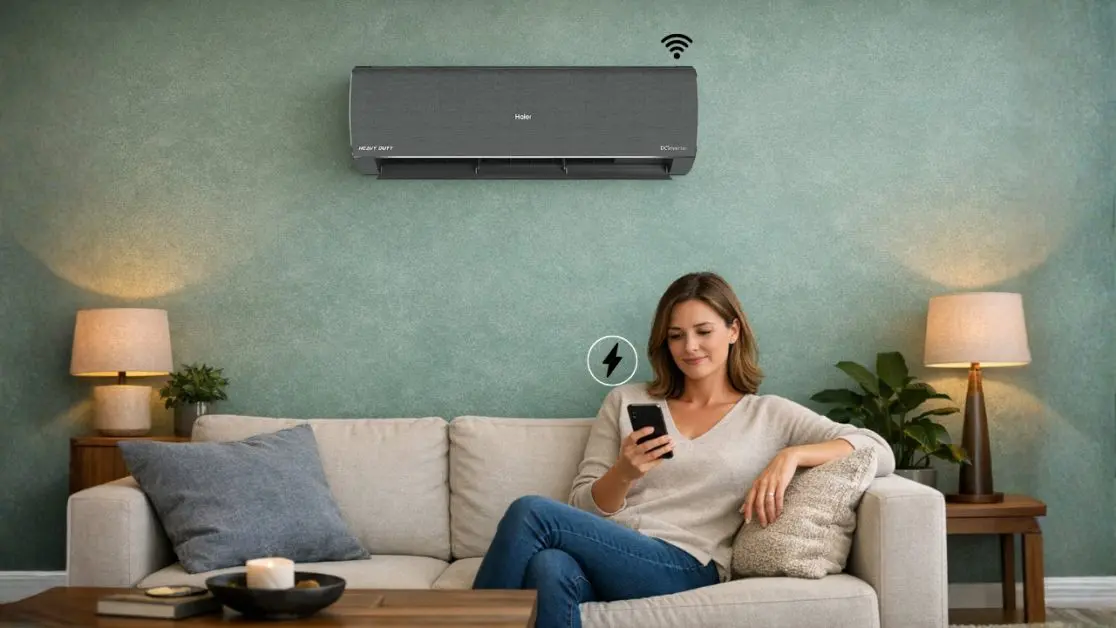
AI-based technology changes that.
They show:
- Daily and monthly energy usage
- Cost estimates in real time
- Mode-wise consumption patterns
- Custom energy-saving targets
What this enables
- Better decisions about usage
- Awareness of peak consumption
- Control over monthly costs
This turns electricity from a surprise into a technology.
What gets measured gets optimised.
Benefit 6: Less manual control, more intuitive living
Why convenience matters more than features
Most appliance features go unused.
Because they require effort.
AI-based ACs reduce that friction.
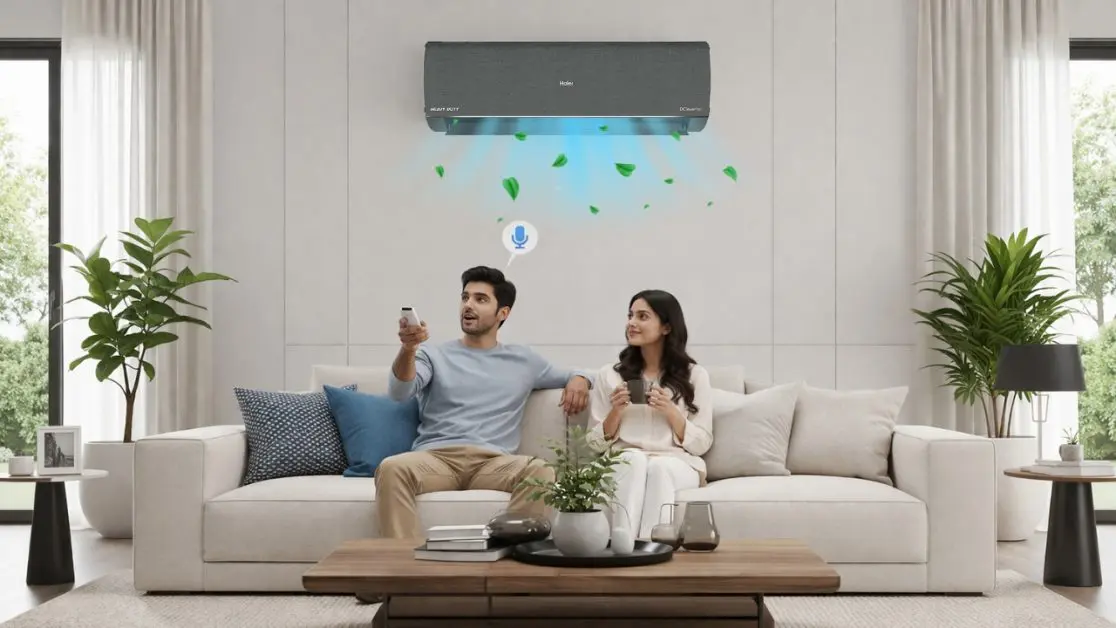
Some technologies even allow direct voice control without needing Wi-Fi in select models .
What this changes
- No remote searching
- No repeated adjustments
- No constant monitoring
Just simple interaction.
Or no interaction at all.
The best technology is the one you stop noticing.
Benefit 7: Cleaner technology, better performance
Why maintenance affects cooling
Dust and dirt reduce efficiency.
Most users delay cleaning.
AI-based technology solves this internally.
Features like:
- Indoor frost self-cleaning
- Outdoor cyclone cleaning
- Automatic dust removal
help maintain performance without manual effort .
The hidden advantage
- Better airflow
- Faster cooling
- Lower energy consumption
- Longer appliance life
Clean technology performs better. Always.
Three ways to think about AI-based cooling
When deciding if AI-based cooling matters, it helps to look at it as a choice.
One option is traditional cooling
- Lower upfront complexity
- Manual control required
- Higher long-term inefficiency
The second option is semi-smart cooling
- Some automation
- Limited adaptation
- Partial savings
The third option is AI-based cooling
- Fully adaptive
- Pre-cooling behaviour
- Continuous optimisation
It is not just a feature upgrade.
It is a technology upgrade.
The larger shift: from appliances to intelligent technology
This is the bigger pattern.
Refrigerators are learning food habits.
Washing machines are optimising cycles.
Air conditioners are understanding behaviour.
Homes are becoming responsive.
Not reactive.
AI-based cooling is part of that shift.
It connects:
- Data
- Behaviour
- Environment
- Efficiency
into one continuous loop.
And once you experience that loop, going back feels different.
What this means for modern Indian homes
Indian homes are changing.
- Smaller spaces
- Flexible routines
- Remote work setups
- Rising electricity costs
Static appliances struggle in dynamic homes.
Adaptive technology fits better.
AI-based cooling does exactly that.
It adjusts to:
- Busy weekday evenings
- Weekend gatherings
- Afternoon downtime
- Night-time sleep patterns
Good appliances fit into homes. Great ones fit into lives.
Final thought: Comfort is no longer a setting
For years, comfort meant setting a temperature.
Now it means something else.
Timing.
Awareness.
Adaptation.
AI-based cooling brings all three together.
And the insight is simple.
The future of cooling is not colder air. It is a smarter decision.
Once that shift happens, everything else follows.
Frequently Asked Questions
Do I really need AI in my air conditioner, or is it just a gimmick?
If your usage is irregular, your schedule changes often, or you forget to turn the AC off/on, AI makes a real difference. It removes manual effort and optimizes cooling automatically, something traditional ACs simply cannot do.
I already have an inverter AC. Will I actually make a noticeable difference?
Yes. Inverter ACs adjust power; AI goes further by learning when, where, and how much to cool. It adds prediction and personalization on top of efficiency.
Is AI cooling worth the extra cost for my electricity bills?
In most cases, yes. The savings come from small, continuous optimizations, like turning down cooling in empty rooms or adjusting compressor usage dynamically.
I don’t want complicated tech. Will AI ACs make things harder?
Quite the opposite. AI reduces interaction. You spend less time adjusting settings because the system learns and automates decisions.
Will the AC actually learn my habits over time?
Yes. It tracks your usage patterns, timing, temperature preferences, and duration and builds a personalized cooling model.
I keep adjusting the temperature manually. Will AI stop that habit?
Eventually, yes. As the system learns your preferences, it reduces the need for manual changes.
Can AI ACs really show how much electricity I’m using?
Yes. Many models provide real-time usage, cost estimates, and consumption trends.
Can I control an AI AC with voice instead of a remote?
In many models, yes. Some even allow voice control without requiring Wi-Fi.