
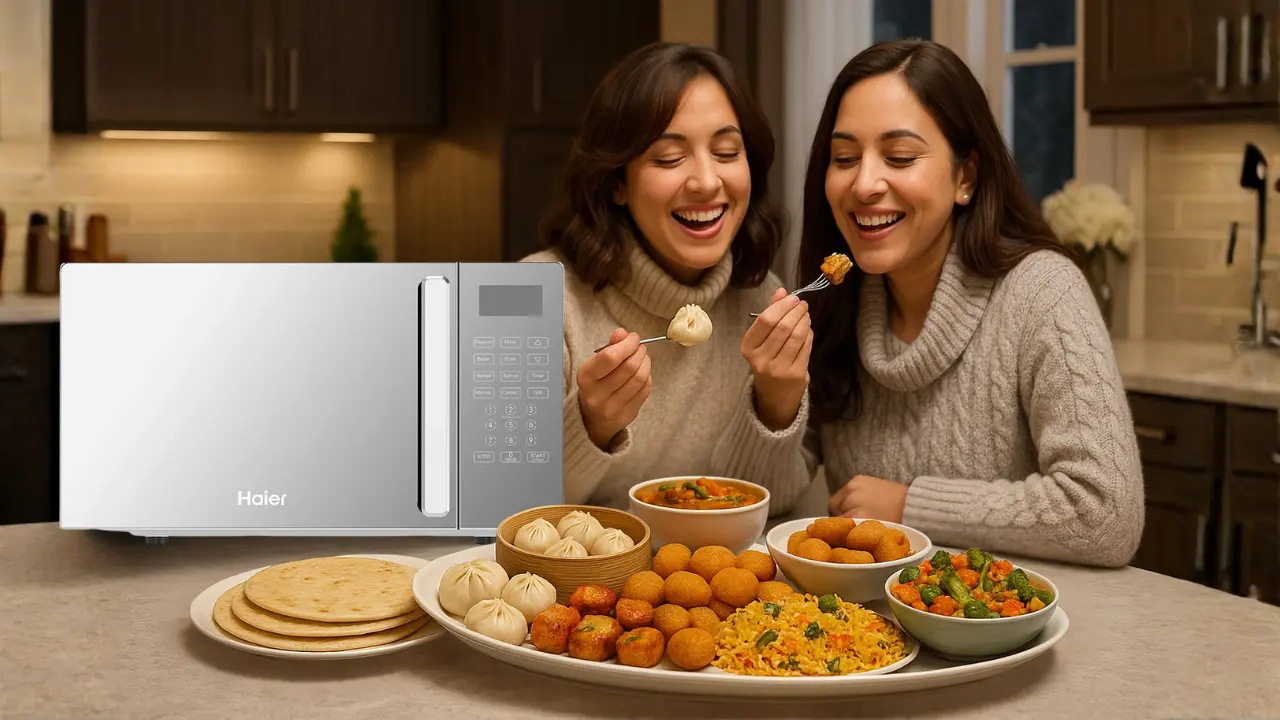

The best microwave settings for frozen foods depend on three things: the power level, the type of food, and the end goal you want.
Most frozen items work best between 30 to 70 percent power, paired with a defrost cycle for even thawing before reheating.
Modern convection microwaves with auto-cook menus remove guesswork entirely, especially models like Haier’s 20L, 25L, and 30L convection series that come with preset combinations for frozen snacks and full meals.
Frozen food is a weekday survival system

Every Indian home has a moment at 8.45 pm.
The day has played out like a marathon you didn’t sign up for. Work deadlines. Traffic. Groceries forgotten. And there it is, the one convenience that never complains: a freezer drawer filled with options.
Frozen parathas. Momos. Nuggets. A tub of dal makhani you saved from a weekend batch cook.
The question always arrives next.
How do I microwave this so it tastes right?
Not soggy. Not cold in the middle. Not burnt edges with a frozen heart.
This is where the microwave stops being an appliance and becomes a decision tool. Every button changes the outcome. Every setting has a purpose. And every food category behaves like its own little system.
The good news: once you understand the logic, frozen food stops feeling like a compromise and starts feeling like a controlled process.
Why power levels matter more than time
Most microwaves default to 100 percent power. That feels logical. It also creates most of the problems.
High heat excites water molecules quickly. In frozen foods, water is unevenly distributed. The edges thaw faster while the centre stays icy. This leads to the classic frustration: scorching on the outside, cold inside.
Power levels fix this imbalance.
A microwave that allows multi-power level control becomes a precision tool. For instance, Haier’s 30L Convection Microwave with In-Built Air Fryer offers five distinct power levels and 305 auto-cook menus that automatically choose the right one for the food in front of you.
The principle is simple.
Lower power equals slower, deeper heating.
Higher power equals fast, surface heating.
And frozen foods need both at different stages.
The three-stage system for handling frozen food
Across cuisines, seasons, and kitchens, one pattern holds true.
Frozen food performs best when microwaved in three stages.
Stage 1: Controlled thawing at low power (30 to 40 percent)
This melts the ice uniformly. It keeps the texture intact. It gives heat time to move towards the centre.
The best setting here is the defrost mode, which many modern microwaves automate.
Haier’s 20L Convection Microwave includes preset menus that already balance power and time to avoid over-thawing.
Stage 2: Gentle reheating at medium power (50 to 60 percent)
This is where the food becomes edible again. Not rubbery. Not dehydrated.
Medium power prevents the sudden temperature spikes that cause tough edges.
Stage 3: Crisping or finishing based on food type
This changes based on the category.
- For snacks, the air fryer mode or grill works beautifully.
- For breads, the convection mode prevents sogginess.
- For curries or rice, a final 20 seconds of high heat ensures steam pressure spreads evenly.
The Haier 30L model integrates a motorised rotisserie and dedicated 36 air-fryer menus, making the last stage effortless.
The bigger idea:
Frozen food isn’t about speed. It’s about sequencing.
What setting works for what food
Here is the question every household asks without saying it out loud.
Why does one frozen item heat perfectly while another becomes a disaster?
Because frozen foods belong to different families, each with its rules.
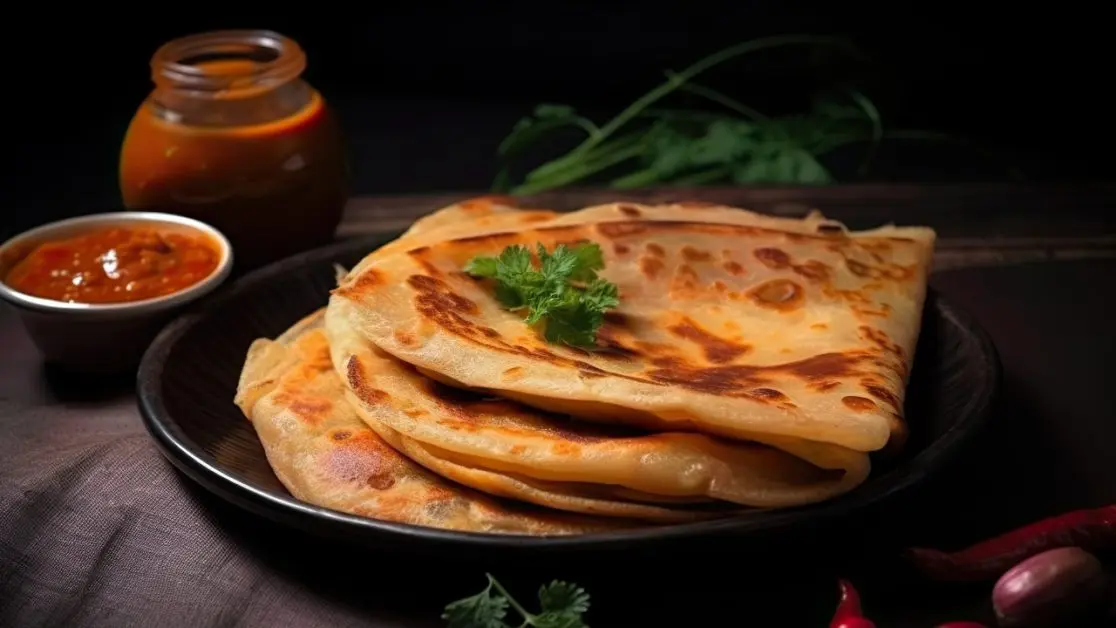
1. Frozen Indian breads: parathas, rotis, kulchas
These need even heating and light crisping.
- Start on defrost or 40 percent power for 30 to 60 seconds.
- Then use convection or grill for 1 to 2 minutes.
Haier’s 25L Convection Microwave includes a dedicated Bread Basket feature that handles naan, paratha, kulcha, and tandoori roti in three steps. It’s designed exactly for this category.
Insight: Breads respond to dry heat better than wet heat. Convection creates that.
2. Frozen snacks: momos, kebabs, nuggets
Snacks need balanced heat plus surface texture.
One option is:
- Defrost for 1 minute.
- Medium power for 2 to 3 minutes.
- Finish with air-fryer or grill mode for crisping.
The second option is:
- Use an auto-cook menu designed for snacks.
The Haier 20L and 30L models both offer multiple preset snack menus so you don’t have to guess.
Insight: Microwaves heat water, not oil. Air fryer modes reintroduce crunch.
3. Frozen curries and dals
These heat best with gradual warming.
- Start at 50 percent power for 2 to 3 minutes.
- Stir.
- Switch to 70 percent power for a final minute.
If reheating multiple servings, always spread curry in a shallow bowl.
Steam distributes better when there’s surface area.
Insight: Liquids behave like insulation. They protect themselves from overheating.
4. Frozen rice or biryani

Rice becomes dry when microwaved fast.
The solution:
- Add two spoons of water.
- Cover loosely.
- Heat at 40 to 60 percent for 3 minutes.
- Rest for 30 seconds before serving.
Insight: Resting is part of cooking. It equalises temperature.
5. Frozen vegetables and mixed sabzis
These are mostly water.
Water likes lower power.
- Start with medium power for 3 minutes.
- Stir.
- Continue at medium or high depending on desired softness.
6. Full meals, pasta trays, lasagna, packed frozen dinners
These are layered foods.
Layered foods require slow penetration.
- Use defrost mode for 3 to 5 minutes.
- Reheat at 50 percent power for 4 minutes.
- Finish at 80 percent for 1 minute.
Insight: Layered foods do not forgive shortcuts.
A simple table for everyday use
| Food Category | Best Setting | Why It Works |
| Breads | Convection + low power thaw | Preserves softness and adds crisp |
| Snacks | Defrost + medium + grill/air fry | Evens heat and restores crunch |
| Curries | Medium then high | Prevents splatter and reheats deeply |
| Rice | Medium power with moisture | Avoids dryness |
| Veggies | Medium power | Protects nutrients and texture |
| Layered meals | Defrost + medium heat | Allows centre to heat safely |
This is the system.
Once you see it, frozen food becomes predictable.
Why modern microwaves change the frozen food experience
Older microwaves were simple.
Heat on. Heat off.
Newer ones behave differently. They automate the logic behind good heating.
Haier’s convection microwave line does this quietly.
- The 20L model includes 66 preset menus that combine power and time so users do not need to calculate anything.
- The 25L model adds the Bread Basket, stainless steel cavity, deodoriser, and 305 auto-cook options.
- The 30L model adds an in-built air fryer, rotisserie, and high power convection for multi-stage cooking.
These aren’t features. They are shortcuts.
Shortcuts that save mental energy at the end of a long day.
The bigger idea:
When machines handle technique, humans focus on taste.
What people overlook about frozen food
Two truths almost everyone learns late.
Truth 1: Frozen doesn’t mean inferior
The moment food freezes, its nutrient structure pauses.
When heated correctly, frozen meals retain flavour and freshness.
Truth 2: Microwaves don’t cook like stoves
Stoves heat from outside to inside.
Microwaves heat from inside to outside.
This inversion creates unexpected behaviour.
When you know this, you stop fighting the machine and start using it the way it was designed.
A small shift that changes everything

The simplest way to improve frozen food results is this.
Stop using only the high power button.
Start combining defrost, medium power, and a finishing mode.
This alone turns mindless reheating into controlled cooking.
It also aligns perfectly with how the Haier convection line is designed.
Preset menus, multi-power levels, stainless steel cavities, rotisserie attachments and air fryer trays all exist to support this deeper logic of heat movement.
Good frozen food is not about luck.
It is about sequencing, power discipline, and matching technique with food structure.
The larger pattern at play
Every Indian home is optimising for time without compromising on quality.
That’s the real story behind frozen food usage.
Working parents reaching home late.
Couples who want dinner done fast without feeling guilty.
Students who want something warm between online classes.
Professionals living solo who need food to fit around unpredictable schedules.
The microwave becomes a bridge between constraints and comfort.
And that is where brands like Haier fit in naturally. Not as products, but as quiet helpers that make modern life feel less chaotic. By automating choices that used to require judgement, they give you back something valuable: space.
Space to breathe.
Space to slow down.
Space to eat well without overthinking.
Final takeaway
Frozen foods are not shortcuts.
They are tools.
Microwaves are not reheating devices.
They are systems.
When you combine both with intention, you get something surprisingly powerful:
Consistent meals without effort draining your day.
If there is one line to remember, let it be this:
Frozen food tastes better when heat is treated as a sequence, not a single event.