

Bigger TV screens feel immersive because they fill more of your natural field of vision, reduce visual distractions around you, and let your brain treat what it sees as an environment, not just an image.
When size combines with the right picture processing, sound, and room fit, the screen stops feeling like a device and starts feeling like a place.
That shift changes everything.
The moment you realise size actually matters,
It usually happens on a weekday evening.
Dinner is done. Phones are charging. Someone scrolls for five minutes longer than planned. Then the match, the series, or the movie finally starts.
On a smaller TV, you watch.
On a bigger screen, you settle in.
That difference is not about luxury. It is about how human vision works.
Your eyes do not experience the world in inches. They experience it from angles. The wider the visual angle a screen covers, the more your brain treats it as reality rather than content.
This is why cinema halls feel absorbing even before the sound kicks in.
Bigger screens recreate that effect at home.
Immersion is a system, not a single feature
Most people think immersion is about resolution.
It is not.
Immersion is what happens when multiple systems align quietly.
- Screen size fills your viewing angle
- Picture depth creates believable contrast
- Motion feels natural, not jittery
- Sound seems to come from the scene, not the TV
- Your room layout supports focus, not distraction
Miss one piece, and the spell breaks.
Bigger screens make this system easier to complete.
Why your brain prefers bigger screens
Your brain evolved to pay attention to environments, not frames.
When a screen crosses a certain size threshold, three things happen automatically.
1. Peripheral vision activates
A larger display engages your side vision. This reduces awareness of the room around you.
Less wall. Less furniture. Less phone temptation.
More story.
2. Eye movement reduces
On a small screen, your eyes jump constantly to track action.
On a big screen, movement flows naturally within your field of view.
That feels calmer. And more real.
3. Emotional cues land better
Faces, expressions, crowd reactions, background details.
They all register faster and deeper when they are physically larger.
This is why sports, drama, and big-budget films benefit the most.
The Indian living room reality
Indian homes do not follow one template.
Some are compact apartments with open kitchens. Others are spacious family homes with shared TV time. Many sit somewhere in between.
What has changed is how central the TV has become.
It is no longer background noise.
It is where families gather for:
- Cricket matches that stretch late into the night
- Weekend movie nights with snacks and pauses
- Festival premieres and shared moments
- Gaming sessions after work or college
As screen time becomes shared time, size starts to matter more.
Not to show off. To include everyone.
One option is staying small and sitting closer
This works. Up to a point.
- It saves money
- It fits tight spaces
- It feels familiar
But it comes with trade-offs.
- Eye strain increases
- Sound feels detached
- The experience stays personal, not communal
You watch. Others glance.
The second option is going bigger and sitting smarter
This is where immersion begins to scale.
- You sit back instead of leaning forward
- Everyone sees clearly, from every angle
- Sound spreads more evenly
- Visual fatigue reduces
The screen becomes the room’s anchor.
Not the room’s obstacle.
The third option is going big without upgrading quality
This is where people get disappointed.
A bigger screen magnifies everything.
Good and bad.
Low contrast looks flatter. Weak motion looks worse. Poor sound feels emptier.
This is why size must pair with processing.
Why picture technology matters more on big screens
On a large display, flaws hide nowhere.
This is where technologies like OLED, high refresh rates, and adaptive HDR stop being spec-sheet terms and start becoming practical.
For example, OLED panels deliver true blacks because each pixel controls its own light. On a 194cm (77) screen, this means night scenes stay detailed instead of washed out. Bright scenes do not bleed into dark ones.
Add adaptive HDR that responds to room lighting, and the image stays balanced whether you are watching in daylight or late at night.
These are not luxury extras. They are stability systems for large screens.
194cm (77) OLED Google TV with Dolby Vision IQ uses pixel-level dimming, a 120Hz refresh rate, and ambient light adaptation to maintain picture integrity even at this scale .
The bigger the screen, the more these systems matter.
Sound scales differently than visuals
Here is a common mistake.
People buy a big TV and keep expecting small speakers to fill the room.
Sound does not scale automatically with size.
On larger screens, audio needs direction, depth, and power to match what you see.
A 2.1 channel system with a dedicated woofer creates separation. Dialogue stays clear. Background sounds feel placed, not flat.
This matters more in Indian homes where:
- Fans run
- Kitchens stay open
- Conversations happen mid-viewing
Immersion survives only when sound competes successfully with real life.
Bigger screens change viewing behaviour
This part surprises people.
Once you move to a genuinely large screen, your habits change.
- You plan what to watch instead of scrolling endlessly
- You watch fewer things, but more fully
- You pause less often
- You finish more films than you abandon
This is not discipline.
It is designed to do its job.
When the experience feels intentional, attention follows.
Distance matters as much as size
Bigger is not about overwhelming the room.
It is about proportion.
Here is a simple rule many installers follow:
- For a 75 to 194cm (77) screen, ideal viewing distance sits around 2.5 to 3 metres
In most Indian living rooms today, that distance already exists.
People upgrade furniture before they upgrade screens. The room has grown. The TV often has not.
The hidden cost of staying small
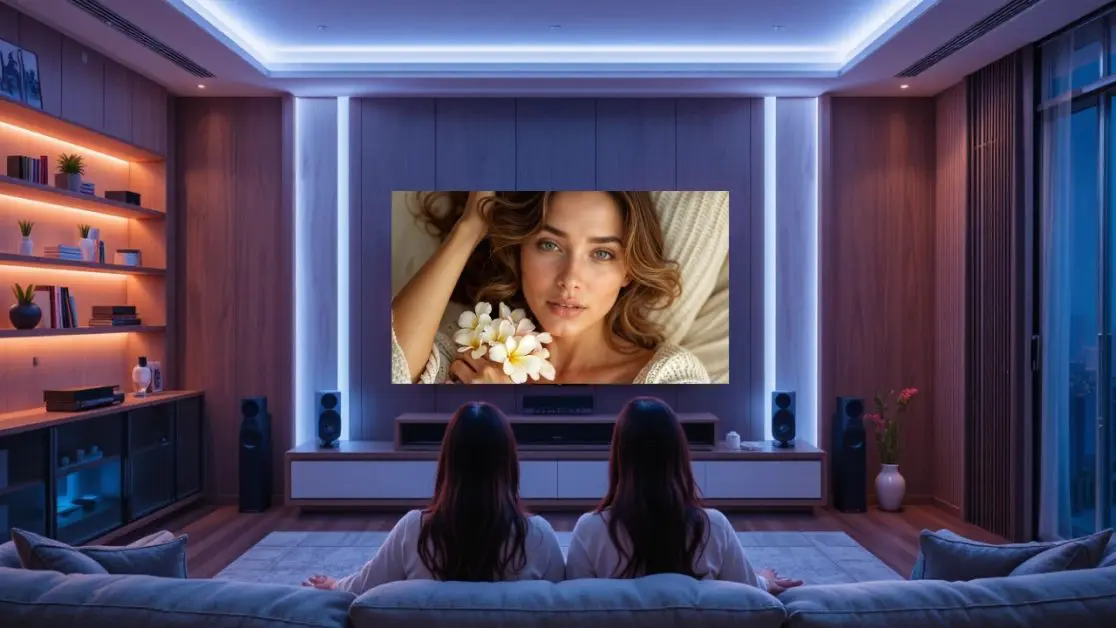
Small screens look cheaper. Until you count the long term.
- Upgrades happen sooner
- Satisfaction plateaus faster
- Shared viewing suffers
- Premium content feels wasted
A larger screen with the right tech lasts longer because it grows with your habits.
Movies. Sports. Gaming. Streaming.
All scale upward over time.
What bigger screens actually deliver
Not numbers. Not inches.
They deliver:
- Presence instead of background
- Shared attention instead of split focus
- Comfort instead of strain
- Ritual instead of randomness
They turn watching into experiencing.
A simple way to think about it
Bookshelves work the same way.
A tiny shelf limits what you place on it. A large shelf lets your collection breathe.
A bigger screen gives content room to exist properly.
The implication for modern homes
Homes are becoming quieter, smarter, and more intentional.
Appliances no longer shout. They support.
The TV sits at the centre of that shift.
Not as a gadget. As a shared surface for life to happen on.
When you choose a bigger screen thoughtfully, with the right balance of picture, sound, and room fit, you are not upgrading entertainment.
You are upgrading how evenings feel.
And that is why size, done right, changes everything.