


Voltage Fluctuation Protection means your appliance stays stable even when your power supply does not.
Built to withstand voltage fluctuations means your appliance continues to function safely during sudden power surges or drops. It protects internal circuits, prevents breakdowns, and extends lifespan. In a country where voltage swings are common, this protection is not a luxury. It is basic survival.
That is the short answer.
The longer one lives in Indian homes.
The evening power dip nobody plans for.
Picture this.
It is 7:45 pm. Pressure cooker whistles. The washing machine hums. The AC runs. Someone switches on the iron. The building transformer feels the load.
Lights flicker.
For a second, everything pauses.
In many Indian cities, voltage regularly moves outside the ideal 220 to 240V range. According to the Central Electricity Authority, peak load stress in urban areas rises sharply during summer evenings. In smaller towns, voltage dips are common during irrigation hours.
We do not see voltage.
We feel its consequences.
Appliances shutting down. Displays blinking. Repairs that arrive earlier than expected.
Voltage fluctuation is invisible friction.
And friction always costs something.
What exactly is voltage fluctuation and why does it matter?
Voltage fluctuation means sudden increases or decreases in electrical supply beyond safe operating levels.
Most Indian homes are designed for 230V systems. But real life is not laboratory perfect.
Here is what usually happens:
| Voltage Situation | What Happens Inside Appliances | Long-Term Impact |
| Sudden Surge | Circuits receive excess load | PCB damage, component burnout |
| Voltage Drop | Motors strain to function | Reduced efficiency, overheating |
| Repeated Fluctuation | Internal parts stress repeatedly | Shortened lifespan |
The Bureau of Indian Standards defines acceptable voltage variation limits, but in reality, distribution networks experience swings.
Now zoom out.
A refrigerator compressor depends on stable voltage. An air conditioner PCB board reacts to spikes. A water heater heating element draws heavy load. Voltage instability is not minor. It directly influences durability.
Stability is silent strength.
Three ways Indian homes respond to voltage instability
Every household makes a choice, consciously or unconsciously.
1. The external stabilizer route
One option is installing a separate voltage stabilizer.
- Cost: Additional purchase and wiring.
- Benefit: Basic protection against surges and dips.
- Limitation: Takes space. Often ignored during installation.
This works. But it adds clutter.
2. The risk it approach
The second option is doing nothing.
- Cost: Potential repair bills.
- Benefit: No upfront investment.
- Reality: High uncertainty.
Most people choose this by default.
3. Built-in protection approach
The third option is choosing appliances designed to withstand voltage fluctuations internally.
- Cost: Slightly higher upfront investment.
- Benefit: Cleaner setup. Continuous protection. Peace of mind.
- Long-term gain: Extended appliance life.
Built-in systems eliminate dependence on external devices.
Design solves what discipline cannot.
Why voltage fluctuation protection matters more today
Modern appliances are smarter than ever.
They include digital boards. Sensors. WiFi modules. LED displays.
And electronics are sensitive.
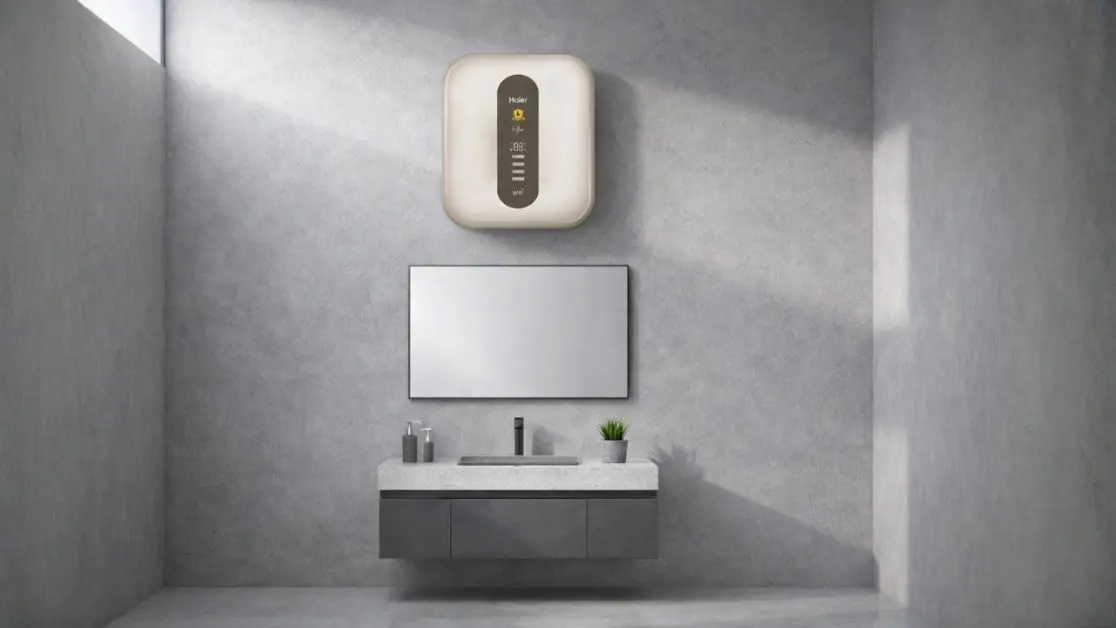
For example, Haier’s 15L Square 5 Star Water Heater is marked as “Voltage Fluctuation Proof Yes” in its specifications. That is not just a feature. It is a structural decision.
Look at its protection layers:
- Shock Proof system
- Dual Thermal Proof
- IPX4 water resistance
- Incoloy 800 heating element
- 8 Bar pressure rating
Voltage fluctuation proofing becomes one layer in a larger safety architecture.
Smart appliances demand smarter resilience.
Voltage fluctuation is not just about power. It is about lifestyle continuity
Think about this in daily life.
A working professional sets the water heater timer before waking up.
A sudden voltage drop hits at 5:30 am.
Without protection, the appliance resets.
Morning routine collapses.
Or consider summer.
Air conditioners account for a significant portion of household electricity consumption during peak months. High load on transformers increases fluctuation risk. When voltage drops, compressors struggle.
The effect?
Cooling inconsistency.
Inverter technology helps manage load efficiency. Built-in voltage protection safeguards internal electronics.
One protects energy use.
The other protects survival.
How built-in voltage protection systems actually work

Let us simplify it.
Voltage protection circuits monitor incoming power continuously.
When voltage moves beyond safe thresholds:
- The system temporarily cuts off supply.
- Internal components stay shielded.
- Once stable levels return, operation resumes.
In the Haier ES15V-SD WIFI water heater, voltage fluctuation proofing works alongside Dual Thermal Sensors and insulation systems.
Protection is layered.
Like a helmet, seatbelt, and airbag working together.
Single protection is good.
Layered protection is smarter.
A closer look at protection features that matter
Here is a quick breakdown inspired by modern storage water heaters:
| Feature | Why It Matters in Indian Conditions |
| Voltage Fluctuation Proof | Protects internal PCB and heating element |
| Shock Proof | Prevents electric leakage risk |
| Dual Thermal Sensors | Stops overheating at 75°C and 95°C |
| 8 Bar Pressure | Suitable for high-rise apartments |
| Glass-lined Tank | Reduces corrosion in hard water areas |
| PUF Insulation | Retains heat, reduces reheating cycles |
In many Indian cities, water hardness is high. Pressure levels vary in high-rise buildings. Power supply fluctuates. Each feature addresses a real environmental variable.
Appliances are not isolated machines.
They respond to local realities.
Voltage fluctuation and the hidden cost of repairs
Let us be honest.
Appliance repairs are rarely budgeted.
A damaged PCB board can cost thousands. Heating elements need replacement. Compressor failures are expensive.
Data from urban service centers show that voltage-related damage remains a frequent cause of electronic appliance repair requests.
When voltage fluctuates repeatedly:
- Internal capacitors degrade.
- Microcontrollers face stress.
- Wiring insulation weakens over time.
It does not fail in one dramatic moment.
It fails gradually.
Durability is not about surviving one surge.
It is about surviving hundreds.
What this means for new homeowners and young families
Millennial and Gen Z buyers approach appliances differently.
They look for:
- Clean aesthetics.
- Energy efficiency.
- Smart control.
- Long-term reliability.
Voltage fluctuation protection aligns with that mindset.
It removes one anxiety from the system.
For couples setting up new homes, the logic is simple:
Invest once.
Reduce variables.
Focus energy elsewhere.
When Haier integrates voltage fluctuation proofing inside a water heater like ES15V-SD WIFI , it signals something deeper.
It understands Indian power conditions.
Design responds to context.
From power stability to emotional stability
This is not dramatic.
It is practical.
A stable appliance reduces interruptions.
Fewer interruptions mean smoother routines.
Smoother routines reduce friction at home.
And homes are systems.
When systems function quietly, families function better.
That is the invisible equation.
Voltage stability → Appliance reliability → Routine continuity → Mental ease.
The strongest design is the one you never notice.
Three practical questions before choosing your next appliance
Instead of focusing only on price or size, ask:
- Does this appliance handle voltage fluctuations internally?
- Does it include layered protection systems?
- Is it designed for Indian load conditions and high-rise pressure?
Those questions shift decision-making from cost to lifecycle value.
Short-term saving feels smart.
Long-term durability is smarter.
Built to withstand voltage fluctuations is really about respect
Respect for unpredictable power grids.
Respect for hard-earned money.
Respect for daily routines.
In India, power supply realities vary from metro apartments to tier 2 towns. Voltage swings are common during peak load seasons. Appliances that ignore this context are fragile by design.
Appliances built to withstand voltage fluctuations accept reality.
They prepare for it.
They stay steady when the environment does not.
And that steadiness changes how a home feels.
Calm.
Reliable.
Sorted.
In the end, technology is not impressive because it is complex.
It is impressive because it quietly handles the chaos around it.
That is what built to withstand voltage fluctuations really means.
Not just electrical stability.
Lifestyle stability.
Frequently Asked Questions
Do I really need voltage fluctuation protection if I live in a metro city?
Yes. Even metros experience evening load stress, transformer overload, and seasonal dips. Urban power grids are not immune to voltage swings, especially during summer peak usage.
I already have a stabilizer. Is built-in protection still necessary?
A stabilizer offers basic regulation, but built-in protection shields internal PCBs, sensors, and heating elements more precisely. Layered protection reduces long-term wear.
Is voltage fluctuation protection just a marketing term?
No. It typically refers to internal circuitry that monitors voltage levels and cuts off power when supply exceeds safe limits. It prevents PCB damage and overheating.
Why is this feature slightly increasing the price?
Because it adds protective components and intelligent monitoring systems. The upfront cost is usually lower than one major repair.
My water heater reset after a power dip. Is that because of voltage fluctuation?
Likely yes. Sudden drops can interrupt digital boards. Built-in protection prevents abrupt resets and protects internal circuits.
I left my water heater timer set overnight. If voltage drops at 5 am, will it damage the appliance?
Without protection, repeated dips strain components. With voltage monitoring systems, the appliance temporarily cuts supply and resumes safely.
Can voltage fluctuation affect water temperature stability?
Yes. Heating elements strain during low voltage and may overheat during surges, causing inconsistent performance.