
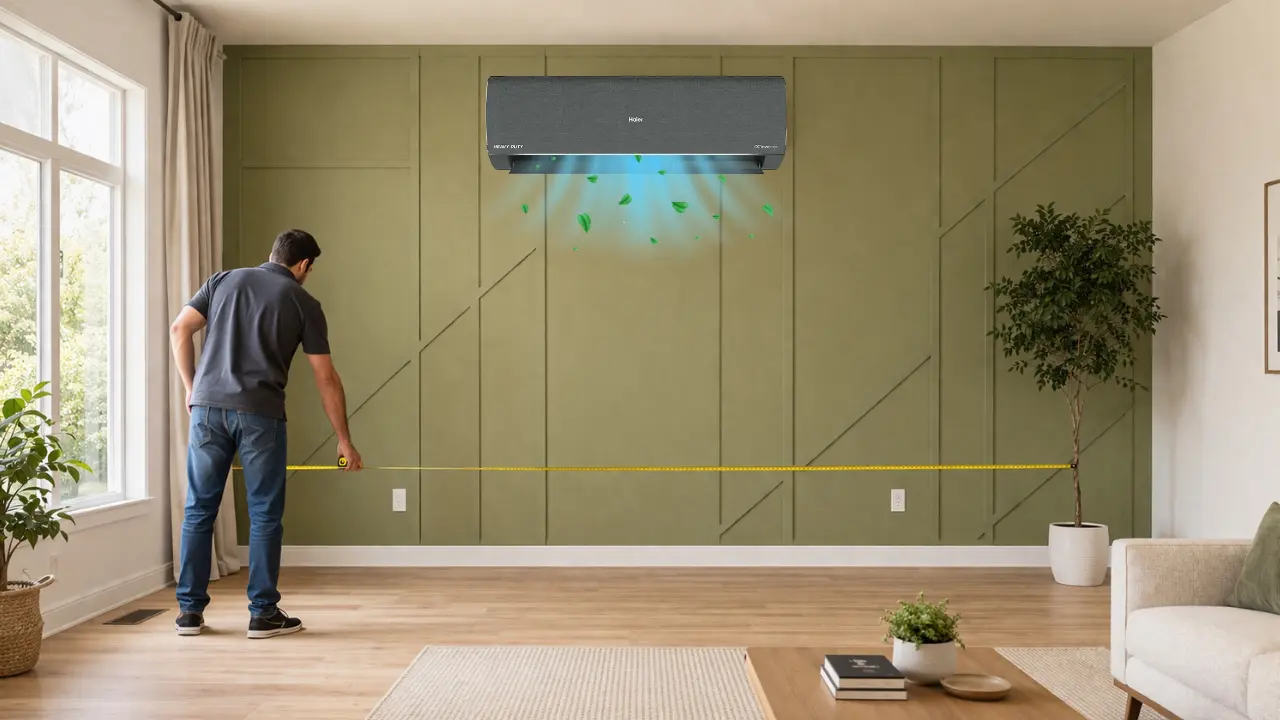

Cooling capacity is the amount of heat an air conditioner can remove from a room in an hour, usually measured in BTU or tons.
To calculate it, multiply the room area by a cooling factor, then adjust for sunlight, people, appliances, and insulation. The result tells you the right AC size for efficient and comfortable cooling.
Why do most people get cooling capacity wrong?
It is 3 PM in May.
The room feels like a pressure cooker. The AC is on. The temperature shows 24°C. Still, something feels off.
Too warm. Or too cold. Or uneven.
That discomfort is not random.
It is a capacity problem.
Most Indian homes do not suffer from bad air conditioners. They suffer from wrong-sized air conditioners.
And the truth is simple.
An AC does not fail because it is weak. It fails because it is mismatched.
What Is Cooling Capacity and Why It Matters
Cooling capacity defines how much heat your AC can remove per hour.
Think of it like this.
- A small fan in a banquet hall feels useless
- A powerful cooler in a tiny room feels overwhelming
Same machine. Different outcomes.
Common Cooling Capacity Units in India
| Unit Type | Meaning | Typical Usage |
| BTU (British Thermal Unit) | Heat removed per hour | Technical calculation |
| Tons | 1 ton = 12,000 BTU | AC sizing in India |
| kW | Power equivalent | Energy efficiency comparison |
One ton of AC does not mean weight. It means cooling power.
Step 1: Start with Room Size
Everything begins here.
Measure your room.
- Length in feet
- Width in feet
Multiply both.
Room Area = Length × Width
Example
- Room size: 12 ft × 15 ft
- Area: 180 sq. ft
Now apply a simple rule.
- 1 sq. ft needs roughly 20 BTU
So:
- 180 × 20 = 3600 BTU baseline
But this is only the starting point.
Raw size is never the final answer. Context changes everything.
Step 2: Factor in Sunlight Exposure
Not all rooms behave the same.
A room facing west in Delhi summer is not the same as a shaded bedroom in Bengaluru.
Adjustment Rule
- Low sunlight: Add 10%
- Moderate sunlight: Add 15%
- Direct sunlight: Add 20%
Example
- Base BTU: 3600
- Direct sunlight: +20%
- Final: 4320 BTU
Sunlight is invisible heat. Ignore it and your AC struggles silently.
Step 3: Count the People in the Room
People generate heat.
Every person adds to the cooling load.
Standard Rule
- Add 600 BTU per person beyond 2 people
Example
- 4 people in room
- Extra people: 2
- Additional load: 1200 BTU
New total: 4320 + 1200 = 5520 BTU
Step 4: Add Heat from Appliances
Look around your room.
- TV
- Laptop
- Refrigerator
- Lighting
Each one adds heat.
Quick Appliance Additions
| Appliance | Approx BTU |
| TV | 400 BTU |
| Laptop/Desktop | 300 BTU |
| Lights | 200 BTU |
Example
- TV + Laptop + Lights
- Total: ~900 BTU
Updated cooling requirement: 5520 + 900 = 6420 BTU
Step 5: Consider Ceiling Height
Most calculations assume an 8 feet ceiling.
But many Indian homes now have higher ceilings.
Adjustment Rule
- For ceilings above 10 ft, add 10 to 20%
Why?
Because more volume means more air to cool.
Step 6: Convert BTU to AC Tonnage

Now comes the practical part.
Divide total BTU by 12,000.
Example
- 6420 BTU ÷ 12,000 ≈ 0.53 ton
But ACs do not come in 0.53 tons.
So you round up.
Final Recommendation
- Choose 0.8 ton or 1 ton AC
Always round up, never down. Undersizing costs comfort. Oversizing costs money.
The Real Decision Framework Most People Miss
Cooling capacity is not just math.
It is a decision technology.
One option is: Undersize the AC
- Lower upfront cost
- Higher electricity bills
- Constant discomfort
The second option: Oversize the AC
- Faster cooling
- Higher cost
- Frequent on-off cycles
The third option: Right-size the AC
- Balanced comfort
- Stable energy usage
- Long-term savings
Good cooling is not about power. It is about precision.
How Smart ACs Are Changing This Entire Equation
Traditional calculations assume static conditions.
But homes are dynamic.
- People enter and leave
- Sunlight changes
- Usage patterns shift
This is where intelligent technology steps in.
According to the AI Atmox technology overview, modern ACs now analyze environmental data and adjust cooling automatically without manual input .
That changes everything.
What Smart Cooling Actually Does
- Learns your usage patterns
- Adjusts cooling based on occupancy
- Prevents overcooling
- Optimizes energy in real time
The machine stops reacting. It starts anticipating.
Why AI-Based Cooling Makes Capacity Calculations Smarter
Let’s break it down.
Traditional technology
- Fixed capacity
- Manual adjustments
- Reactive cooling
AI-Based technology
- Dynamic capacity control
- Pre-cooling adjustments
- Adaptive cooling
Features like AI pre-cooling even prepare the room before you arrive, based on your movement patterns .
And targeted cooling focuses only where needed, reducing wasted energy.
The future of cooling is not bigger machines. It is a smarter decision.
Common Mistakes to Avoid While Calculating Cooling Capacity
Most people do math.
Few people question the assumptions.
Mistake 1: Ignoring Sunlight
A west-facing room can increase load by 20%.
That is the difference between comfort and frustration.
Mistake 2: Forgetting Occupancy
A room used by one person is different from a family of four.
Capacity must reflect usage.
Mistake 3: Overlooking Appliances
Every screen and light adds heat.
Modern homes generate more internal heat than ever.
Mistake 4: Choosing Based on Budget Alone
Cheaper upfront often means expensive later.
Electricity bills reveal the truth over time.
Quick Reference Table for Indian Homes
| Room Size (sq. ft) | Ideal AC Size |
| Up to 120 | 0.8 ton |
| 120 to 180 | 1 ton |
| 180 to 250 | 1.5 ton |
| 250 to 350 | 2 ton |
Use this as a starting point.
Then adjust using the steps above.
What This Means for Modern Indian Homes
Cooling is no longer a seasonal decision.
It is a daily technology.
- Work from home setups
- Compact urban apartments
- Multi-use living spaces
All of this changes cooling demand.
And the real insight is this:
Comfort is engineered. It does not happen by accident.
A Final Way to Think About Cooling Capacity
A bookstore does not stack infinite books.
It curates just enough.
A restaurant does not cook everything at once.
It serves based on demand.
Cooling works the same way.
The best technology does not work harder. They work smarter.
Where to Go From Here
If you are setting up a new home or upgrading your AC, start with this:
- Measure the space
- Calculate the load
- Adjust for real-world factors
- Choose precision over guesswork
And when technology like AI-powered climate control enters the picture, the burden shifts.
From you to the machine.
From manual control to intelligent comfort.
The One Insight Worth Remembering
Cooling capacity is not about square feet. It is about understanding how your space lives, breathes, and heats up over time.
Once you see that, every AC decision becomes clearer.
And comfort stops being a struggle.
It becomes predictable.
Frequently Asked Questions
I’m confused between 1 ton and 1.5 ton AC. How do I decide for my room?
Start with your room size (sq. ft × 20 BTU), then adjust for sunlight, people, and appliances. If your final BTU is near a boundary, always round up. A slightly larger AC is safer than an undersized one.
I don’t want to overspend. Is a bigger AC always better?
No. Oversized ACs cool too fast, shut off frequently, and waste energy. You want balanced capacity, not maximum power.
I feel like my AC works but comfort is inconsistent. Why?
That’s usually a sizing mismatch. Either the AC is too small (struggling constantly) or too large (short cycling and uneven cooling).
Should I trust quick online tonnage charts or do full calculations?
Use charts only as a starting point. Real comfort depends on sunlight, occupancy, and appliances, not just square footage.
If I buy a smart AC, do I still need to calculate cooling capacity?
Yes, but less precisely. Smart ACs optimize performance, but they still need a reasonable base capacity to work effectively.
What does AI cooling actually do in real life?
It adjusts cooling based on occupancy, sunlight, and usage patterns reducing overcooling and saving energy.
Can smart ACs handle changing room conditions automatically?
Yes. They adapt dynamically instead of relying on fixed assumptions like traditional ACs.
Is AI cooling worth it for small rooms?
It’s most useful where conditions change frequently (shared rooms, living rooms, work-from-home setups).