
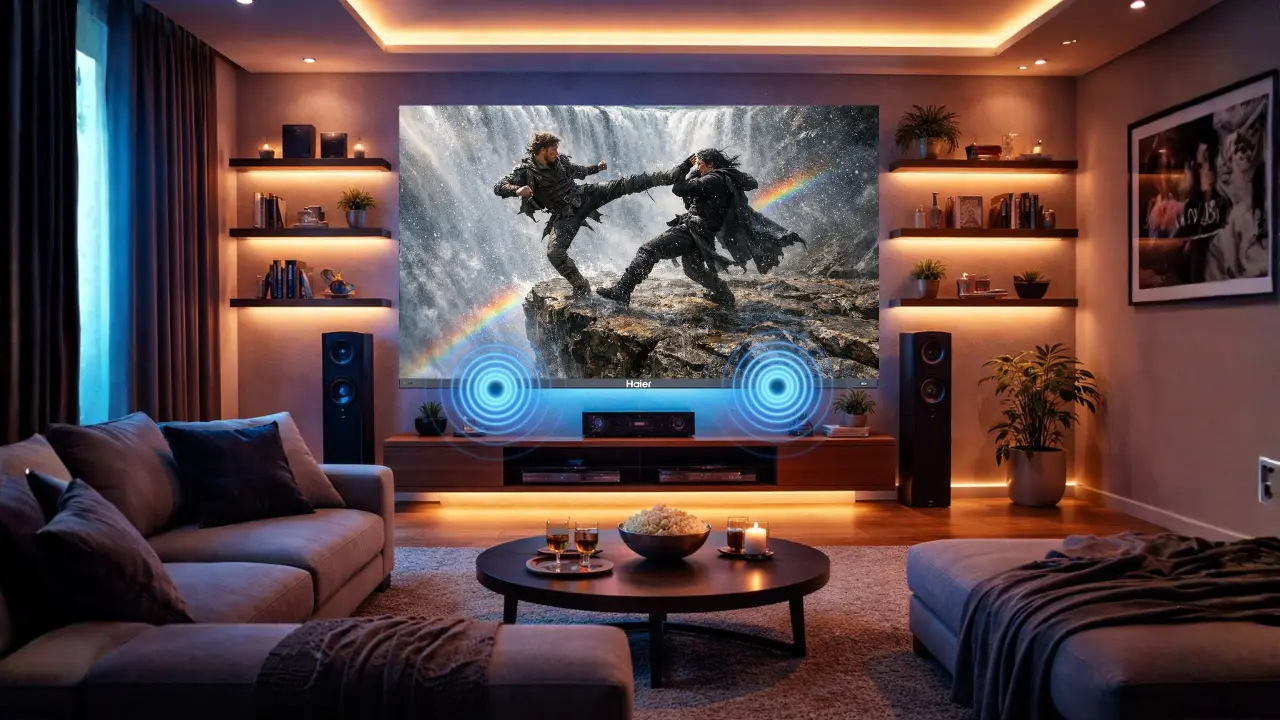

6.2.2 channel sound creates a true surround experience by adding height, depth, and balance to audio.
With six main speakers, two dedicated subwoofers, and two upward-firing height channels, sound no longer stays flat.
It moves around you and above you, creating a three-dimensional sound field that feels natural, immersive, and remarkably close to how we hear the real world.
That is the specification-level explanation.
The lived experience is something else entirely.
The evening when sound suddenly feels incomplete.
It does not happen during a demo.
It happens at home.
A quiet movie night.
A tense last over.
A dialogue-heavy scene where every pause matters.
You turn the volume up.
Then a little more.
Not because the TV is soft.
But because something feels missing.
Voices sound thin.
Crowd noise feels stuck to the screen.
The atmosphere refuses to spread into the room.
This is where most people assume a soundbar is the solution.
It is also where modern TV audio quietly changes the rules.
Why louder sound is not better sound
Most Television can get loud.
Very few can get immersive.
Traditional TV speakers push audio forward. Everything, from dialogue to explosions, fights for the same space. The result is familiar to most Indian homes:
- Dialogues get lost during background music
- Action scenes feel noisy, not powerful
- Larger rooms expose the weakness instantly
This is not a power problem.
It is a design problem.
Sound needs direction, separation, and space.
Understanding 6.2.2 channel sound without the jargon
Let us simplify this properly.
A 6.2.2 channel system does not just add speakers.
It adds layers.
Here is what each part does
- 6 main channels manage front, side, and rear sound movement
- 2 subwoofers handle low-frequency depth like bass, impact, and rumble
- 2 height channels create vertical sound by firing upward
Why this matters is simple.
Real-world sound does not travel on a flat plane.
Rain falls from above.
Helicopters move overhead.
Crowds surround you, not just face you.
A 6.2.2 channel layout is designed to mirror that reality.
Why height channels are the real breakthrough
Height channels are easy to underestimate.
They do not shout.
They shape.
By reflecting sound off the ceiling, upward-firing speakers create the illusion that audio exists above the screen.
What height channels change in daily viewing
- Stadium noise feels open and surrounding
- Weather effects gain realism
- Background scores feel layered, not compressed
The effect is subtle but powerful.
When sound occupies vertical space, your brain stops questioning it.
Surround sound versus true surround experience

These two phrases are often used interchangeably.
They should not be.
Basic surround sound
- Moves audio left and right
- Adds some rear presence
- Focuses on impact
True surround experience
- Places sound around and above you
- Keeps dialogue separate from effects
- Maintains clarity even at lower volumes
One fills the room.
The other convinces your senses.
Why two subwoofers make a real difference
Bass is misunderstood.
It is not about shaking walls.
It is about grounding sound.
Single subwoofer systems often create uneven bass, especially in wide or asymmetrical living rooms, which are common in Indian apartments.
With dual subwoofers:
- Bass feels centred instead of cornered
- Low frequencies stay controlled
- Music and effects do not bleed into voices
Good bass should support the moment quietly.
If you notice it too much, it is doing its job poorly.
How 6.2.2 channel sound improves everyday content
This is not a feature meant only for blockbuster movies.
Its biggest impact shows up in daily viewing.
Live cricket
- Crowd ambience feels layered
- Commentary remains clear
- Bat hits sound sharp but not harsh
OTT series
- Dialogues stay intelligible during background scores
- Quiet scenes retain emotional weight
- Suspense feels sustained
Music and concerts
- Vocals remain anchored
- Instruments feel placed, not piled
- Bass supports rhythm instead of overpowering it
Sound becomes part of the storytelling system.
Not a background accessory.
Why integrated audio is replacing soundbars

For years, the upgrade logic was predictable.
Buy a TV.
Add a soundbar later.
That logic is fading.
One option is the old route
- Basic TV speakers
- External soundbar
- Extra cables, remotes, and wall planning
The second option is integrated multi-channel audio
- Speakers built into the TV
- Tuned as one system
- No additional clutter
The real advantage is not convenience.
It is timing.
When picture and sound are designed together, audio cues align perfectly with visuals. There is no lag. No mismatch. No sense of separation.
The sound feels intentional.
The role of Sound by KEF tuning in clarity and balance
Speaker placement matters.
Tuning matters more.
Sound by KEF, globally respected for precision speaker engineering, approaches sound with a focus on balance and separation rather than raw loudness.
In practice, this means:
- Dialogues stay locked to faces
- Effects do not overpower voices
- Bass remains controlled and musical
This philosophy fits perfectly with multi-channel systems, where clarity matters more than volume.
The goal is not to impress you.
It is to make sound disappear into the experience.
A familiar evening in a modern Indian home
Imagine this.
Dinner is done.
Lights are dimmed.
Someone is half-watching, half-scrolling.
The volume stays modest.
With traditional TV audio, details vanish at low volume.
With a 6.2.2 channel system, details remain intact.
This is where true surround sound proves its value.
It respects shared spaces.
It adapts to real living conditions.
How Haier brings this system together
In the Haier M96 Series 254cm (100) QD Mini LED AI Smart Google TV (H100M96FUX), the 6.2.2 channel speaker system is built into the TV itself, not added as an afterthought.
Sound is designed alongside picture processing, supported by Dolby Atmos and Sound by KEF audio tuning.
Because audio and visuals are handled together by the TV’s AI processing system, sound adapts to content type, room dynamics, and viewing context.
The result is a cinematic experience without external speakers, complicated wiring, or setup fatigue, as detailed in the product specifications.
The technology stays out of sight.
The experience stays front and centre.
The hidden system most people never think about
Sound is not just output.
It is feedback.
When sound feels natural, you relax.
When it feels strained, you lean forward.
This affects how long you watch.
How immersed you feel.
How comfortable your space becomes.
Great audio does not demand attention.
It earns trust.
What this shift means for the future living room
Homes are getting quieter.
Screens are getting larger.
Attention is more fragile than ever.
In this environment, sound must do more without becoming louder.
The 6.2.2 channel speaker reflects a shift from amplification to intelligence. From volume to placement. From noise to nuance.
The living room stops feeling like a setup.
It starts feeling complete.
The insight worth keeping
True surround sound is not about filling the room.
It is about understanding it.
When sound knows where to go, you stop noticing the speakers and start noticing the story.
And once you experience that balance, there is no going back.
Frequently Asked Questions
I’m upgrading my TV mainly for picture quality. Does 6.2.2 audio really make a noticeable difference?
Yes and often more than you expect. The picture impresses you in a showroom. Sound is what affects you every evening. A 6.2.2 system spreads audio across front, sides, height, and bass layers, making everyday viewing feel immersive without adding extra speakers.
Do I still need a soundbar if my TV already has 6.2.2 channel speakers built in?
In most living rooms, no.
A properly integrated 6.2.2 system distributes sound across multiple internal drivers, including dedicated bass and height channels. That removes the need for separate soundbars and reduces wiring clutter.
My sofa is against the wall. Will surround-style sound still work?
Yes. Unlike traditional surround systems that need rear speakers, 6.2.2 systems use front-facing and upward-firing drivers to create spatial perception without rear placement.
My house has noisy fans running, kitchen sounds, people talking. Will this really help?
Yes, because clarity improves.
Multi-channel systems separate dialogue from bass and ambient layers, so voices stay clear even in real-world household noise.
Why does loud TV audio still feel unclear sometimes?
Because loudness is not the same as clarity.
When all frequencies are pushed through limited speakers, dialogue gets buried under music and effects. Multi-channel audio distributes workload, reducing listener fatigue.
I constantly adjust volume between scenes. Will 6.2.2 fix that?
Yes, in most cases.
Because bass, dialogue, and ambient sound are handled separately, sudden spikes feel controlled and balanced.
How does AI help in a multi-channel TV system?
AI can dynamically balance sound levels, optimize dialogue clarity, and adjust bass response based on content type (sports, movies, news).