
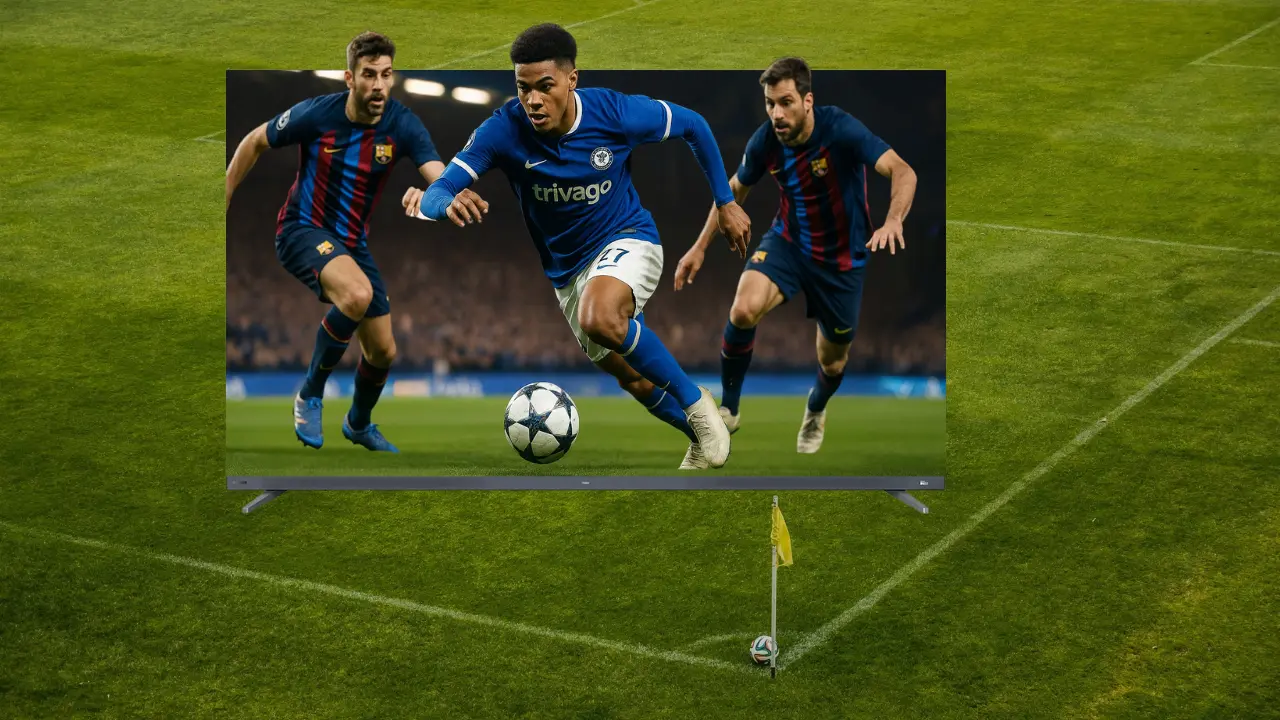

If Chelsea’s latest Champions League masterclass taught us anything, it is this. Modern football isn’t just played differently.
It is watched differently. And watching a match like Chelsea vs Barcelona demands a screen that can keep up with the speed, colour, contrast and emotion the game now carries.
Because last night’s performance wasn’t a match. It was a visual event.
A match that deserved more than a second-screen glance

Every Indian home knows this moment.
The clock hits 12.45 AM. The house is silent. But football people don’t negotiate with sleep. They gather. They whisper. They hope the WiFi behaves.
And then comes a match like Chelsea vs Barcelona. A match that refuses to be background noise.
The goal report reads like a highlight reel.
Estevao weaved through defenders before smashing one into the top net. A Kounde own goal after chaos inside the box. Liam Delap turning a half-chance into a full moment. And Marc Cucurella who didn’t just defend, he locked Lamine Yamal out of the game entirely, a performance Goal.com itself called “brilliant across the night” .
This wasn’t a match to follow while scrolling.
This was a match to experience.
Which makes you wonder a simple question.
Are our screens keeping up with our football?
Football has evolved.
It is faster. Sharper. More technical. More intense. The Premier League alone has seen sprint speeds rise, pass sequences lengthen, and player movement densify. The camera tech has improved too. Tighter angles. Faster frames. More colour data.
The only thing that often stays old is the screen we watch it on.
A modern match stretches the limits of an old display.
Motion blur kills counter-attacks.
Low brightness washes out night shots.
A weak sound makes 60,000 people sound like six.
And then we wonder why the match didn’t feel as electric.
This is the hidden system most people miss.
The quality of the match you experience is only half football. The rest is your display.
What Chelsea’s win looks like on a modern screen
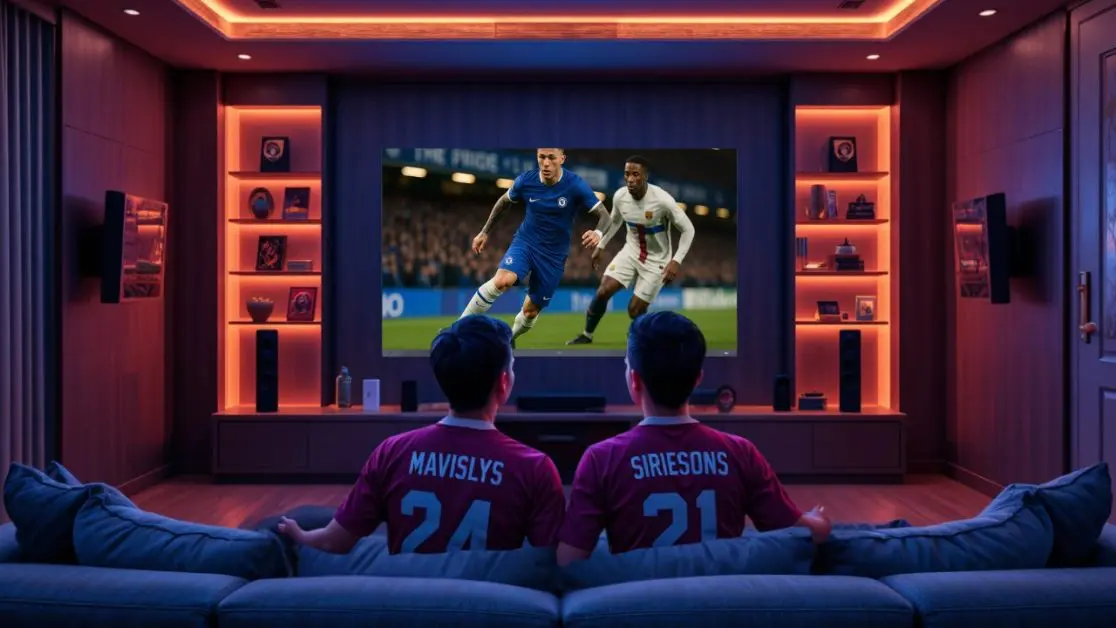
Think of three frames from last night.
1. Estevao’s dribble
The close control. The footwork. The change of pace. On a regular TV, this is a blur.
On a 144Hz QD-Mini LED panel, the motion stays sharp, even when players accelerate across the screen.
2. Cucurella shutting down Yamal
Defensive battles are all micro-details. Shoulder angles. Studs digging. Shadow movement.
With per-LED dimming zones (over 2100), those shadows actually hold detail that older TVs lose.
3. Delap’s finish
A pass threaded through bodies, with players running across the frame.
This is where a high contrast ratio (20,000,000:1) lets you see passing lanes the way players do.
You don’t just watch the game.
You understand it better.
Why Indian homes are rethinking their screens this season
Modern Indian households have changed.
Evenings look different. Weekends look different.
We multitask more. We share screens more. We turn living rooms into mini-arenas when friends come over.
A great screen isn’t a luxury anymore. It is part of the lifestyle.
Here’s what people now expect:
- Crisp detail for fast sports
- Bright, punchy HDR that works even with room lights on
- Wide viewing angles because not everyone gets the sofa’s center spot
- Sound that fills the room without needing external speakers
- Smart features that reduce friction instead of adding steps
And this is where modern QD Mini-LED TVs quietly step in.
The Haier M96 Series, for example, uses QD-Mini LED tech with 99 percent DCI-P3 colour, Dolby Vision IQ, and a 6.2.2 channel speaker setup tuned by Sound by KEF all designed to make fast sports and rich visuals feel real, even in a busy Indian living room .
Again, no hard sell.
Just what modern viewing demands.
What makes a match night feel bigger at home
People think a big match is about the big moment.
But it is actually built from smaller systems working together.
One. The people in the room.
Friends, siblings, a partner who pretends they don’t care but eventually joins.
Two. The rituals.
Cut fruit. Late-night Maggi. A blanket pulled over my legs. WhatsApp group buzzing.
Three. The screen.
The unspoken anchor of the night.
When the screen is good enough, something interesting happens.
You stop noticing it.
The picture is sharp enough to disappear.
The sound is full enough to feel natural.
The brightness adapts to the room.
The reflections don’t distract.
This is the paradox of good technology.
The better it gets, the less it pulls attention toward itself.
The future of match nights in Indian homes
Chelsea’s win is a reminder that football is entering its high-resolution era.
Wonderkids like Estevao and Yamal aren’t just fast. They are cinematic. The game is getting more expressive, more tactical, more visually dense.
And our homes are adapting too.
Larger screens in compact apartments.
Better sound in busy homes.
AI processing that adjusts brightness when someone opens a window.
Solar remotes. Hands-free voice commands. Ambient-aware HDR that shifts tone on the fly .
We are entering a time when the living room can feel like a small stadium without trying to be one.
The insight that stays
Modern football demands modern screens.
Not because it is trendy.
Not because it is flashy.
But because the game itself has evolved and the way we experience it at home should evolve with it.
A great display isn’t about technology.
It is about connection.
To the match.
To the moment.
To the people watching beside you.
And on nights like Chelsea vs Barcelona, that connection becomes the whole point.