


The complete home theatre experience today lives inside a single, well-designed TV.
One screen.
One sound system. One intelligent brain that adapts to light, content, and mood.
No extra boxes. No tangled wires. Just cinema-level immersion that fits into everyday Indian living rooms without asking for more space, more setup, or more effort.
That is the shift.
And once you notice it, you cannot unsee it.
The living room is no longer a room. It is a ritual.
Friday night.
The week finally slows down.
Someone orders biryani. Someone dims the lights. Someone says, “Let’s watch just one episode.”
But the experience depends on one thing.
The TV.
In most Indian homes, the television is not background noise. It is where families gather. Where cricket nights stretch past midnight.
Where kids watch animated films on Sunday mornings. Where couples binge shows after long workdays.
The hidden system here is simple.
When the screen works harder, people relax more.
A complete home theatre experience is not about volume or size alone. It is about removing friction from moments that matter.
Why assembling a home theatre feels outdated now

For years, the idea of a “real” home theatre meant assembling pieces.
A big screen.
A soundbar.
Rear speakers.
An AV receiver.
Multiple remotes.
Confusing settings.
It looked impressive.
It also demanded patience.
Most households never used these setups to their full potential. Wires got hidden behind furniture. Sound settings stayed untouched. Half the speakers went silent.
The system promised immersion.
Reality delivered maintenance.
Complex systems rarely survive real life.
That is why the modern home theatre experience is consolidating back into one intelligent screen.
One TV. Three invisible systems working together.
A complete home theatre TV is not defined by a single feature. It works because three systems move in sync.
1. The picture system adapts, not just displays
2. The sound system surrounds, not shouts
3. The intelligence system adjusts, not interrupts
When these align, the TV stops feeling like hardware.
It feels like an environment.
Picture quality is no longer about resolution alone
Most people think a better picture means 4K.
That is outdated thinking.
Clarity is about control, not pixels.
Modern cinematic TVs rely on technologies like QD Mini LED with thousands of local dimming zones to control light precisely. Dark scenes stay dark. Bright scenes stay detailed. Colors do not bleed into each other.
For example, high-end Mini LED panels can reach contrast ratios as high as 20,000,000:1 with over 2000 dimming zones, allowing scenes to hold detail even in mixed lighting conditions.
This matters in Indian homes because lighting changes constantly.
Morning sunlight.
Evening lamps.
Festival décor lights.
Late-night darkness.
A smart picture system senses these shifts and adjusts brightness, contrast, and tone automatically.
Great visuals do not demand perfect rooms. They adapt to imperfect ones.
Motion matters more than most people realise
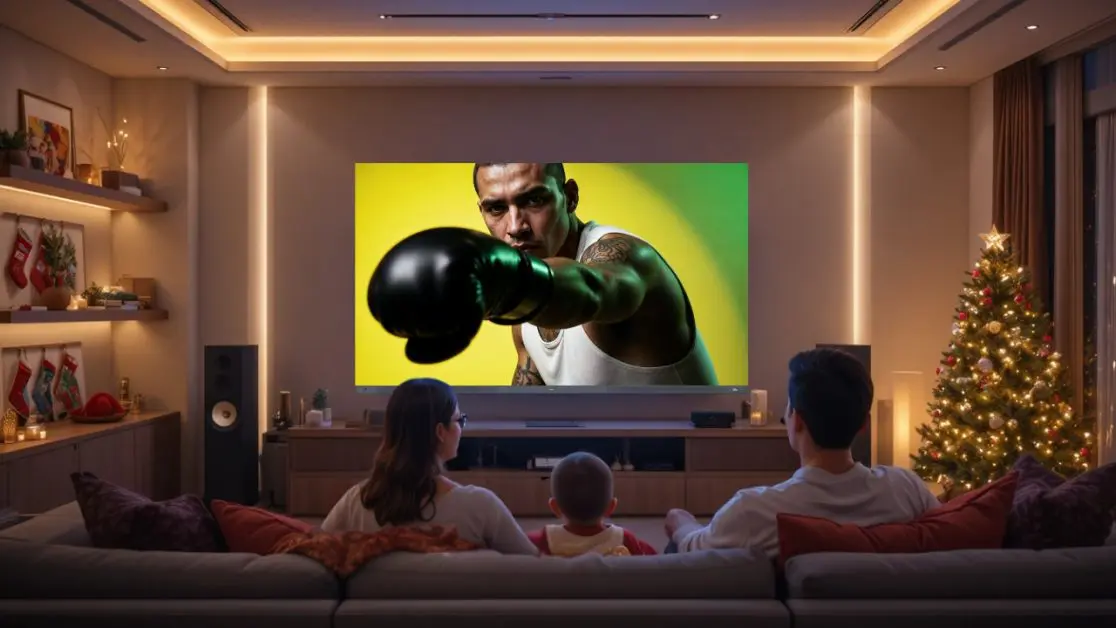
Fast action exposes weak TVs.
Cricket balls blur.
Football passes smear.
Car chases lose impact.
High refresh rates, like 144Hz, solve this by refreshing frames faster, keeping motion sharp during sports and gaming. It is the difference between watching the match and feeling inside it.
The system benefit is clear.
- Sports look fluid, not fuzzy
- Gaming feels responsive, not delayed
- Action scenes hold intensity, not chaos
This is not a luxury. It is functional clarity.
The sound is not loud. It is placement.
Most TVs sound flat because sound comes from the wrong place.
Downward speakers.
Rear-facing grills.
Compressed output.
A complete home theatre TV treats sound as architecture.
Advanced systems use multi-channel speaker layouts like 6.2.2 configurations, placing audio across horizontal, vertical, and bass channels to create real spatial depth.
Sound feels like it moves.
Rain falls from above.
Crowds roar from around.
Dialogue stays centered and clear.
Add Dolby Atmos processing, and the sound wraps instead of blasting.
Good sound does not demand attention. It earns it.
Why built-in audio now replaces external speakers
External speakers promise power.
Integrated systems promise balance.
The newer approach wins because it understands context.
A TV with audio tuned in partnership with specialist sound engineers, like KEF, is designed for the screen itself. The cabinet shape, screen size, and room reflection are accounted for together.
This delivers:
- Clear dialogue at low volumes
- Rich bass without distortion
- Balanced sound across movies, music, and sports
The hidden benefit is simplicity.
No extra remotes.
No calibration apps.
No space sacrificed.
Just press play.
The intelligence layer changes everything
Here is where modern TVs quietly outperform older setups.
Artificial intelligence now sits at the center of the experience.
Not flashy AI.
Useful AI.
Systems like AI Ultra Sense processors analyse scenes in real time and adjust picture and sound parameters instantly. Faces get sharper. Motion smooths out. Brightness balances itself.
Some systems also reduce flicker and blue light automatically, lowering eye strain during long viewing sessions.
This matters because screen time is no longer occasional.
It is daily life.
A complete home theatre must work across moments, not just movies
The mistake people make is thinking cinema experience equals movies only.
Real life is broader.
Weekday news at low volume
Kids watching cartoons in daylight
Match night chaos with friends
Quiet late-night binge sessions
A complete home theatre TV handles all of it without manual tweaking.
The system adjusts itself so people do not have to.
When technology disappears, experience improves.
Gaming is now part of the home theatre equation
For Gen Z and younger millennials, gaming is not separate entertainment.
It is shared entertainment.
Modern TVs support gaming features like VRR, ALLM, AMD FreeSync Premium Pro, and refresh rates scaling up to 240Hz in game modes, ensuring minimal lag and screen tearing.
This means:
- Faster response
- Smoother visuals
- Less eye fatigue
Gaming nights become social events, not solitary sessions.
Smart platforms reduce friction, not add it
The best content systems do not overwhelm.
They curate.
Google TV based platforms organize shows, movies, sports, and apps into a single view. Voice control removes the need to scroll endlessly. Content suggestions improve with usage.
The system learns.
- What you watch
- When you watch
- How you watch
This is not about surveillance.
It is about saving time.
Convenience is the most underrated luxury.
Why size matters differently now
Big screens once felt excessive.
Today, they feel appropriate.
Large displays like 215cm (85) or 254cm(100) screens no longer dominate rooms visually thanks to ultra-slim designs and near bezel-less frames. Mounted cleanly, they blend into modern interiors.
The effect is subtle.
The screen disappears when off.
It transforms the room when on.
That balance defines modern home theatre thinking.
Where Haier fits into this evolution
Haier’s approach to televisions reflects this entire shift.
Instead of selling screens, the brand designs integrated experiences.
Products like the Haier M96 Series QD Mini LED AI Smart Google TV combine picture control, spatial sound, gaming performance, and adaptive intelligence into one unit designed for real homes, not showroom demos.
The value is not in specifications alone.
It is in what those specifications remove.
- Extra devices
- Extra setup
- Extra confusion
What remains is usage.
The cost-benefit reality most people overlook

Let us break it down simply.
Traditional home theatre setup
- Multiple devices
- Higher installation cost
- More maintenance
- Inconsistent usage
Single-TV home theatre experience
- One device
- Lower long-term complexity
- Higher daily usage
- Consistent performance
The second option aligns better with modern lifestyles.
Busy.
Compact.
Shared.
The future of home entertainment is consolidation
Every technology cycle follows the same pattern.
First, systems expand.
Then, they simplify.
Home theatres are entering that second phase.
The complete experience now fits inside one intelligent screen that adapts to people, spaces, and moments.
The best technology does not ask for attention. It earns trust.
So what should you look for in one TV that does it all
Use this framework.
- Picture that adapts to light and content
- Sound that surrounds without external clutter
- Intelligence that works quietly in the background
- Performance that holds up across sports, movies, and gaming
- Design that fits Indian homes, not overwhelms them
When these align, you are not buying a TV.
You are redesigning how your home relaxes.
The bigger implication
As work becomes flexible and entertainment becomes shared, the living room evolves again.
It becomes a place of reset.
A place of togetherness.
A place of escape.
A place of everyday cinema.
And the technology that supports this does not need to shout.
It just needs to work.
Quietly.
Reliably.
Beautifully.
That is what a complete home theatre experience on one TV really means.
Frequently Asked Questions
My living room isn’t perfect. Will I still have a good experience?
That’s exactly who these TVs are built for. Adaptive picture systems adjust to sunlight, lamps, and night viewing automatically, so you don’t need blackout curtains or manual tweaking.
Am I overpaying for features I won’t use?
The value today isn’t in rare-use features, but in daily friction removed: no calibration, no extra remotes, no sound mismatch. You use more of what you pay for.
I already have a 4K TV. Will I really see a difference?
Yes, because clarity now comes from light control, not resolution. QD Mini LED panels with thousands of dimming zones maintain detail in both dark and bright scenes, especially in mixed lighting common in Indian homes.
Why do dark scenes still look washed out on my current TV?
Limited dimming zones cause light bleed. Advanced Mini LED systems precisely control backlighting, keeping blacks deep and highlights sharp.
Will higher refresh rates make normal content look odd?
No. The TV scales performance based on content, so movies stay cinematic while sports stay fluid.
Can built-in TV speakers really replace a soundbar now?
In many cases, yes. Advanced TVs use multi-channel speaker layouts (like 6.2.2) and Dolby Atmos to place sound around you, not just blast it forward.
Will dialogue be clear at low volume, especially at night?
That’s one of the biggest improvements. Integrated systems are tuned for clarity at everyday listening levels, not just max volume.
I play games occasionally. Do gaming features still matter?
Yes. Features like VRR, ALLM, AMD FreeSync Premium Pro, and high refresh game modes reduce lag and tearing, even for casual players.