
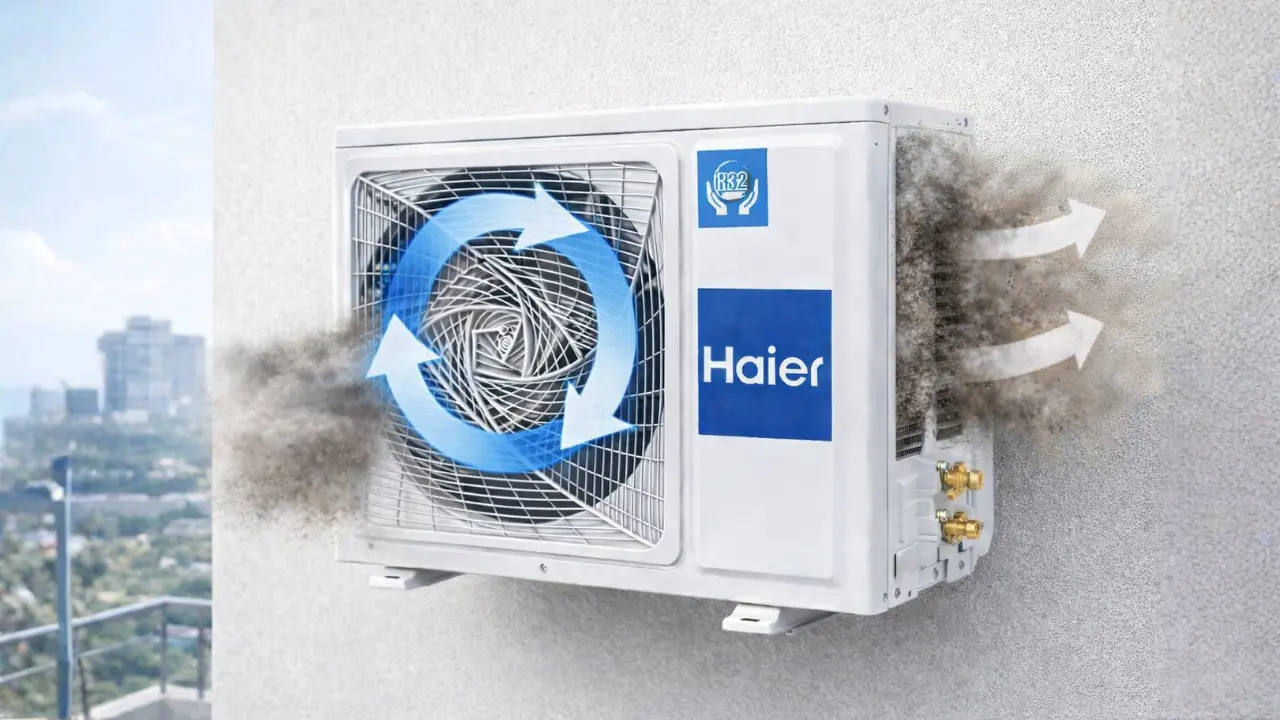

Consistent cooling in dusty environments depends on how well an air conditioner protects its internal systems from dust buildup while continuing to manage airflow, heat exchange, and energy efficiency.
In Indian homes, this means smart self-cleaning mechanisms, stable compressors, and adaptive cooling logic that keeps performance steady even when the air outside is not.
That is the headline.
The real story lives inside everyday Indian homes.
Why is dust the invisible enemy of comfort?
Dust is not dramatic.
It does not announce itself.
It quietly settles.
On window grills.
On ceiling fans.
Inside AC outdoor units that face roads, balconies, construction sites, and open terraces.
In India, dust is not seasonal. It is structural.
According to the Central Pollution Control Board, most Indian cities regularly record particulate matter levels far above safe limits.
Fine dust enters homes through ventilation, doors, and windows. Over time, it coats condenser coils, blocks airflow, and forces air conditioners to work harder for the same result.
The outcome is predictable.
- Cooling becomes uneven
- Rooms take longer to reach comfort
- Power consumption rises
- Maintenance visits increase
Dust does not break an AC instantly.
It slowly erodes consistency.
The real frustration is not heat. It is unpredictability

Ask any working professional who comes home after a long day.
One evening, the room cools in ten minutes.
Another evening, it takes thirty.
The thermostat setting has not changed.
The weather feels similar.
Yet the experience is different.
This is not about temperature control alone.
It is about system reliability.
Cooling systems are designed around airflow and heat exchange. Dust disrupts both. When condenser coils are clogged, heat cannot escape efficiently. When indoor units accumulate grime, airflow weakens. The machine compensates by running longer and harder.
Consistency disappears first.
Efficiency disappears next.
Traditional fixes treat symptoms, not systems
Most households rely on three familiar responses.
One option is frequent manual cleaning
Service calls every few months.
Water sprays.
Temporary relief.
This works, but it is reactive. Dust returns quickly, especially in high-pollution zones or homes near construction.
The second option is overcooling
Lower the temperature.
Increase fan speed.
Let the AC struggle harder.
This creates short-term comfort at the cost of higher electricity bills and long-term wear.
The third option is smarter design
Systems that expect dust.
Systems that adapt.
Systems that clean themselves.
This is where modern air conditioning quietly changes the rules.
Why self-cleaning is no longer a luxury
Self-cleaning sounds like a feature.
In dusty environments, it is infrastructure.
Dust primarily damages two parts of an AC.
- The indoor unit coils
- The outdoor condenser
If either is compromised, cooling efficiency drops.
Advanced AC systems now use automated cleaning cycles to protect both.
For example, Haier’s AI-enabled self-cleaning mechanisms include indoor frost self-cleaning and outdoor cyclone cleaning, which actively remove dust buildup without manual intervention .
The implication is simple.
Cleaner coils mean better heat exchange.
Better heat exchange means stable cooling.
Stable cooling means predictable comfort.
Consistency comes from protecting airflow
Cooling is not magic.
It is a movement.
Air moves across coils.
Heat moves out.
Cool air moves in.
Dust blocks movement.
Modern AC systems that maintain consistent cooling in dusty environments focus on airflow protection in three ways.
First, by cleaning proactively
Automated cleaning cycles activate after set usage hours. This prevents thick dust layers from forming in the first place.
Second, by maintaining coil efficiency
Clean coils transfer heat faster. This reduces strain on the compressor and shortens cooling cycles.
Third, by reducing dependency on human action
No reminders.
No guesswork.
No delayed maintenance.
Consistency improves when systems take responsibility.
Why intelligent cooling matters more in Indian homes

Indian homes are not uniform.
- Different room sizes
- Different ceiling heights
- Different sunlight exposure
- Different occupancy patterns
Dust compounds these variables.
This is why static cooling settings fail over time.
AI-based climate control systems adjust cooling output based on environmental feedback rather than fixed assumptions. They learn usage patterns, monitor temperature changes, and optimize performance even as external conditions shift .
The system adapts so the user does not have to.
The hidden cost of inconsistent cooling
Inconsistent cooling does not just affect comfort.
It affects trust.
When an appliance behaves unpredictably, households stop relying on it intuitively. Settings are adjusted repeatedly. Energy usage increases. Satisfaction drops.
From a systems perspective, inconsistency creates friction.
- More manual control
- More cognitive load
- More maintenance dependency
Consistent cooling removes all three.
Dust-resilient cooling is also energy-responsible

There is a quiet link between dust management and power savings.
When coils are clean and airflow is unobstructed:
- Cooling cycles shorten
- Compressors rest sooner
- Electricity draw stabilizes
According to energy efficiency studies referenced by the Bureau of Energy Efficiency, poorly maintained air conditioners can consume up to 15 to 20 percent more power for the same cooling output.
Dust is expensive.
Self-maintaining systems protect both comfort and cost.
What consistent cooling actually feels like
Consistency is subtle.
It feels like entering a room that always behaves the same way.
- The temperature settles quickly
- The air feels balanced
- The noise stays predictable
- The power bill stops surprising you
There is no moment of adjustment.
No second guessing.
That is when technology disappears.
A practical checklist for dusty environments
If you are evaluating cooling performance for an Indian home, especially in high-dust areas, focus on systems rather than specifications.
- Does the AC clean its indoor and outdoor units automatically
- Does it maintain airflow efficiency over time
- Does it adapt cooling output instead of relying on fixed modes
- Does it reduce manual maintenance dependency
Capacity matters.
Star ratings matter.
But systems matter more.
The broader shift – appliances that expect reality
The biggest change in home appliances is not intelligence.
It is realism.
Modern appliances no longer assume ideal conditions. They assume dust. Heat. Usage variation. Human forgetfulness.
They are built for how homes actually function.
Consistent cooling in dusty environments is not about beating dust.
It is about designing around it.
The insight worth remembering
Comfort is not created by peak performance.
It is created by reliable performance.
In a country where dust is constant and environments are unpredictable, the most valuable appliances are the ones that quietly hold the line.
Day after day.
Season after season.
That is what consistency looks like when systems are designed for real life.
Frequently Asked Questions
Why does my AC cool well some days and poorly on others, even when I use the same settings?
Dust buildup slowly disrupts airflow and heat exchange. Your AC compensates by running longer, which makes cooling unpredictable. The machine hasn’t “failed” its system consistency has eroded.
I clean my house regularly. Why does dust still affect my AC so much?
Indoor cleanliness doesn’t stop fine particulate matter from entering through windows, doors, and ventilation. Dust accumulates inside coils and outdoor units where daily cleaning can’t reach.
Why does my room sometimes cool in 10 minutes and sometimes take 30?
Dust-clogged coils and weakened airflow force the compressor to work harder. Even if outside conditions feel similar, internal efficiency changes daily.
Is this inconsistency normal in Indian homes?
Unfortunately, yes. High particulate pollution makes static cooling systems unstable over time unless they are designed to adapt and self-maintain.
What parts of an AC does dust damage the most?
Indoor unit coils (affect airflow and cooling speed)
Outdoor condenser (affect heat rejection and efficiency)
How does self-cleaning actually improve cooling consistency?
Clean coils restore heat exchange efficiency. That stabilizes compressor load and shortens cooling cycles, making performance predictable again.