
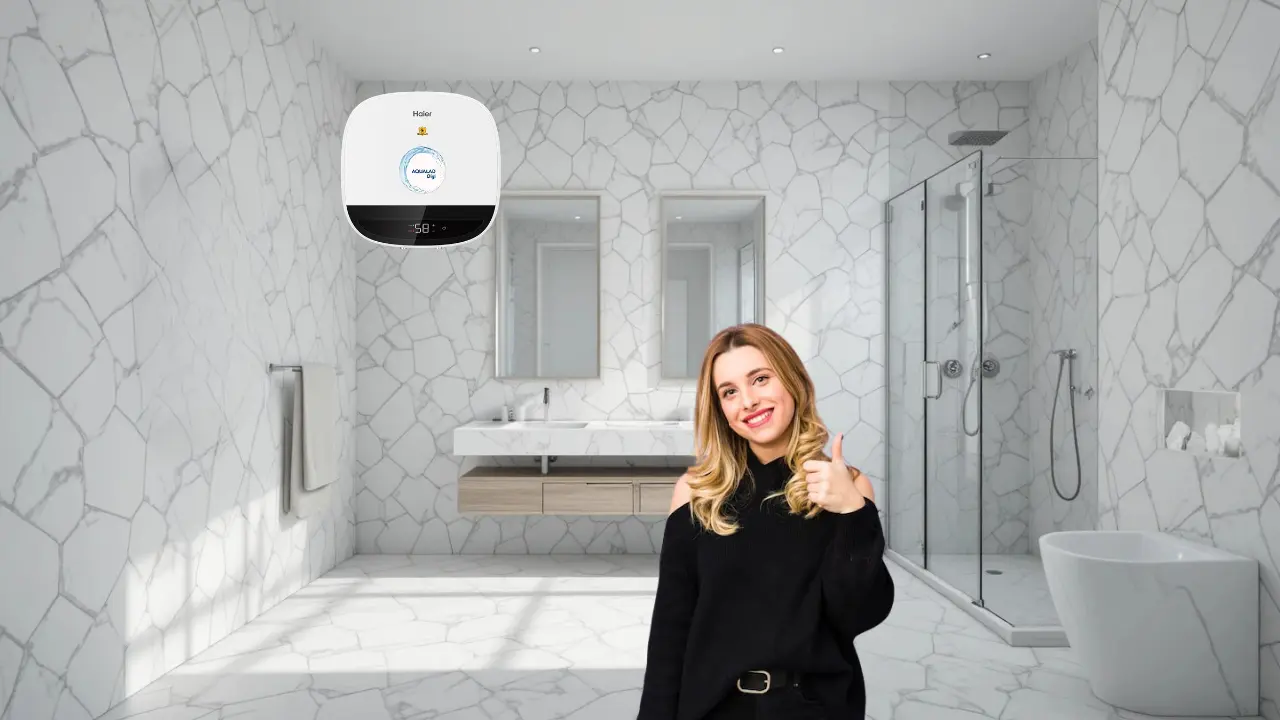

1–3KW Convertible Power lets you choose exactly how much electricity your water heater consumes.
Instead of running at one fixed wattage, you switch between 1kW, 2kW, or 3kW depending on the moment.
Lower load when demand is light. Higher output when speed matters.
In models like the Haier 15L Square AQUALAD PRO 5 Star Water Heater (ES15V-AQUALAD PRO) and the Haier 25L Square AQUALAD PRO 5 Star Water Heater (ES25V-AQUALAD PRO), this flexibility becomes practical, not theoretical.
Control changes everything.
Not because it is dramatic.
Because it is repeatable.
Why Does Energy Usage Feel So Hard to Manage?
Electricity bills rarely spike because of one big decision.
They rise because of small, automatic habits.
Water heaters are among the highest energy-consuming appliances in Indian homes, especially in winter. According to data from the Bureau of Energy Efficiency, storage water heaters contribute significantly to residential power usage in urban households.
Most traditional heaters operate at a fixed wattage.
Full power.
Every cycle.
No adjustment.
But demand is never constant.
Morning rush feels different from a late-night shower.
A family of four behaves differently from a solo professional.
Rigid power assumes rigid life.
Life is not rigid.
What Does 1–3KW Convertible Power Actually Do?
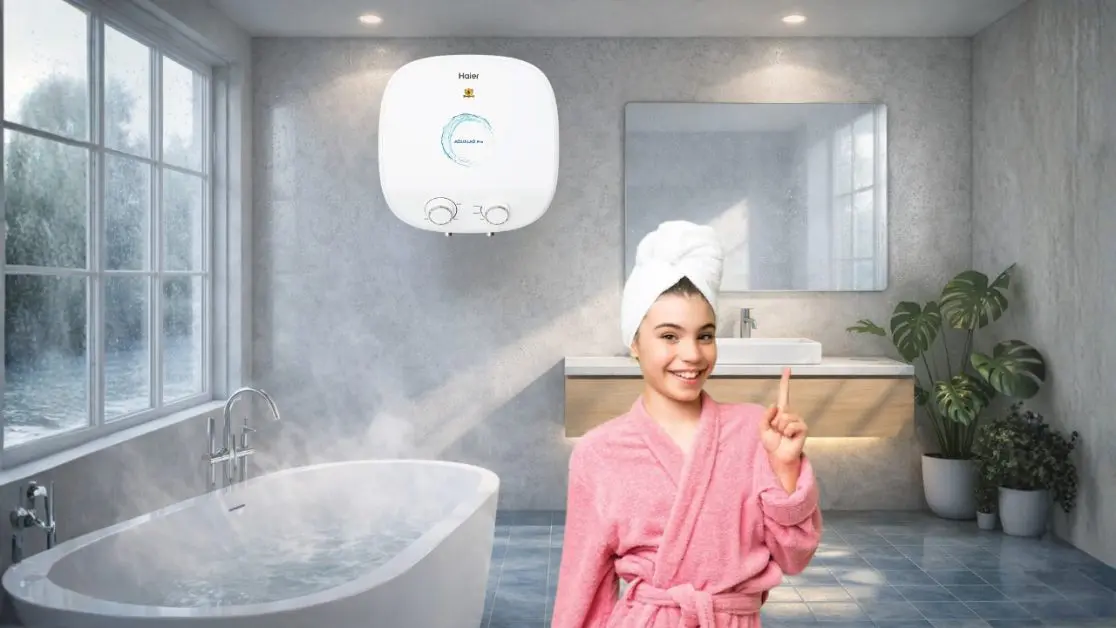
Convertible power means adjustable wattage.
In the Haier 15L Square AQUALAD PRO 5 Star Water Heater (ES15V-AQUALAD PRO) and Haier 25L Square AQUALAD PRO 5 Star Water Heater (ES25V-AQUALAD PRO), the rated power is selectable between 1kW, 2kW, and 3kW, as shown in the official product specifications.
Here is how that plays out:
- 1kW Mode
Slower heating. Lower electricity load. Ideal for light usage. - 2kW Mode
Balanced performance. Moderate heating speed. - 3kW Mode
Rapid heating. Best for peak demand.
Think of it like adjusting fan speed.
Same appliance.
Different intensity.
Energy control is not about switching off.
It is about scaling intelligently.
Real Indian Home Scenarios Where Convertible Power Matters
Morning in a Family Apartment
Everyone is waiting.
Time is short.
3kW mode reduces waiting time and delivers quick heating.
Evening in a Studio Flat
One person. No rush.
1kW mode keeps usage minimal without sacrificing comfort.
Weekend Deep Cleaning or Guests Visiting
Water usage spikes.
2kW offers a balanced response.
One appliance.
Three rhythms.
Systems that adapt reduce waste automatically.
What Does Math Say About Savings?
Let us simplify.
Energy consumption is measured in kilowatt-hours.
| Mode | Power | 30 Minutes Usage | Units Used |
| Low | 1kW | 0.5 hr | 0.5 units |
| Medium | 2kW | 0.5 hr | 1 unit |
| High | 3kW | 0.5 hr | 1.5 units |
If electricity costs ₹8 per unit:
- 1kW costs ₹4
- 2kW costs ₹8
- 3kW costs ₹12
Used daily, that difference compounds.
Savings rarely arrive in one month.
They accumulate across seasons.
Convertible power gives you the option to lower consumption during non-peak usage. Over a year, those small adjustments can translate into meaningful cost differences.
Efficiency rewards consistency.
Why Insulation Makes Convertible Power Even More Effective
Adjustable wattage is only part of the equation.
Heat retention matters just as much.
Both the Haier 15L Square AQUALAD PRO 5 Star Water Heater (ES15V-AQUALAD PRO) and the Haier 25L Square AQUALAD PRO 5 Star Water Heater (ES25V-AQUALAD PRO) feature PUF insulation, designed to retain hot water longer and reduce reheating frequency .
Better insulation means:
- Fewer reheating cycles
- Lower cumulative energy draw
- Stable water temperature
According to energy efficiency research from the International Energy Agency, improved insulation in heating systems can reduce overall energy use by up to 20 percent in certain conditions.
Power control plus insulation equals compound efficiency.
Not speed alone.
Stability.
Does Adjustable Power Compromise Safety?
It should not.
That is why these models integrate multiple safety systems, including:
- Shock Proof protection
- Dual Thermal Protection System
- 8 Bar pressure handling
- BPS antibacterial heating at 80°C
These features are detailed in the official product highlights .
High-rise apartments require up to 8 bar pressure compatibility.
Thermal control prevents overheating.
Shock protection ensures electrical safety.
Energy savings must feel secure.
Otherwise, they feel risky.
Convertible power works because it balances efficiency with safety.
Is Higher Wattage Always Better?
Not necessarily.
Higher wattage heats water faster.
It does not automatically reduce total electricity use.
If reheating cycles increase, overall consumption rises.
The smarter approach is selective intensity:
- Use 3kW during demand spikes
- Use 1kW during stable periods
Peak demand should be managed, not defaulted to.
Homes function like ecosystems.
Balance sustains them.
Why 5 Star Rating Complements Convertible Power
Both the 15L and 25L Square AQUALAD PRO models carry a 5 Star rating .
Star ratings reflect energy efficiency performance aligned with Bureau of Energy Efficiency standards.
A 5 Star appliance typically offers:
- Lower standby heat loss
- Better insulation performance
- Improved temperature regulation
Convertible power adds behavioural control to structural efficiency.
Design plus decision-making.
That combination creates a measurable impact.
Who Benefits Most from 1–3KW Convertible Power?
Young Professionals
Usage fluctuates daily.
Lower wattage prevents unnecessary consumption.
Newly Married Couples
Budgets are being defined.
Convertible power reduces predictable monthly costs.
Families with Children
Morning intensity requires speed.
Evening routines demand balance.
Flexible appliances mirror flexible households.
That alignment reduces friction.
The Bigger Picture: Energy Is About Choice
India’s electricity demand continues to grow due to urbanisation and increased appliance ownership.
The solution is not fewer devices.
It is a smarter device.
1–3KW Convertible Power transforms a water heater from a fixed-load appliance into an adaptive system.
The Haier 15L Square AQUALAD PRO 5 Star Water Heater (ES15V-AQUALAD PRO) and Haier 25L Square AQUALAD PRO 5 Star Water Heater (ES25V-AQUALAD PRO) embody that philosophy by combining adjustable wattage, strong insulation, and multi-layered safety.
Power is expensive.
Control is valuable.
When an appliance adapts to your rhythm instead of forcing you into its limits, your home feels calmer.
Bills feel predictable.
Comfort feels intentional.
And that is the quiet shift modern Indian homes are moving toward.
Not louder.
Smarter.
Frequently Asked Questions
How do I decide when to use 1kW, 2kW, or 3kW in my daily routine?
1kW → Solo use, no urgency
2kW → Balanced family use
3kW → Morning rush or multiple back-to-back showers
Will switching modes daily actually make a difference in my bill?
Yes. Small daily savings compound monthly and seasonally. Even ₹4–₹8 saved per day adds up significantly across a year.
If I use 1kW mode, will the water still get properly hot?
Yes. It heats more slowly, but reaches usable temperatures. It’s about speed, not capability.
Does lower wattage mean bacteria risk?
No. These models include BPS antibacterial heating up to 80°C, ensuring hygienic water when required.
I prefer very hot showers. Should I always use 3kW?
Not necessarily. Use 3kW to heat quickly, then switch to lower wattage for maintenance.
Is higher wattage more energy efficient because it heats faster?
Not automatically. Faster heating reduces waiting time, but if used unnecessarily, total units consumed rise.
If I use 3kW for 15 minutes instead of 1kW for 45 minutes, which is cheaper?
It depends on total units consumed. Energy = Power × Time. The smarter move is matching wattage to real demand.
Why does my bill feel higher in winter?
Because reheating cycles increase. Colder water and ambient temperatures demand more energy.