
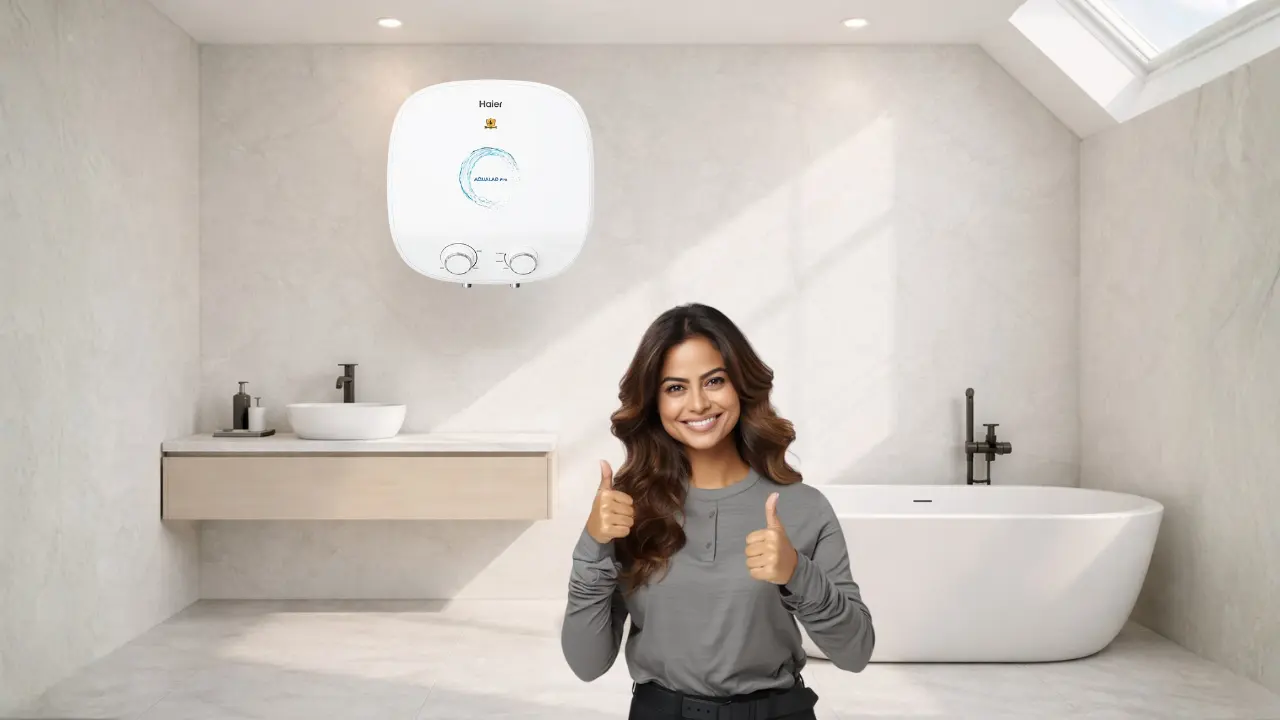

Convertible Power Technology in water heaters allows you to manually control how much electricity the heater uses, depending on your daily hot water needs.
Instead of running at full power all the time, the heater lets you switch between different power levels, helping you save electricity during low usage and heat water faster when demand is high.
It sounds technical.
It is actually deeply practical.
Because it is built around one simple truth.
Indian homes do not use hot water the same way every day.
A winter morning explains this better than any manual.
It is 6:30 am.
One bathroom.
Parents getting ready for work.
A child waiting for school.
Someone checking emails on their phone.
The water heater becomes the invisible decision maker.
Either the morning flows. Or it doesn’t.
Some days, everyone bathes back to back.
Some days, only one person needs hot water.
Yet most traditional water heaters behave exactly the same every day.
Full power. Full load. Full electricity draw.
Convertible Power Technology exists because real homes are not fixed systems.
What exactly is Convertible Power Technology?
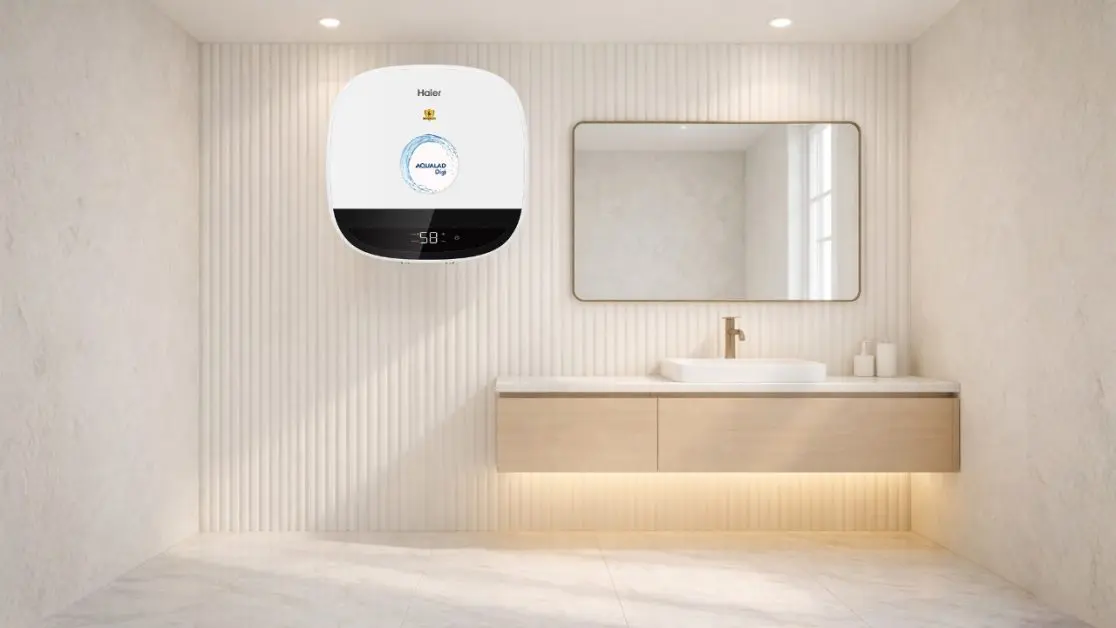
Convertible Power Technology allows a storage water heater to operate at multiple power levels, usually 1 kW, 2 kW, or 3 kW.
You can manually choose the power level based on household size, usage patterns, and electricity availability. This helps reduce power consumption without compromising comfort.
In simple words, you decide how hard your water heater works.
Why fixed power water heaters quietly waste electricity
Most conventional electric water heaters operate at one fixed wattage.
Usually the highest one.
This means:
- The heater pulls maximum electricity even for light usage
- Power consumption stays high during off peak hours
- Winter electricity bills rise without obvious explanation
This is not poor technology.
It is outdated thinking.
When systems ignore context, waste becomes normal.
Convertible Power Technology matches effort with real demand
Think about how you drive.
You do not accelerate the same way in traffic and on an open road.
Yet fixed power water heaters do exactly that.
Convertible Power Technology introduces choice.
One option is low power mode
- Ideal for one person or light usage
- Lower electricity draw
- Slower heating, but efficient
The second option is medium power mode
- Balanced for couples or small families
- Good heating speed
- Better cost control
The third option is high power mode
- Designed for peak morning usage
- Faster heating during winters
- Useful when multiple baths are planned
Same appliance.
Different priorities.
Your call.
How Convertible Power Technology works inside the heater
There is no gimmick here.
Just smart engineering.
In water heaters with Convertible Power Technology:
- The heating element supports multiple wattage levels
- Internal circuitry allows safe power switching
- Thermostats regulate temperature at each setting
- Safety systems prevent overheating or overload
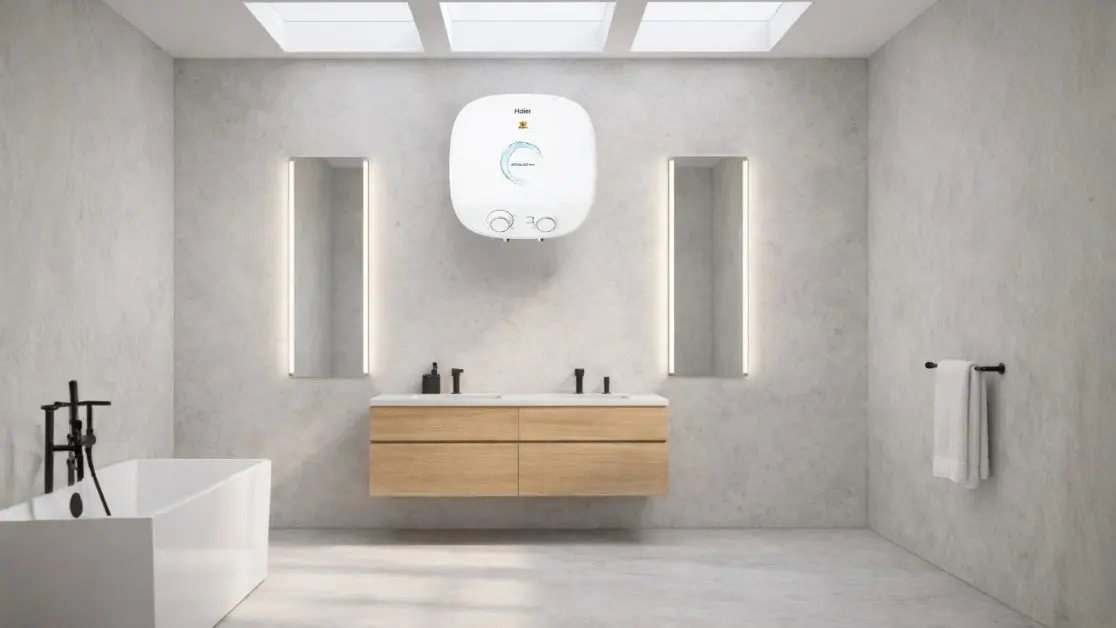
For example, both the 25L Square AQUALAD PRO 5 Star Water Heater (ES25V AQUALAD PRO) and the 15L Square AQUALAD PRO 5 Star Water Heater (ES15V AQUALAD PRO) support 1 kW, 2 kW, and 3 kW power modes, allowing users to adjust power based on daily needs .
Same tank.
Same water.
Smarter control.
Why this technology fits Indian homes especially well
Indian households are not uniform.
We have:
- Joint families and nuclear families
- Studio apartments and independent homes
- Paying guests and rental setups
- High rise buildings with pressure variations
And then there is electricity reality.
Power cuts and voltage fluctuations still exist
Convertible Power Technology helps because:
- Lower power modes reduce load on limited supply
- Tripping risks decrease during peak hours
- Heating remains stable even with fluctuating voltage
Control is not a premium feature.
It is a practical necessity.
Energy savings that actually show up on your bill
Let us talk about the real impact.
A traditional storage water heater running at full power can consume 2 to 3 units of electricity per hour.
By switching to a lower power mode:
- Electricity usage reduces proportionally
- Heat loss reduces with good insulation
- Reheating cycles become fewer
Across a winter season, many households see 10 to 25 percent lower water heating costs, depending on usage habits.
Efficiency is not about cutting comfort.
It is about cutting excess.
Why insulation matters just as much as power control
Convertible Power Technology works best when paired with strong insulation.
Look for:
- High density PUF or EPS insulation
- Well designed storage tanks
- Accurate thermostats
In the Haier AQUALAD PRO series, PUF insulation helps retain hot water for longer periods, reducing the need for frequent reheating and saving electricity over time .
Power control without insulation is incomplete thinking.
Is Convertible Power Technology safe for everyday use?
Bathrooms demand safety first.
Water heaters with Convertible Power Technology usually include:
- Dual thermal cut off protection
- Shock proof systems
- Pressure relief valves
- IPX4 rated water resistance
The Haier ES25V AQUALAD PRO and Haier ES15V AQUALAD PRO include Dual Thermal Safety, Shock Proof protection, MUV valves, and IPX4 waterproofing, ensuring safety even with frequent power adjustments .
Flexibility only works when safety is built in.
Who should actively look for Convertible Power Technology?
This feature is especially useful if:
- Your electricity bills rise sharply in winter
- Your household size changes often
- You live in a high rise apartment
- You prefer manual control over full automation
- You value long term efficiency
Smart homes are built by people who understand patterns.
A simple comparison puts things in perspective
| Feature | Fixed Power Water Heater | Convertible Power Water Heater |
| Power usage | Always maximum | Adjustable |
| Energy efficiency | Moderate | Higher |
| Usage flexibility | Low | High |
| Bill control | Limited | Strong |
| Daily adaptability | Poor | Excellent |
Good technology reduces friction.
It does not demand attention.
Why this technology signals a larger shift in appliances
Convertible Power Technology reflects a bigger change.
From rigid appliances to responsive systems.
From one size fits all to context aware design.
We already see this shift in:
- Inverter air conditioners
- Variable speed washing machines
- Smart refrigerators
Water heaters are finally evolving in the same direction.
The future is not about more features.
It is about better judgement built into products.
Where Haier fits into this shift naturally
Haier focuses on how homes actually function.
Instead of designing for ideal conditions, it designs for real ones.
In models like the 15L Square AQUALAD PRO 5 Star Water Heater and 25L Square AQUALAD PRO 5 Star Water Heater, Convertible Power Technology works alongside insulation, pressure handling, and safety systems to support modern Indian bathrooms without making life complicated .
No unnecessary noise.
No forced smartness.
Just thoughtful engineering.
The real takeaway
Most people do not want advanced appliances.
They want calmer mornings.
Predictable bills.
Less friction at home.
Convertible Power Technology delivers that quietly.
By respecting context.
By giving control without effort.
The smartest appliances are not the ones that demand attention.
They are the ones that adapt and let life move smoothly.
Frequently Asked Questions
Is Convertible Power Technology just marketing jargon?
No. It’s a practical control feature, not automation fluff. It exists because Indian homes don’t use hot water the same way every day, some days one bath, some days four, some days none.
I hate thinking about appliances every morning, does this add complexity?
No. It actually reduces mental load. Instead of guessing why my bill is high, I just choose the power level once and move on.
Will I actually see savings on my electricity bill?
Yes, especially in winter. By using lower power modes:
1. Electricity usage drops proportionally
2. Heat loss reduces with good insulation
3. Reheating cycles decrease
Many households see 10–25% lower water heating costs across a season.
What if everyone needs to bathe back-to-back?
That’s when high power mode (3 kW) makes sense:
Faster heating
Less waiting
Smooth mornings
The key is choice, not limitation.
Is it safe to keep switching power levels frequently?
Yes. Convertible Power Technology is designed with:
Dual thermal cut-off protection
Shock-proof systems
Pressure relief valves
Waterproof electrical components
Safety is built into the system, not added later.
Should I actively look for Convertible Power Technology?
Yes, if:
1. My winter electricity bills spike
2. My household size changes
3. I live in a high-rise apartment
4. I prefer manual control over forced automation
5. I value long-term efficiency over gimmicks