
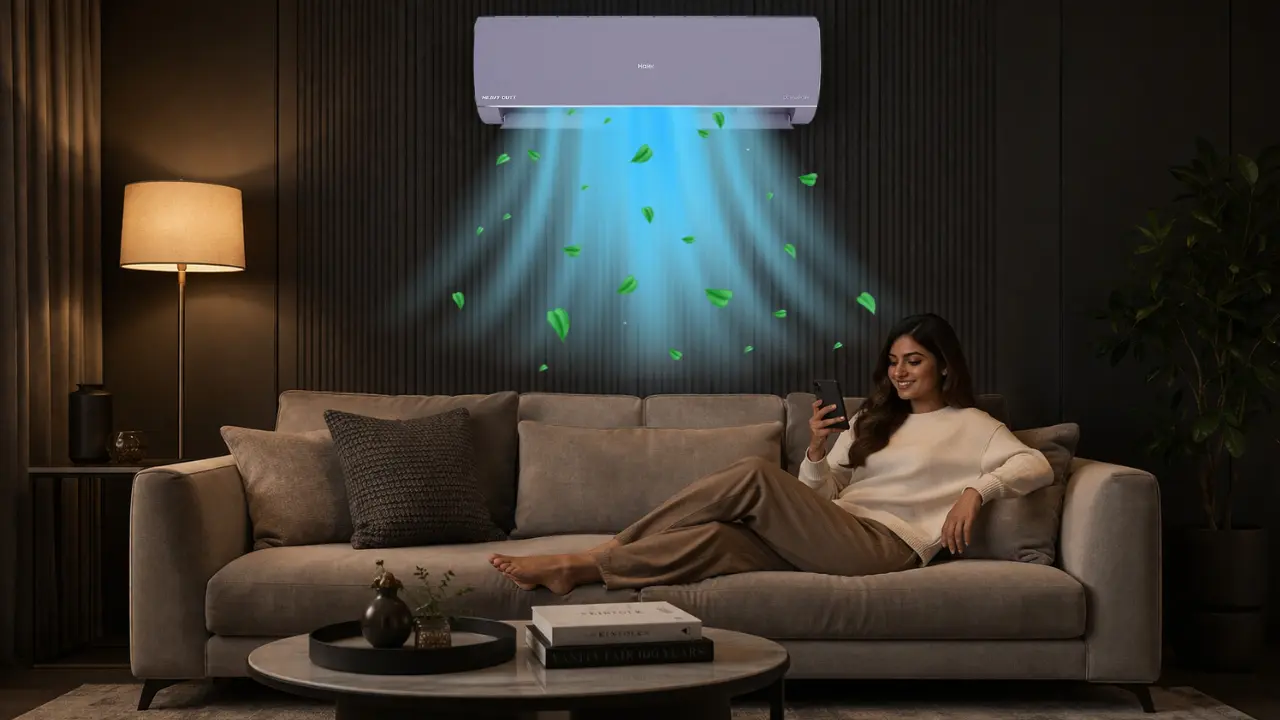

Cooling that adjusts to your seating layout means directing cool air exactly where people sit, relax, or work instead of cooling the entire room blindly.
Smart air conditioners use sensors, AI mapping, and airflow targeting to focus comfort where it matters most. The result is faster cooling, lower electricity use, and a room that feels comfortable instantly.
Comfort, after all, is rarely evenly distributed.
Think about a typical evening in an Indian living room.
Someone stretches out on the sofa after work.
A child sits on the floor with homework.
Grandparents prefer the armchair near the window.
The television plays quietly in the background.
Everyone shares the same room.
But nobody sits in the same place.
And that reveals a quiet problem most traditional air conditioners never solved.
They have cool rooms.
People live in zones.
Modern cooling begins when technology starts recognizing this difference.
Why Traditional Air Conditioning Often Misses the Point
Most air conditioners follow a simple rule.
Cool the entire room evenly.
On paper, that sounds logical. In real life, it creates inefficiencies.
Some areas become too cold.
Others remain slightly warm.
Energy is spent cooling spaces where nobody sits.
The result is familiar.
Someone grabs a blanket.
Someone else raises the temperature.
The remote control keeps moving around the room.
This is not a comfort problem.
It is a design problem.
The room has structure.
People follow patterns.
Airflow should adapt to both.
Modern cooling systems now recognize this hidden pattern.
And once you see it, you cannot unsee it.
How Seating Layout Shapes the Way Cooling Should Work
Walk into any Indian home and you will notice something interesting.
Furniture quietly defines the climate zones of a room.
A sofa becomes the relaxation zone.
A dining table becomes the conversation zone.
A study desk becomes the focus zone.
Each space demands a slightly different environment.
A person watching television wants steady comfort.
A person cooking nearby wants slightly stronger airflow.
A person sleeping prefers gentle, quieter cooling.
Cooling systems that recognize these zones behave differently.
Instead of flooding the room with air, they direct it with purpose.
The difference feels subtle.
But the energy savings are significant.
The Hidden Logic of Targeted Cooling
When cooling adapts to seating layout, three changes happen instantly:
| Cooling Factor | Traditional AC | Layout-Based Cooling |
| Airflow direction | Fixed | Directed toward seating zones |
| Cooling speed | Slower | Faster where people sit |
| Energy use | Higher | Lower due to focused cooling |
| Comfort consistency | Uneven | Balanced |
The insight here is simple.
Comfort improves when cooling follows human presence, not just room dimensions.
The Rise of AI-Based Target Cooling
Technology has started solving this problem quietly.
Modern AI-powered air conditioners analyze how a room is used and adjust airflow accordingly.
For example, systems like Haier’s AI-powered climate platform can deliver targeted cooling directly to the desired area instead of cooling the entire room blindly, improving comfort while reducing energy waste.
This approach changes how cooling behaves inside a home.
The system begins to understand patterns.
Where people sit.
How long they stay.
Which direction airflow should travel.
And gradually, cooling becomes context aware.
Not mechanical. Intelligent.
What Smart Target Cooling Actually Does
Modern cooling systems powered by AI can perform several adjustments automatically:
- Detect where people are sitting in the room
- Direct airflow toward active seating areas
- Reduce airflow in empty zones
- Maintain consistent temperature near occupants
- Optimize cooling speed and energy use
These adjustments may feel invisible.
But they transform how comfort is delivered.
Because the best technology does not announce itself.
It simply makes life easier.
Three Ways Modern Homes Experience Layout-Based Cooling
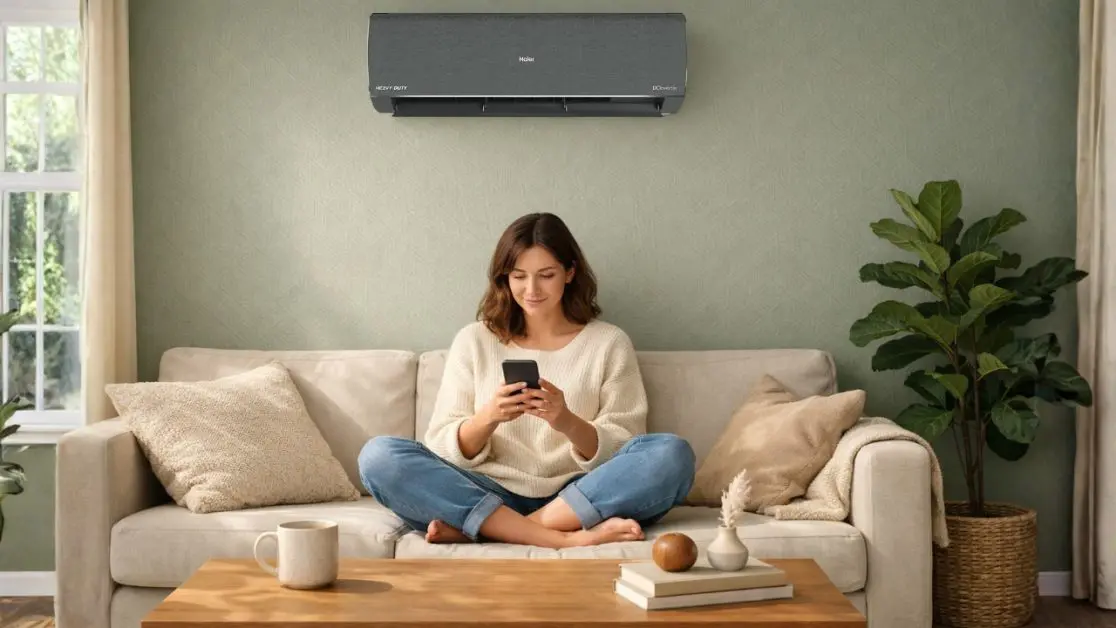
Different households experience targeted cooling differently.
The seating layout becomes the trigger.
1. The Movie Night Layout
Picture a Saturday evening.
The family gathers around the television.
Everyone settles on the sofa.
Traditional AC cooling fills the entire room.
Target cooling sends airflow directly toward the sofa zone.
Benefits:
- Faster comfort during movie nights
- Lower cooling load for the rest of the room
- Stable temperature where people sit
One insight becomes clear.
Comfort should follow attention.
Where people gather, cooling should gather too.
2. The Work-From-Home Layout
Many Indian homes now include small work zones.
A desk near the window.
A laptop on the dining table.
A corner chair used for video calls.
Target cooling adapts to these patterns.
Benefits include:
- Focused cooling for long working hours
- Reduced overcooling across unused areas
- Lower electricity consumption during daytime use
Workspaces need stability.
Temperature swings reduce concentration.
Targeted airflow quietly solves this.
3. The Multi-Zone Family Layout
Evenings in Indian homes often include multiple activities.
Someone watches television.
Someone reads.
Someone cooks nearby.
Cooling systems that adapt to seating layout recognize these micro-zones.
Benefits include:
- Balanced cooling across activity areas
- Reduced energy waste
- Greater comfort for everyone simultaneously
A room does not hold a single experience.
It holds many.
Cooling should adapt accordingly.
Why Targeted Cooling Saves Energy
Cooling an entire room consumes more energy than cooling the areas where people actually sit.
This sounds obvious.
Yet traditional systems ignore this simple reality.
Targeted cooling systems change the equation.
Here is why.
| Factor | Impact on Energy Use |
| Focused airflow | Faster cooling with less compressor load |
| Reduced unused cooling | Less wasted energy |
| Smart sensors | Adjust output based on activity |
| Adaptive airflow | Prevents overcooling |
This is where AI begins to matter.
According to Haier’s AI climate technology framework, cooling systems can analyze environmental conditions and user behavior to dynamically adjust performance for optimal comfort and energy efficiency.
Translation.
The AC begins learning how your room actually works.
The Quiet Intelligence Behind Smart Cooling
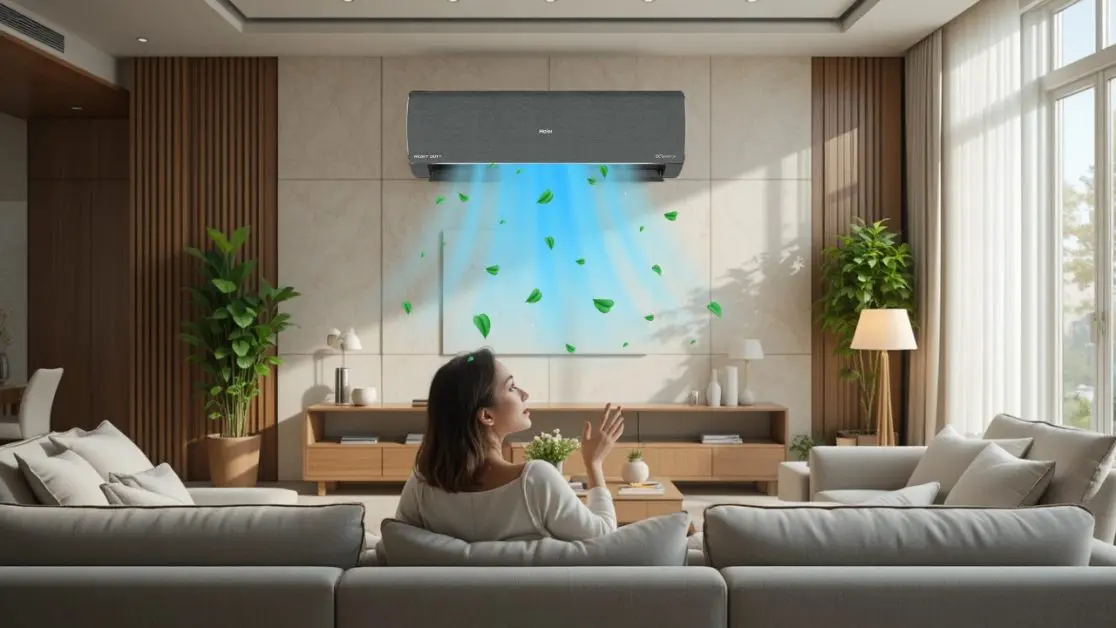
Most people think air conditioners operate in simple modes.
Cool.
Fan.
Sleep.
Modern systems behave differently.
They observe.
Sensors track room temperature changes.
AI systems analyze usage patterns.
Cooling adapts to activity and seating positions.
Over time, the system becomes familiar with your routine.
When you arrive home.
Where you usually sit.
How long the room stays occupied.
This intelligence allows cooling to feel effortless.
Because technology works best when it disappears.
Practical Tips to Get the Most From Layout-Based Cooling
Even the smartest cooling system benefits from thoughtful room design.
A few small changes make targeted cooling far more effective.
1. Place seating within airflow range
Avoid placing sofas directly beneath the AC unit.
Optimal airflow happens when seating sits slightly across the airflow path.
2. Avoid blocking airflow
Large cabinets or tall décor pieces can interrupt cooling flow.
Keep the path between AC and seating areas open.
3. Keep layouts consistent
Smart cooling systems learn patterns over time.
Frequent furniture rearrangement may interrupt those learning cycles.
4. Use zoning intentionally
Define activity areas clearly.
Sofas, desks, and chairs naturally guide airflow targeting.
Comfort often improves when rooms have structure.
The Future of Cooling Is Personal
For decades, cooling technology focused on machines.
Compressor power.
Airflow speed.
Energy ratings.
But comfort is not mechanical.
It is personal.
Where you sit.
How you relax.
How your home is arranged.
Cooling that adjusts to your seating layout recognizes this reality.
It moves away from cooling empty air.
And toward cooling people.
The Insight That Changes How We Think About Cooling
A bookstore arranges chairs near the reading lamps.
A theatre directs sound toward the audience.
A restaurant places lighting above the table.
Every thoughtful space directs comfort toward people.
Cooling should follow the same principle.
Because the real goal of technology inside a home is not to control the environment.
It is to quietly improve how life feels inside it.
And sometimes, the difference between a room that feels comfortable and one that feels perfect comes down to something surprisingly simple.
Where the cool air decides to go.
Frequently Asked Questions
I’m tired of adjusting my AC all the time. Will targeted cooling actually reduce this hassle?
Yes, that’s one of its biggest advantages. Layout-based cooling automatically directs airflow toward where people are sitting, so you don’t need to keep changing temperature or fan settings. The system adapts in real time, reducing the constant “too cold / too warm” adjustments.
Do I really need an AI AC, or is this just a fancy marketing feature?
If your room has multiple seating areas or uneven cooling, it’s genuinely useful. Traditional ACs treat the room as one unit, but AI-based systems treat it as zones. If you live alone in a small room, it may not matter much but in family settings, the difference is noticeable.
Will I actually save electricity with seating-based cooling?
Yes. Because the AC focuses only on occupied zones, it avoids wasting energy cooling empty spaces. This reduces compressor load and shortens cooling time both of which directly lower electricity usage.
My family sits in different places every evening. Can one AC really handle that?
Yes, modern systems use sensors to detect presence and adjust airflow direction dynamically. Instead of forcing one uniform temperature, they balance comfort across multiple seating zones.
I usually sit on the floor while others use the sofa. Will I still feel cool?
With targeted airflow, yes. These systems can angle airflow downward or toward active zones, ensuring comfort isn’t limited to just one height or position.
How does my AC know where I’m sitting?
It uses sensors (like motion or thermal detection) combined with AI algorithms to map occupancy and adjust airflow direction accordingly.
Will the AC learn my routine over time?
Yes. Many AI systems analyze patterns like when you enter the room or where you usually sit and begin optimizing airflow automatically based on those habits.