

Old ACs cool air. New ACs manage environments.
Uneven cooling in old ACs happens because they rely on fixed speeds, basic thermostats, and manual settings. They switch on, overcool, switch off, and repeat.
New air conditioners use sensors, variable compressors, and AI-based climate control to adjust airflow, temperature, and energy in real time. That is why cooling feels balanced instead of patchy.
Now let us talk about what that actually means inside a real Indian home.
The sofa is cold. The kitchen is hot. Why?
Picture a Sunday afternoon in May.
The AC is on. The living room feels cool near the unit. Step ten feet away toward the dining area and the air feels warmer. The bedroom down the hallway feels humid. Someone increases the temperature. Someone else reduces it.
Nothing is wrong with the machine.
The system is just outdated.
Old ACs operate like a light switch. On. Off. Full power. No nuance.
According to the Bureau of Energy Efficiency, inverter-based air conditioners can save up to 30 percent* more energy compared to fixed-speed units because they regulate compressor speed continuously. Regulation changes comfort, not just bills.
Cooling is not about power. It is about control.
Why Old ACs Create Uneven Cooling
1. Fixed-Speed Compressors Create Temperature Swings
Traditional air conditioners run at one speed.
When the room crosses the set temperature, the compressor stops. When it rises again, it restarts at full power.
This creates:
- Rapid cooling bursts
- Sudden shutdowns
- Noticeable temperature swings
- Uneven airflow distribution
The result is simple. Cold pockets near vents. Warm zones in corners.
That start-stop cycle also increases electricity spikes. India’s peak summer demand crossed 240 GW in recent years, and air conditioning plays a large role in that load.
Old systems react. They do not anticipate.
2. Basic Thermostats Read One Point, Not the Room
Most older ACs measure temperature near the indoor unit.
But rooms are dynamic.
- Sunlight hits one wall.
- The kitchen releases heat.
- Four people enter during a cricket match.
- Curtains open. Doors close.
A single temperature reading cannot represent the entire environment.
So the AC thinks the room is cool. The far corner disagrees.
3. Airflow Design Was Not Built for Modern Living
Indian homes have evolved.
Open layouts. Larger windows. Multiple devices generating heat. Work-from-home setups.
Older ACs were not designed for this lifestyle shift.
They deliver air in one direction, often without adaptive airflow or long-distance distribution.
Cooling stays local.
Comfort stays uneven.
Why New ACs Feel Balanced Instead of Patchy
Modern air conditioners do something subtle.
They observe.
Then they adjust.
Let us break this into systems.
1. Inverter Technology Maintains Stability
Inverter compressors do not shut off abruptly. They modulate speed.
That means:
- Consistent airflow
- Smaller temperature variations
- Reduced energy spikes
- Lower noise fluctuations
Instead of a rollercoaster, the room experiences a steady glide.
India’s Energy Efficiency Services Limited has highlighted inverter adoption as a key contributor to reducing residential cooling energy demand.
Balanced cooling is an outcome of continuous modulation.
2. AI Climate Control Reads the Whole Room
This is where systems thinking enters.
New-generation ACs like those powered by AI-driven platforms analyze:
- Ambient temperature
- Humidity
- User habits
- External weather patterns
In Haier’s AI-enabled models, features such as AI Climate Control automatically analyze the environment and optimize cooling without manual input.
Instead of reacting to a number, the system interprets a pattern.
Comfort shifts from manual guessing to intelligent adjustment.
3. Targeted Cooling Reduces Waste
Traditional ACs cool the entire room uniformly, whether needed or not.
Modern systems use data from installation position and user preference to direct airflow precisely where it is required.
According to Haier’s AI Target Cooling concept, cooling focuses only on required zones to maximize efficiency and reduce energy waste.
Think of it like watering a garden.
Old ACs flood everything.
New ones irrigate intentionally.
Old vs New AC: A Clear Comparison
| Feature | Old AC | New AI-Enabled AC |
| Compressor | Fixed-speed | Inverter variable-speed |
| Temperature Control | Single-point thermostat | Multi-factor AI climate sensing |
| Cooling Pattern | On-off bursts | Continuous modulation |
| Energy Efficiency | Higher peak spikes | Smarter load balancing |
| Airflow Direction | Static | Targeted and adaptive |
This table explains the experience difference in simple terms.
Balanced cooling is not luck. It is engineering.
Why Uneven Cooling Feels Worse in Indian Summers
Indian summers are not mild.
They are layered.
High humidity in Mumbai. Dry heat in Delhi. Sudden pre-monsoon fluctuations in Bengaluru.
The India Meteorological Department reports an increasing frequency of heatwaves across major cities in the last decade.
In such climates, small temperature swings feel amplified.
A one-degree fluctuation indoors feels like five outdoors.
That is why fixed systems feel harsher.
And adaptive systems feel calmer.
The Hidden Cost of Uneven Cooling
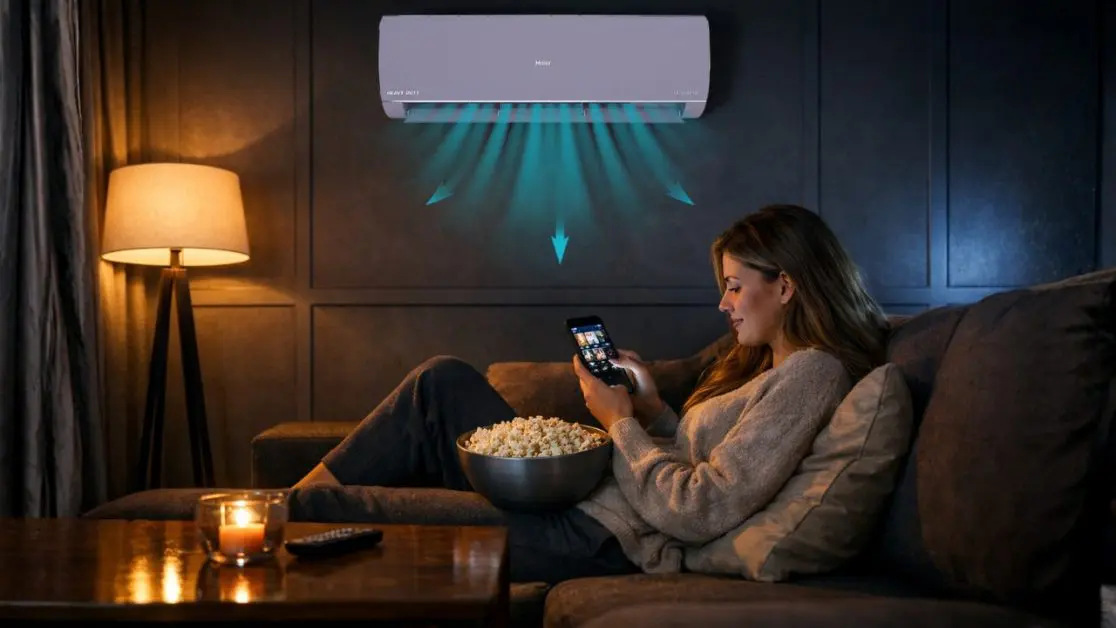
Uneven cooling is not just uncomfortable.
It creates secondary problems.
- Higher electricity bills due to repeated manual adjustments
- Frequent thermostat changes
- Overcooling near vents
- Underperformance in far corners
One option is to live with it.
The second option is to increase AC tonnage, which raises cost and energy use.
The third option is to upgrade to a system that manages balance intelligently.
Each choice carries a cost.
Balanced systems cost more upfront but reduce energy waste and improve comfort consistency.
This is the same logic organizations use when investing in automation instead of manual oversight.
Systems scale better than supervision.
How AI Pre-Cooling Changes Perception
Imagine entering your home at 7 pm.
Instead of switching the AC on and waiting ten minutes, the room already feels comfortable.
Some AI-enabled ACs predict arrival using geofencing and pre-cool automatically.
That changes expectations.
Cooling becomes proactive.
Not reactive.
Comfort shifts from delayed to immediate.
And once that becomes normal, old systems feel inadequate.
Cleaner Units Cool More Evenly
Here is something rarely discussed.
Dust accumulation on indoor and outdoor units reduces airflow efficiency.
Older ACs require manual cleaning.
Newer models use automated frost self-clean and cyclone clean processes to maintain efficiency.
Cleaner coils mean:
- Faster cooling
- Better airflow distribution
- Lower power consumption
- Longer lifespan
Uneven cooling often begins with clogged airflow.
Balanced cooling depends on maintenance automation.
Balanced Cooling Is a Lifestyle Shift
The real shift is psychological.
Old AC ownership feels like management.
Remote in hand. Temperature adjustments. Energy anxiety.
New AC ownership feels like delegation.
Set preference. Let the system adapt.
In Indian homes where AC usage can account for nearly 40 percent* of summer electricity consumption, intelligent control reduces both friction and cost.
Balanced cooling is not about luxury.
It is about removing daily micro-decisions.
So What Should You Look For?
If the goal is balanced cooling instead of patchy airflow, consider three priorities:
- Inverter compressor with continuous modulation
- AI-based climate sensing and adaptive airflow
- Self-cleaning mechanisms for long-term efficiency
One of the most comprehensive examples in this direction is Haier’s AI-Atmox powered air conditioning platform, which integrates AI Climate Control, AI Target Cooling, AI Eco 2.0 and power monitoring systems.
The point is not the brand.
The point is system intelligence.
The Bigger Pattern
Every industry evolves from power to precision.
Cars moved from carburetors to smart engines.
Phones moved from buttons to predictive touch.
Air conditioners are moving from cooling machines to climate managers.
Uneven cooling is a symptom of static systems in dynamic environments.
Balanced cooling is the result of responsive systems in real time.
That is the pattern.
And once you notice it, it is difficult to ignore.
Because comfort is not about lower numbers on a display.
It is about how the room feels when you stop thinking about it.
That quiet moment when no one reaches for the remote.
That is when you know the system is working.
And in a country where summers are only getting hotter, balanced cooling is not an upgrade.
It is preparation for the future of living.
Frequently Asked Questions
Why do I keep changing my AC temperature every hour?
If you’re constantly adjusting the remote, your AC is likely a fixed-speed system. It cools aggressively, shuts off, and then lets the room warm up again. That swing forces you to manually correct it. Inverter ACs reduce this because they maintain steady modulation instead of extreme on-off cycles.
My parents and I fight over the AC setting every night. Is the machine the problem or us?
It’s usually the machine. Older ACs create cold pockets near the unit and warmer zones elsewhere. So different people feel different temperatures in the same room. AI-based models distribute air more evenly, reducing these comfort conflicts.
I feel anxious about my electricity bill every time I lower the temperature. Is that normal?
Yes fixed-speed ACs spike power when restarting, so lower temperatures often mean higher consumption. Inverter ACs adjust gradually and consume power more efficiently, which reduces both energy anxiety and bill fluctuations.
Is AI in an AC just marketing, or does it actually improve comfort?
When properly implemented, AI analyzes room temperature, humidity, user habits, and even weather patterns. It shifts from reactive cooling to predictive adjustment, reducing manual intervention.
What is targeted cooling, and does it save electricity?
Targeted cooling directs airflow to required zones instead of flooding the entire room. This reduces energy waste and improves perceived comfort.
How does pre-cooling work?
Some AI-enabled ACs use geofencing via smartphone apps. They detect when you’re approaching home and start cooling in advance, so the room feels comfortable upon arrival.
Is upgrading worth it if my current AC still “works”?
If “working” means constant manual adjustment, uneven comfort, and rising bills, upgrading may reduce long-term costs and daily friction. Balanced cooling is about consistency, not just cooling.