

The premier cooling setups now go beyond simply reducing heat. They study your daily habits.
Climate control that aligns with your lifestyle rhythms means your AC unit adjusts to your typical schedules, anticipates what you require, and refines ease and power consumption without input. Rather than continuous manual tweaking, smart cooling technologies observe behavior, track surroundings, and provide comfort precisely where and when it’s crucial.
Well-being transforms into a process, not an on/off setting.
And this alters the atmosphere within residences.
Why do traditional cooling often feel out of sync with real life?
Consider a standard weekday within an Indian home.
The morning flurry begins.
Preparation of school lunches.
Workday communications commence sooner than anticipated.
The air conditioner runs for a period. Subsequently, forgetting to power it down occurs.
By midday, the space is vacant, yet power consumption persists.
As evening arrives, the dwelling feels warmer, requiring the AC to exert more effort to achieve comfort.
Conventional cooling mechanisms operate under one premise.
That occupants adhere to a set timetable.
However, contemporary residences operate quite differently now.
Remote workdays erode established patterns.
Visitors on weekends alter which areas are utilized.
Children transition between different activity areas.
The cycle of cooling needs remains fluid.
This prompts a compelling line of inquiry.
What if the climate control technology adjusted to your way of living, rather than demanding manual oversight?
Cooling Works Best When It Understands Human Patterns
The true essence of clever climate management isn’t about the degree of heat.
It’s about conduct.
Up-to-date, AI-driven cooling setups examine three elements concurrently:
Atmospheric factors like warmth and moisture
User tendencies encompassing favored cooling settings and scheduling
Spatial usage rhythms such as presence and motion
After these sequences are discerned, the apparatus commences modifications on its own.
Rather than responding belatedly, it starts anticipating.
For instance, smart climate mechanisms can independently review the space’s state and tailor cooling output to sustain ease while conserving power.
The change is minor yet impactful.
Responsive cooling conditions spaces. Foresight-driven cooling comprehends individuals.
Three Ways Smart Cooling Aligns With Everyday Life
Different households use cooling differently.
A young professional living alone has different habits from a family with children.
Smart cooling technology accommodates these variations through three core mechanisms.
1. Pre-cooling Before You Even Enter the Room
Coming home after a long summer commute in Delhi or Mumbai usually means one thing.
A wave of heat when you open the door.
Pre-cooling changes that experience.
Some AI-powered technology can detect when the user enters a predefined geographic radius and begin cooling the room automatically before arrival.
So instead of waiting ten minutes for the room to cool down, the comfort is already there.
| Scenario | Traditional Cooling | Pre-cooling |
| You arrive home | Room is hot | Room already cooled |
| Setup required | Manual timer | Automatic |
| Energy efficiency | Moderate | Optimized |
The principle is simple.
Good technology removes waiting from comfort.
2. Targeted Cooling Instead of Wasting Energy
Traditional AC technology cools the entire room evenly.
But that often wastes energy.
Think about it.
You are sitting on the sofa watching a cricket match.
The rest of the room is empty.
Why cool everything equally?
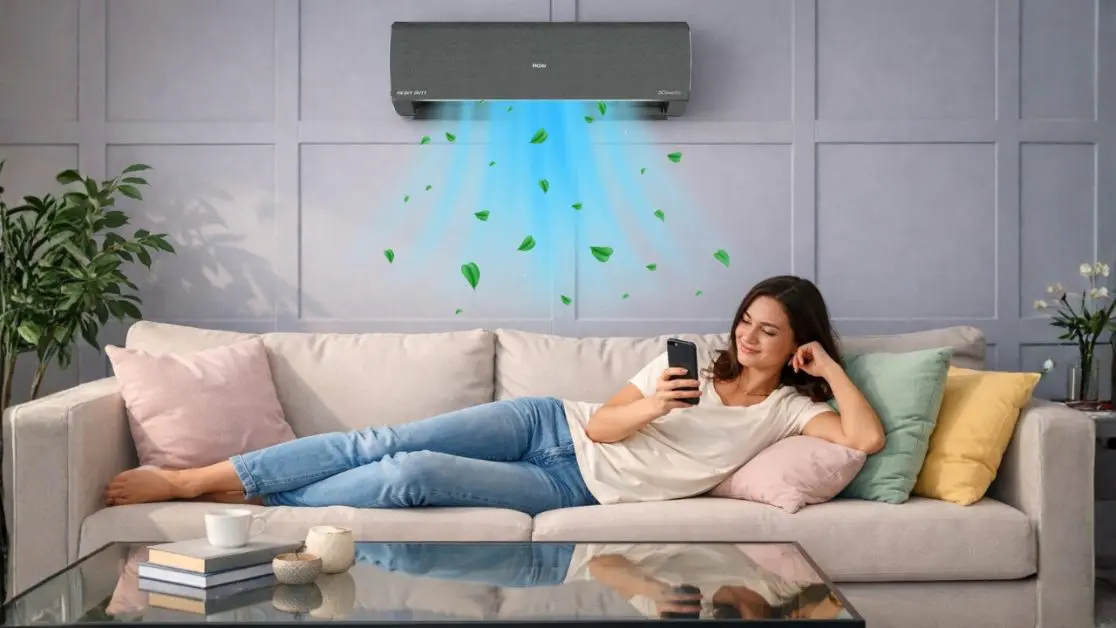
Targeted cooling focuses airflow exactly where people are sitting or resting.
AI-driven cooling technology can deliver airflow directly to a desired area rather than cooling the entire room uniformly, improving both comfort and efficiency.
The result is surprisingly practical.
- Faster cooling for occupied areas
- Lower electricity consumption
- More precise comfort
It feels similar to adjusting a reading lamp.
You light the page you are reading, not the entire library.
3. Adaptive Energy Modes That Adjust Automatically
Electricity bills remain one of the biggest concerns in Indian households.
Cooling helps comfort.
But uncontrolled cooling drains budgets.
This is where adaptive energy modes become useful.
Some modern technologies adjust cooling capacity based on the temperature difference between the room and the target temperature.
For example:
| Temperature Gap | Cooling Mode | Energy Impact |
| Above 3°C | High cooling | Faster temperature drop |
| 1–3°C | Moderate cooling | Balanced efficiency |
| Below 1°C | Low power mode | Maximum energy saving |
The technology constantly recalculates.
Comfort remains stable. Energy use drops.
Efficiency is not about running less. It is about running smarter.
When Cooling technology Start Learning From Your Habits
A quiet transformation is happening in home appliances.
Machines are becoming observers.
Not in an intrusive way.
In a useful way.
Advanced cooling technology now track usage patterns like:
- Preferred temperature settings
- Duration of cooling sessions
- Time of day usage peaks
- Seasonal changes in cooling demand
Machine learning models then build a personalized cooling profile for the household.
This creates a feedback loop.
Usage teaches the machine.
The machine improves the experience.
Over time the technology becomes better at predicting comfort.
The best appliances disappear into routine. They quietly get things right.
The Hidden Cost of Manual Cooling
Most households still operate air conditioners the same way they did a decade ago.
Remote control.
Timer setting.
Occasional adjustments.
This works.
But it introduces hidden inefficiencies.
| Manual Cooling Habit | Hidden Cost |
| Forgetting to switch off AC | Energy waste |
| Cooling empty rooms | Higher electricity bills |
| Uneven cooling | Discomfort |
| Frequent temperature changes | Lower efficiency |
Smart cooling technology solves these problems automatically.
Occupancy sensors can detect human presence and reduce power when the room becomes empty.
In some technology, energy-saving modes activate within minutes of inactivity.
Small adjustments.
Big long-term savings.
A Simple Framework for Choosing Lifestyle-Aligned Cooling
Not every home needs the same cooling approach.
But the decision can become clearer if we frame it around three choices.
Option 1: Basic Cooling
Best for smaller rooms or occasional use.
Benefits:
- Lower upfront cost
- Simple operation
Limitations:
- Manual control required
- Less energy optimization
Option 2: Smart Connected Cooling
Best for tech-friendly homes.
Benefits:
- App control
- Scheduling and remote management
Limitations:
- Requires active management
Option 3: AI Lifestyle Cooling
Best for households with dynamic routines.
Benefits:
- Learns habits automatically
- Pre-cooling
- Targeted airflow
- Adaptive energy management
Limitations:
- Slightly higher initial investment
But the long-term benefits often outweigh the costs.
technology that learns to save effort. technology that adapts to save energy.
How Modern Indian Homes Are Redefining Comfort
A few years ago, cooling meant beating summer heat.
Today it means something more nuanced.
Comfort during video calls.
Quiet cooling during sleep.
Balanced airflow during family movie nights.
Different moments require different cooling responses.
This is where innovations like Haier’s AI-powered climate control platforms are quietly reshaping the experience.
For example, AI-based technology can combine environmental data, user behavior, and machine learning to automatically maintain comfort while minimizing energy consumption.
The cooling technology becomes part of the home’s rhythm.
Not an appliance you constantly manage.
The Real Insight: Comfort Should Follow Life, Not Interrupt It
When technology works well, people barely notice it.
Lights switch on automatically.
Music adjusts to the room mood.
Cooling adapts to the environment.
The future of home comfort is not louder machines or bigger hardware.
It is smarter behavior.
Cooling that understands:
- when you arrive home
- where you are sitting
- how long you usually run the AC
- how weather patterns affect your home
This is where cooling technology is heading.
Quiet intelligence.
Invisible convenience.
The One Idea Worth Remembering
The smartest appliances do not demand attention. They quietly learn how you live.
Cooling that syncs with lifestyle patterns reflects this philosophy.
It reduces effort.
It saves energy.
It improves comfort without constant input.
And in a country where summers stretch longer every year, that quiet intelligence becomes more valuable than ever.
Because the future of cooling is not colder air.
It is better timing.
Frequently Asked Questions
Why do I feel like I’m constantly adjusting my AC throughout the day?
Because traditional ACs don’t adapt they rely on manual input. Your schedule shifts (work, sleep, errands), but the AC doesn’t learn those patterns, so you keep correcting it.
I always forget to turn off my AC when I leave. How can I fix this without relying on memory?
Smart or AI-based cooling systems use occupancy sensors or geofencing to automatically reduce or stop cooling when no one is home.
Why does my room feel uncomfortable even though the AC is on?
Comfort isn’t just temperature it’s timing, airflow direction, and room usage. Traditional ACs cool uniformly instead of focusing on where you actually are.
Can my AC automatically adjust based on my daily routine without me setting schedules?
Yes. AI-powered systems learn your habits over time and start predicting when to cool, how much, and where without manual scheduling.
Why does my AC sometimes cool too fast and then feel too cold?
Because it runs at full power until the target temperature is reached, without gradual adjustment. AI systems reduce intensity as the gap narrows.
Is faster cooling always better?
Not necessarily. Rapid cooling uses more energy and can create discomfort. Balanced cooling maintains comfort while saving electricity.
How do adaptive energy modes actually save electricity?
They adjust cooling power based on how far the room is from the desired temperature, high power when needed, low power when close.
Can my AC start cooling before I reach home?
Yes. With geofencing, the system detects your proximity and begins pre-cooling automatically.
What is targeted cooling and how is it different from normal cooling?
Instead of cooling the entire room evenly, targeted cooling directs airflow to where people are sitting or resting.
Do smart ACs really “learn” my behavior or is that just marketing?
Advanced systems use machine learning to track usage patterns and improve over time, it’s a real, evolving feature.
Will I still need to use a remote or app every day?
Less and less. The goal of AI cooling is to reduce daily interaction by automating comfort.