
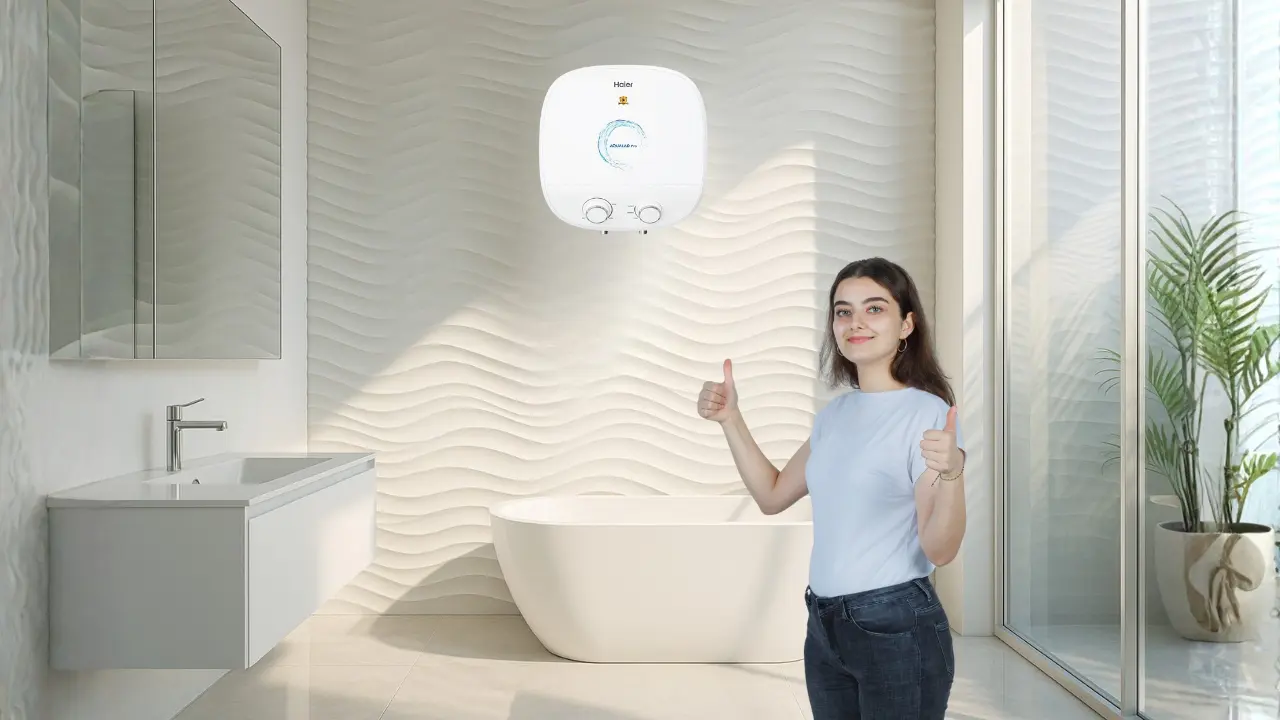

Copper heating elements heat water faster and cost less upfront, but they corrode faster and need more maintenance. Titanium heating elements offer stronger corrosion resistance, longer life, safer performance, and consistent heating even in hard water areas.
They are the premium choice for modern Indian bathrooms, especially in cities with high TDS water. Haier’s Square AQUALAD PRO models use titanium heating elements and titanium tanks for reliability and protection, as shown in their specifications.
Why do heating elements matter more than we think?
Picture a winter morning in a typical Indian home.
The geyser switch becomes a ritual. A two minute task that secretly shapes comfort, electricity bills and morning moods.
Some days, the water heats quickly. Other days, the heater groans because of limescale buildup.
Inside that heater sits the quiet hero of the story. The heating element.
Most people never think about it.
Yet it decides how long a water heater lasts.
How much energy your home spends before a bath.
How reliably your geyser performs under daily demand.
Understanding copper versus titanium is understanding why some heaters age early while some stay steady for years.
This is not about technical jargon.
This is about the hidden system that makes everyday comfort possible.
Copper vs Titanium: What really separates them?
Below is a simple table that captures the heart of the difference.
Heating Element Comparison at a Glance
| Feature | Copper Heating Element | Titanium Heating Element |
| Corrosion resistance | Low | Very high |
| Lifespan | Moderate | Long lasting |
| Hard water suitability | Weak | Strong |
| Maintenance needs | Frequent | Minimal |
| Heating speed | Fast | Fast and consistent |
| Cost efficiency | Low upfront cost | Best long term value |
| Safety | Prone to scale and degradation | Stable performance over time |
Copper is the everyday choice. Titanium is a long game.
And most Indian homes are learning that the long game pays for itself.
What makes copper popular and where does it fall short?
Copper heats quickly.
That is its biggest advantage. It responds fast, making it useful in smaller heaters or homes with low usage.
But copper has a natural limitation.
It reacts with minerals.
And Indian water is full of minerals.
From Pune to Ahmedabad to Delhi NCR, hard water is a daily reality.
Copper elements in such water develop scale, reduce heating efficiency, and wear out faster.
Over time, scale buildup does three things.
1. It slows heating.
2. It increases electricity use.
3. It stresses the tank and thermostat.
This is why copper heaters often need replacement elements or extra maintenance after a few years.
Copper gives speed but demands care.
Why titanium feels like the future of heating elements

Titanium solves copper’s biggest weakness.
It does not corrode easily.
It does not react aggressively with minerals.
It remains stable even under high temperature and high pressure conditions.
In Haier’s Square AQUALAD PRO models, the titanium heating element and titanium tank work as a pair for durability and reliability, reducing corrosion and increasing lifespan. This is mentioned directly under the specifications for both the 15L and 25L units where the tank type and heating element are listed as titanium.
Think of titanium like a seasoned marathon runner.
Steady. Efficient. Unaffected by the environment around it.
Titanium elements deliver three advantages that matter deeply for Indian homes:
1. They resist corrosion.
Mineral heavy water does not wear them down.
This protects both the heating element and the inner tank.
2. They stay efficient for years.
Where copper slows down, titanium continues heating evenly.
This translates into lower electricity usage across seasons.
3. They improve safety and reliability.
Stable heating means fewer overheating events, fewer failures, and fewer surprises.
In other words, titanium turns a water heater into a dependable appliance.
That dependability is what modern households value.
Where does the difference show up in real life?
Let us zoom in on three everyday situations.
A young couple in a high rise apartment
Their building pumps water at high pressure.
Copper elements struggle in such conditions.
Titanium handles pressure with ease.
Haier’s AQUALAD PRO models are designed for 8 bar pressure and high rise performance, which pairs perfectly with titanium elements.
A family in a hard water city
Their old heater develops scale every winter.
Electricity bills rise.
Water heats unevenly.
Titanium elements help retain performance even in harsh water conditions.
A working professional living solo
Their heater stays on for short cycles.
They want something low maintenance.
Titanium ensures consistent heating without frequent servicing.
The pattern is simple.
Titanium supports modern lifestyles by reducing friction.
The hidden system: Water quality shapes heater life
This is the part most shoppers overlook.
Heating elements do not fail because they are weak.
They fail because water quality is demanding.
Hard water contains calcium, magnesium and bicarbonates.
These minerals settle as limescale when heated.
This limescale clings to copper.
Titanium resists it.
This resistance is what protects the heater tank, thermostats and insulation over time.
If your city has hard water, the choice between copper and titanium is not a preference.
It is a strategy.
How heating elements influence power consumption
Heat transfer efficiency decides your electricity bill more than the heater size.
Copper starts fast but loses efficiency quickly due to scale buildup.
This forces the heater to work harder for the same temperature.
Titanium remains efficient across years.
Efficiency means:
- less reheating
- faster recovery
- stable temperature control
Haier’s water heaters also use PUF insulation to retain heat longer.
This helps reduce reheating cycles further.
When good insulation teams up with a titanium element, you get a heater that saves power without you thinking about it.
That is silent efficiency.
Safety: A detail you feel but never see
Copper elements are safe when maintained.
But their degradation increases the chances of hotspots or temperature fluctuations.
Titanium’s stability reduces these risks.
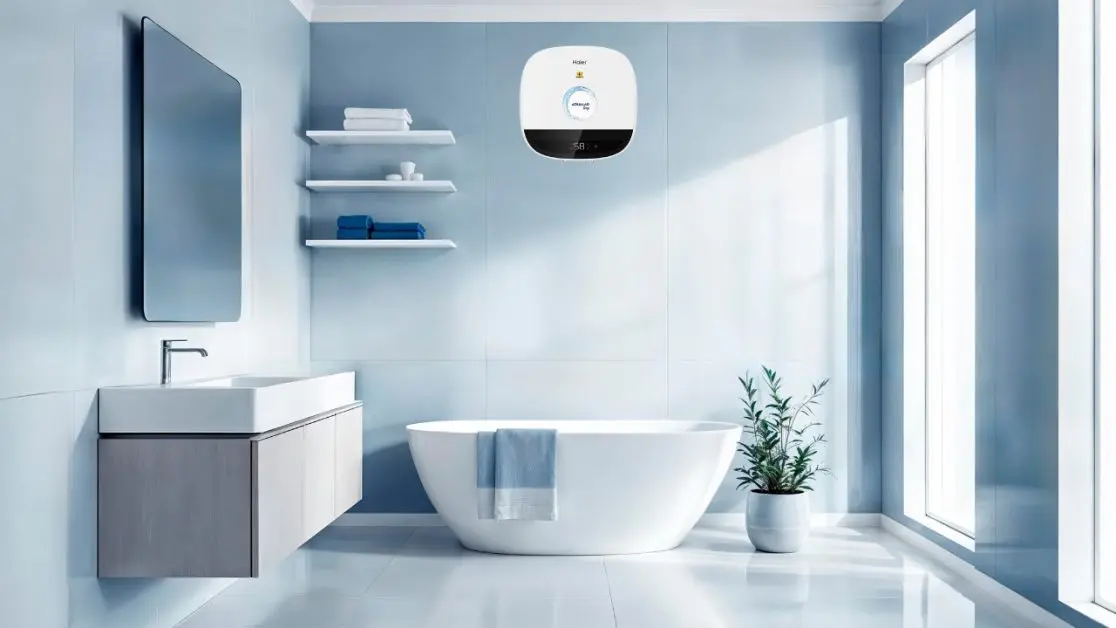
Haier adds multiple safety layers such as:
- Shock Proof Technology that lowers voltage in case of leakage
- Dual thermal protection with capillary thermostat and thermal cut off
- Over pressure and over heat protection
- BPS mode that heats water to 80 degrees to reduce bacteria growth
These systems work best when the heating element performs consistently.
Titanium supports that consistency.
Safety is never one feature.
It is a chain.
Titanium strengthens that chain.
Which heating element should you choose for your home?
Let us turn this into a simple decision framework.
Choose copper when:
- Water quality is soft
- Usage is light
- Budget is tight
- You do not mind periodic maintenance
Choose titanium when:
- You live in a hard water area
- You want a long term investment
- Your family uses hot water multiple times a day
- You prioritise low maintenance
- You want stable heating and higher safety
Titanium costs more upfront but saves far more over the heater’s life.
This is long term thinking.
The kind that pays off quietly every winter.
Where Haier fits into this story
Haier approaches water heating the way it approaches refrigeration, cooling and televisions.
Not as an appliance.
As a lifestyle system.
The Square AQUALAD PRO series uses:
- Titanium tank
- Titanium heating element
- PUF insulation
- Shock Proof system
- Dual thermostat TTS safety
- BPS mode
- 8 bar rated pressure capability
All these details appear in the product specifications for both the 15L and 25L models.
The result is simple.
A heater that behaves the same on day 500 as it did on day one.
Modern homes do not want surprises.
They want systems that fade into the background and simply work.
Haier designs for that rhythm.
The insight that stays with you
Copper gives you heat.
Titanium gives you confidence.
Buying a heater is not buying an appliance.
It is choosing how you want your mornings to feel for the next decade.
When you choose a titanium based water heater, you are choosing stability over seasons, safety over uncertainty and efficiency over compromise.
A heating element is a small detail.
But small details shape daily life.
That is the secret most people never see.
And the difference between copper and titanium is the difference between replacing and relying.