
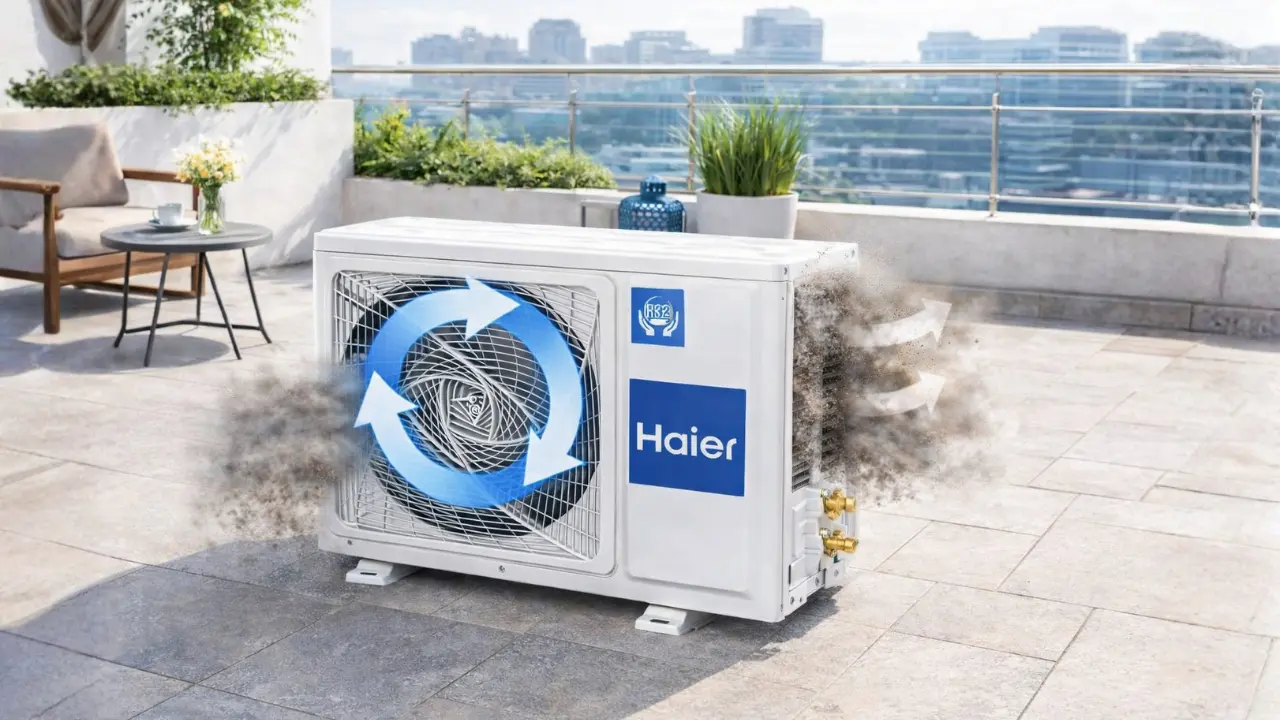

Cyclone Clean improves heat exchange efficiency by keeping the outdoor condenser coil clean automatically.
By reversing the outdoor fan after switch off and blowing away dust, the AC maintains free airflow across the coil. Cleaner coils transfer heat faster, cool rooms quicker, and use less electricity over time.
Why does cooling performance quietly drop over time?
It usually begins with a feeling, not a fault.
The AC still runs.
The remote still responds.
Cold air still comes out.
Yet something feels slower.
Rooms take longer to cool.
The compressor sounds like it is working harder.
Electricity bills edge upward without explanation.
This is not about technology failing.
It is about a hidden system getting dirty.
In most Indian homes, the outdoor unit sits quietly on a balcony, terrace, or external wall. It faces dust, pollution, pollen, construction debris, and seasonal humidity. Over months, this dust coats the condenser coil.
That layer acts like insulation.
Heat struggles to escape.
The system compensates by running longer.
Efficiency slips without anyone noticing.
Cooling problems rarely start indoors. They start outside.
Heat exchange is the real job of an air conditioner
Cooling is not about blowing cold air.
It is about moving heat.
Every air conditioner does one core thing. It pulls heat from inside the room and releases it outdoors. This exchange happens at the condenser coil in the outdoor unit.
For this to work well, three conditions matter:
1. Clean coil surfaces for maximum contact with air
2. Unrestricted airflow across those coils
3. Stable operating temperatures so the compressor stays efficient
When dust blocks the coil fins, all three conditions break down.
Heat lingers.
Pressure rises.
Power consumption increases.
Most people respond by lowering the temperature.
That treats the symptom, not the cause.
The hidden cost of dusty outdoor units
A dirty condenser creates a chain reaction.
Here is what typically happens in Indian conditions:
- Dust buildup reduces airflow across the condenser
- Heat rejection slows down
- The compressor runs longer to achieve the same cooling
- Energy consumption rises
- Component stress increases over time
This is why an AC that once cooled a room in ten minutes now takes twenty.
And this is why regular servicing matters, but also why it often gets delayed. Outdoor units are harder to access, messier to clean, and easy to forget until summer hits hard.
Cyclone Clean changes how maintenance works
Cyclone Clean flips the problem on its head.
Instead of waiting for dust to accumulate and then calling for manual cleaning, the system cleans itself automatically.
Here is what actually happens.
After the AC is switched off, the outdoor fan briefly reverses direction. This reverse airflow creates a strong burst of air that blows dust off the condenser surface.
No water.
No chemicals.
No human effort.
Just physics applied at the right moment.
This process keeps the heat exchange surface closer to its original condition, even after months of use.
Why reverse airflow is such a smart idea
Dust sticks because air normally moves in one direction.
Cyclone Clean interrupts that pattern.
By reversing airflow, it breaks the bond between dust particles and the coil fins. This prevents layers from forming in the first place.
Think of it like shaking a doormat regularly instead of washing it once a year.
Small actions, repeated consistently, prevent big problems later.
This is systems thinking applied to everyday appliances.
Cleaner coils mean faster heat transfer
Heat exchange efficiency depends on surface contact.
When condenser fins are clean:
- Air touches more metal surface
- Heat moves out faster
- The compressor reaches target conditions sooner
- The system shuts down earlier
That last point matters.
Shorter run cycles mean:
- Lower electricity use
- Less wear on components
- More consistent cooling
Efficiency is not just about peak performance. It is about how quickly the system completes its job.
The real impact on everyday cooling
Cyclone Clean does not announce itself.
You notice it indirectly.
Cooling feels more consistent across seasons.
Performance does not drop sharply after a few months.
Bills stay closer to expectations.
These are quiet wins.
Especially in cities where dust levels spike during construction seasons or dry months, automatic outdoor cleaning keeps performance stable without adding another task to your life.
Manual cleaning versus automatic cleaning
Most households rely on one of three approaches.
One option is ignoring the outdoor unit.
This is common. Performance declines slowly. Costs rise silently.
The second option is periodic manual servicing.
Effective, but dependent on timing, access, and follow-through.
The third option is automatic cleaning like Cyclone Clean.
It works in the background, consistently, without reminders.
Each option has a cost.
The difference is who pays it and when.
Why efficiency is also about reliability
When heat exchange suffers, the system compensates.
Higher pressure.
Longer cycles.
More heat stress.
Over time, this affects reliability.
Cleaner condensers operate within safer thermal ranges. Components age more slowly. Performance stays predictable.
Good efficiency is not just about saving money this month. It is about preserving the machine over years.
Cyclone Clean fits into a bigger system

Cyclone Clean is not a standalone trick.
It works alongside other intelligent features that manage cooling, energy use, and comfort as a connected system. Outdoor cleanliness supports everything else.
Clean heat exchange enables:
- Smarter temperature control
- More accurate energy management
- Stable performance in high ambient conditions
Efficiency compounds when systems support each other.
What this means for Indian homes
Indian homes deal with extremes.
High heat.
High humidity.
High dust.
Designing for these realities matters more than adding flashy features.
Cyclone Clean addresses a very Indian problem in a very practical way. It respects how people actually live and how environments behave.
No reminders.
No scheduling.
No extra work.
Just a cleaner outdoor unit, day after day.
The deeper lesson behind Cyclone Clean
The best technology does not ask for attention.
It removes friction.
Cyclone Clean is not about novelty. It is about acknowledging that heat exchange efficiency depends on cleanliness, and cleanliness should not depend on human memory.
When systems take responsibility for their own upkeep, life gets easier.
Cooling becomes predictable again.
Energy use stays under control.
Comfort feels effortless.
And that is the real upgrade.
Final thought
Most performance problems are maintenance problems in disguise.
Cyclone Clean solves one of the most ignored ones by design. By keeping the condenser clean automatically, it protects heat exchange efficiency where it matters most.
Not with more control.
But with better systems.
That is how appliances quietly make homes feel more sorted.
Frequently Asked Questions
My AC is running, but why does the cooling feel weaker than before?
Because cooling efficiency usually drops quietly. Dust builds up on the outdoor condenser coil, slowing heat release. The AC still works, but it needs longer cycles to do the same job.
Is weak cooling more about airflow or temperature settings?
Airflow and heat exchange matter more. If heat cannot escape outdoors due to dusty coils, lowering the temperature only masks the problem, it doesn’t fix it.
Why does cooling performance decline even when nothing is “broken”?
Most AC problems start outside. Dust acts like insulation on the condenser coil, trapping heat and forcing the system to work harder over time.
Does Indian dust really affect AC performance that much?
Yes. Pollution, construction dust, pollen, and humidity rapidly coat outdoor units in Indian cities, especially when installed on balconies or terraces.
I never touch my outdoor unit. Should I be worried?
Probably. Outdoor units are easy to forget, but they handle the most critical job: releasing heat. Ignoring them leads to silent efficiency loss.
Why do AC problems usually show up in peak summer?
Because dust buildup meets extreme heat. The system is already stressed, and poor heat exchange pushes it past comfortable operating limits.
How does a clean condenser actually save electricity?
Clean coils release heat faster. Faster heat rejection means the compressor reaches target conditions sooner and shuts off earlier.
Is efficiency about peak performance or daily operation?
Daily operation. The real savings come from shorter, smoother cycles, not just how cold the AC can get at maximum power.